
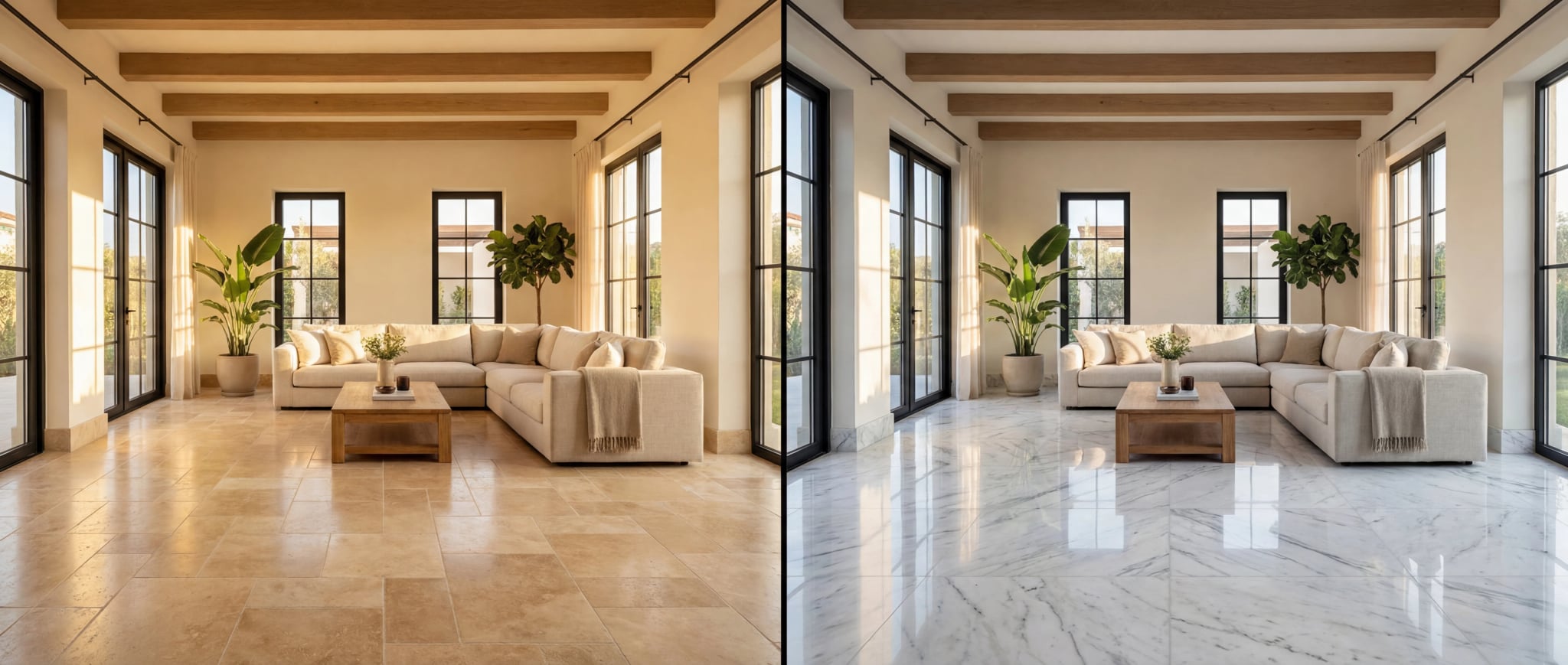
Same geological origins, same quality certifications, 30-60% lower cost. Discover why architects worldwide are choosing Turkish natural stone over Italian marble.
42%
Global Market Share
30-60%
Cost Savings
CE
Certificates on Request
20+
Years Experience
Quick Answer
Turkish and Italian marbles share the same geological origins in the Alpine-Himalayan tectonic belt, with identical mineral composition (calcite/CaCO3). Turkey controls 42% of global marble trade and offers varieties like Afyon White and Mugla White that are 30-60% cheaper than Carrara, with CE documentation available from the producing factory on request. Explore our stone catalog to see the quality firsthand.
Shared Origins
Both Turkish and Italian marbles formed from ancient Tethys Sea limestone deposits during the Alpine Orogeny, 65-5 million years ago. They belong to the same Alpine-Himalayan tectonic belt and share identical calcite (CaCO3) mineral composition. Browse our Turkish stone collection to see the results of this shared geology.
Quarried from the Afyon, Mugla, and Denizli regions of western Turkey, these stones formed from Tethyan sediments compressed during the Alpine Orogeny. Surface-level quarries yield a remarkable diversity of colors and textures, including whites, beiges, silvers, and golds. Turkey's geological richness produces marble, travertine, limestone, and onyx from the same tectonic belt.
Extracted from the Apuan Alps of Tuscany, Italian marbles like Carrara, Calacatta, and Statuario formed under more intense metamorphic pressure at greater depths. This deeper formation produces denser stone with the bold veining patterns that made Italian marble famous. Quarrying in the Apuan Alps is tightly regulated, which keeps the supply of top grades limited and prices high.
Key Insight
Both Turkish and Italian marbles are predominantly crystalline calcite and react the same way to dilute hydrochloric acid. The main differences are aesthetic (color palette and veining) rather than structural. Turkish whites from Afyon and Mugla are comparable to Italian whites in compactness and mechanical strength; ask us for the EN test report of the exact stone you choose.
Price Comparison
Turkish whites typically cost 30-60% less than comparable Italian marble. Here is a variety-by-variety comparison of relative FOB price for 2 cm standard slabs.
| Variety | Origin | FOB price (relative) | Notes |
|---|---|---|---|
| Afyon White | Turkey | $ | Premium Turkish white; large reserves in Afyon region; comparable to Carrara aesthetics |
| Mugla White | Turkey | $ | Diverse whites from Mugla; strong global trade presence; excellent veining |
| Classic Travertine | Turkey | $ | Denizli origin; warm beige tones; ideal for flooring and facades |
| Silver Travertine | Turkey | $ | Cool grey-silver tones; contemporary aesthetic; versatile applications |
| Carrara | Italy | $$$ | Classic grey veining on white; most accessible Italian marble tier |
| Calacatta | Italy | $$$$ | Dramatic gold-grey veins on pure white; luxury tier pricing |
| Statuario | Italy | $$$$ | Rare bold grey veining; highest Italian tier; very limited supply |
| Botticino Classico | Italy | $$$ | Warm beige tone; used in Vatican interiors; consistent color |
Relative FOB price for 2 cm thick slabs (2025-2026). Freight and delivery are quoted per shipment. Contact us for project-specific quotations.
Quality & Certifications
Turkish marble factories comply with the same European standards as their Italian counterparts. Thanks to the EU-Turkey Customs Union, CE-marked Turkish stone circulates freely across Europe. View our stone collection.
CE Marking
Natural stone sold in the EU is CE-marked under the Construction Products Regulation, based on EN tests (EN 1469 for slabs, EN 12057/12058 for tiles) covering flexural strength, abrasion resistance, water absorption and dimensional tolerances. Turkish factories test to the same standards as Italian ones, and the producing factory supplies the CE documents and test reports on request.
ISO 9001
Leading Turkish quarries and processing facilities hold ISO 9001 certification, ensuring consistent quality management from extraction through processing and shipping. This certification provides documented traceability, systematic quality control, and continuous improvement processes that match or exceed the standards of Italian competitors.
Ask for the test reports that match the exact stone, finish and thickness you order. We pass the factory's CE and EN documents on with your quote, and every order ships with a pre-shipment inspection report.
Application Guide
Turkish natural stone offers performance and value advantages across the most demanding architectural applications. Here is where it outshines Italian marble.
For large-format flooring projects, Turkish marble and travertine deliver 30-60% cost savings at equivalent durability. Afyon White and Mugla White provide the refined white aesthetic that architects specify, while Classic Travertine offers warm, organic tones that hide wear beautifully. On a 500 m² project, the material saving over Carrara is substantial.
Turkish stone is well suited to exterior facade applications. Dense whites like Afyon White, as well as Turkish limestone and travertine, have a long track record on facades in Mediterranean and continental climates, while Italy's premium whites are often too expensive for large exterior surfaces.
Turkish travertine is the global standard for pool deck installations. Its natural non-slip texture, thermal comfort underfoot, and resistance to pool chemicals make it superior to polished Italian marble, which becomes dangerously slippery when wet. Tumbled and brushed finishes from Denizli quarries provide both safety and elegance at a fraction of Italian marble costs.
Both origins perform well in bathroom applications with proper sealing. Italian marble offers slightly more dramatic veining for statement walls, while Turkish marble provides equivalent aesthetics at lower cost for larger surfaces. For floor-to-ceiling marble bathrooms, Turkish varieties save 30-60% without compromising the luxury feel architects demand.
Italian marble retains a prestige edge for ultra-luxury countertops (Calacatta bookmatched slabs). However, Turkish whites like Afyon and Mugla deliver nearly identical aesthetics for bathroom vanities and kitchen countertops at 30-60% less. For commercial projects requiring 20+ identical countertops, Turkish stone offers unmatched consistency from large quarry reserves.
Hotels, offices, and retail spaces require volume, consistency, and budget control. Turkey's 42% global market share reflects its dominance in commercial supply. Large quarry operations in Afyon and Mugla can fulfill orders for thousands of square meters with consistent color and veining, which is harder and costlier to source from the premium Italian quarries. Browse our full collection to see commercial-grade options.
Get a competitive quote for Turkish marble delivered to your doorstep.
Project Economics
Beyond material costs, here is how Turkish and Italian marble compare across a complete project lifecycle. This comparison is based on a 500 m² commercial flooring project delivered to a European destination.
| Cost Factor | Turkish Stone (relative) | Italian Marble (relative) | Savings |
|---|---|---|---|
| Material (500 m², 2 cm slabs) | $ | $$ | 30-60% |
| Shipping (FCL to Europe) | $$ | $ | -20% (Italian closer) |
| Installation Labor | $$ | $$ | Equal |
| Maintenance (10 years) | $ | $ | Equal |
| Total Project Cost | $ | $$ | Lower |
| Net cost per m² | $ | $$ | Lower |
On a typical 500 m² commercial project, choosing Turkish stone cuts the material cost by 30-60%. The total saving is a little smaller, because sea freight from Turkey costs more than trucking from Italy and installation costs the same. Contact us for a detailed project estimate tailored to your specifications.
Relative costs are estimates based on 2025-2026 market data for European delivery. Actual pricing varies by specific variety, finish, slab dimensions, and destination port. Request a custom quotation for accurate project pricing.
Supply Chain & Logistics
Turkey offers a streamlined, cost-effective supply chain for natural stone exports, with modern port infrastructure and EU customs simplification via the Turkey-EU Customs Union.
Go2Stone works directly with quarry owners in Afyon, Mugla, and Denizli. You get prices from the source with full traceability from block selection through slab processing and packaging, and one quote to your port or your door. Tiles and cut-to-size pieces are cut to your specifications.
From Izmir (Aliaga) to Spanish Mediterranean ports, current sailings take about 5 days to Valencia, 11 days to Barcelona and 12 days to Algeciras. Freight is quoted per shipment, and the Turkey-EU Customs Union keeps the paperwork simple.
From Izmir to US East Coast ports (New York/New Jersey, Savannah, Miami), sea transit is about 18-22 days. The US West Coast takes about 30-35 days.
Under the Turkey-EU Customs Union, Turkish stone travels with an A.TR certificate and enters the EU at 0% customs duty; you pay only local VAT. CE-marked stone needs no extra product approval.
Every order undergoes factory inspection before loading. We verify dimensions, finish quality, color consistency, and packaging. High-resolution photos and measurement reports are shared with clients before containers leave the port.
From order confirmation to delivery at your project site, typical lead time is 4-6 weeks for standard varieties. This includes block selection (1 week), processing (2-3 weeks), and shipping (1-2 weeks to Europe). Rush orders can be accommodated for in-stock materials.
Centuries of Heritage
Turkish marble has been specified by master architects for over 1,500 years. These iconic structures showcase the enduring beauty and structural integrity of Turkish natural stone.
Anthemius of Tralles & Isidore of Miletus (537 AD)
Its walls are lined with bookmatched Proconnesian (Marmara Island) marble panels alongside coloured marbles from across the empire, a showcase of Byzantine craftsmanship. The marble has endured nearly 1,500 years of continuous use, surviving earthquakes and environmental exposure.
Mimar Sinan (1557 AD)
Mimar Sinan's masterwork uses white Marmara (Proconnesian) marble for its mihrab, minbar and courtyard. More than four and a half centuries later, the carved marble is still in daily use.
Fatih Sultan Mehmet Era (1465 AD)
Extensive Marmara marble adorns walls, columns, terraces, fountains, and intricate relief carvings across the Kubbealti and Enderun sections. Five centuries of exposure demonstrate the exceptional weathering resistance of Turkish marble.
Garabet Amira Balyan (1856 AD)
Marmara marble features prominently in the palace docks, baths and baroque ornamental elements. This 19th-century palace blends European and Ottoman design.
Decision Framework
Use this framework to match your project priorities with the best stone origin. For most commercial and residential projects, Turkish stone offers the optimal balance of quality, cost, and supply reliability.
| Your Priority | Choose Turkish | Choose Italian |
|---|---|---|
| Tight Budget | 30-60% savings | |
| Ultra-Premium Prestige | Brand recognition | |
| Bulk Order (500+ m²) | Volume pricing & consistency | |
| Fast Delivery to Europe | 5-12 days from Izmir | 2-5 days from Genova |
| Outdoor / Pool Use | Travertine is ideal | |
| Interior Luxury Statement | Afyon/Mugla White | Calacatta/Statuario |
| Maximise Resale Value | Best value proposition | Brand premium |
| Unique Aesthetic Range | Marble, travertine, limestone, onyx | Mostly marble, plus Roman travertine |
Samples are free; you cover the courier. Compare them next to the Italian stone you are considering.
Our Collection
Explore our curated selection of Turkish marble, travertine, and natural stone. Every variety is available for immediate quotation; CE documentation is supplied by the producing factory on request.
Common Questions
Expert answers to the most common questions about choosing between Turkish and Italian natural stone.
Get a custom quote for Turkish marble, travertine, or limestone delivered to your project. Browse our complete collection or request samples to compare quality firsthand.
Free quotation within 24 hours. Free samples; you cover the courier.
Project enquiry
Share the material, format, quantity, destination, and timing.
What helps us answer accurately
Stone · Format and finish · Quantity · Destination city or port
You can expect a reply within
One business day
Need a quick answer? Ask Selim in the chat.
