
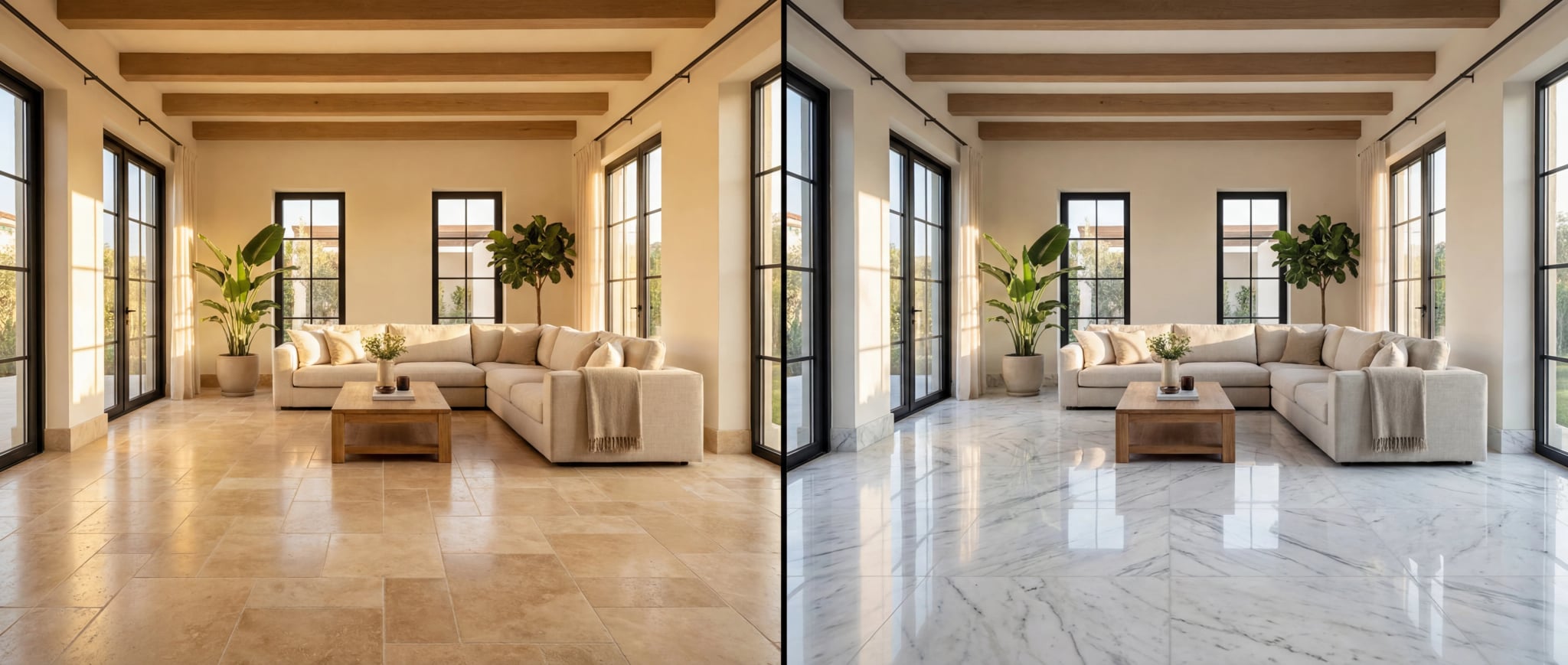
Compare geology, current test results, finish, application, maintenance and landed cost before choosing either natural stone.
20+
Years Experience
40+
Countries Served
EN / ASTM
Test Methods
Project
Specific Decisions
Last updated: · Reviewed by Sezai Suda
Quick Answer
Travertine is a porous calcium-carbonate stone deposited from mineral-rich water; marble is a recrystallised metamorphic stone. Neither category is automatically stronger, safer, cheaper or more durable. Choose by current test results for the exact selection and finish, intended use, installed system, maintenance tolerance and a like-for-like landed quote. Marmol Turco supplies both from Turkish quarries.
Geology & Formation
Their geological origins explain the familiar visual difference, but they do not provide a project specification. Performance still has to be verified for the exact commercial selection and finish.
Travertine forms when calcium carbonate precipitates from mineral-rich water, often around springs. Layering, pores and voids are characteristic, but their size, continuity and filling vary by deposit, block, cut and factory treatment. Those variables affect appearance and the test results used for specification.
Marble is a metamorphic rock formed when carbonate rock recrystallises under heat and pressure. Its mineralogy, grain structure, veining and natural discontinuities vary substantially between commercial varieties and blocks, so the word marble alone does not establish engineering performance.
Common Misconception
Travertine is not geologically marble. Both are commonly calcite-rich and therefore acid sensitive, but they form differently and are covered by different product descriptions. Specify the exact stone, selection, finish and current test documentation.
Technical Sources
These sources support the geological distinction and the test categories buyers should request. They do not replace current reports for the exact supplied stone.
Technical Specifications
Category averages can conceal the variation that matters on a real project. Use the table as a document checklist and compare current declarations or laboratory reports for the exact stone, orientation, fill and finish offered.
| Property | Travertine | Marble | Project Check | Standard |
|---|---|---|---|---|
| Density (kg/m3) | Use current selection result | Use current selection result | Compare EN 1936 declarations | EN 1936 |
| Compressive Strength (MPa) | Use current selection result | Use current selection result | Match EN 1926 to design loads | EN 1926 |
| Flexural Strength (MPa) | Use current selection result | Use current selection result | Match EN 12372 to format and support | EN 12372 |
| Water Absorption (%) | Use current selection result | Use current selection result | Review EN 13755 with finish and fill | EN 13755 |
| Open Porosity (%) | Use current selection result | Use current selection result | Review EN 1936 with void condition | EN 1936 |
| Mohs Hardness | Use current selection result | Use current selection result | Use abrasion and finish tests, not Mohs alone | - |
| Thermal Conductivity (W/mK) | Use current selection result | Use current selection result | Use current product or assembly data | EN 12524 |
| Surface Temp in Sun | Use current selection result | Use current selection result | Test a site mock-up in local conditions | Field test |
| Fire Classification | Use current selection result | Use current selection result | Verify the product declaration | EN 13501-1 |
No category-wide value is a project certificate. Confirm sampling date, test method, orientation, wet or dry condition, filled or unfilled state, finish and declared product before comparing results.
Visual Characteristics
Choosing between travertine and marble is often an aesthetic decision as much as a technical one. Each stone brings a distinct visual language to interior and exterior spaces.
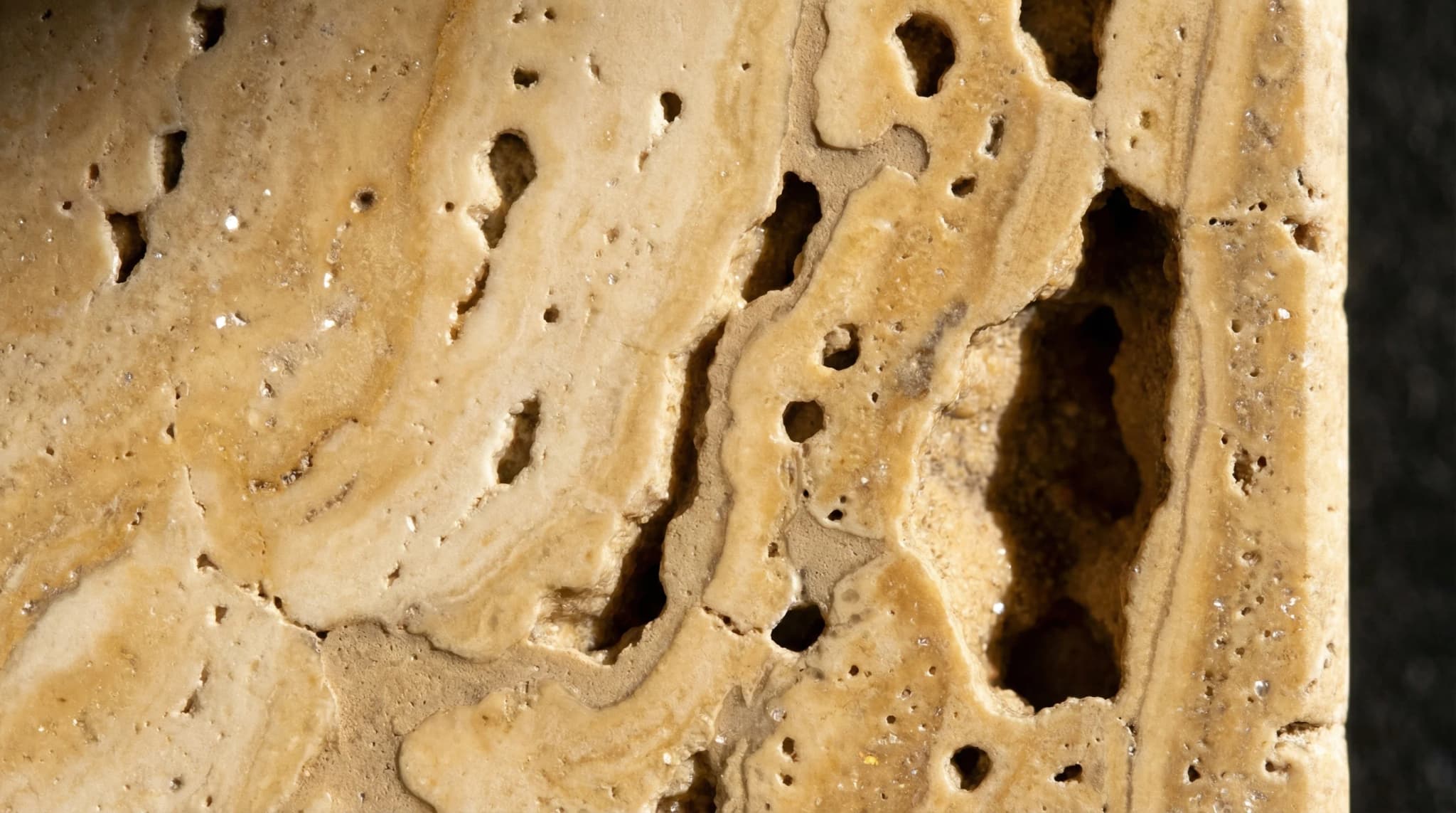
Travertine's colour palette runs from ivory and cream through gold, walnut, silver, and occasional reds. Its defining visual feature is the natural pore structure, which creates an organic, flowing texture unlike any manufactured material. These tones work naturally with biophilic and Mediterranean design trends, lending warmth and tactile interest to floors, walls, and outdoor surfaces. Varieties like Classic Travertine and Light Travertine showcase this warm palette.
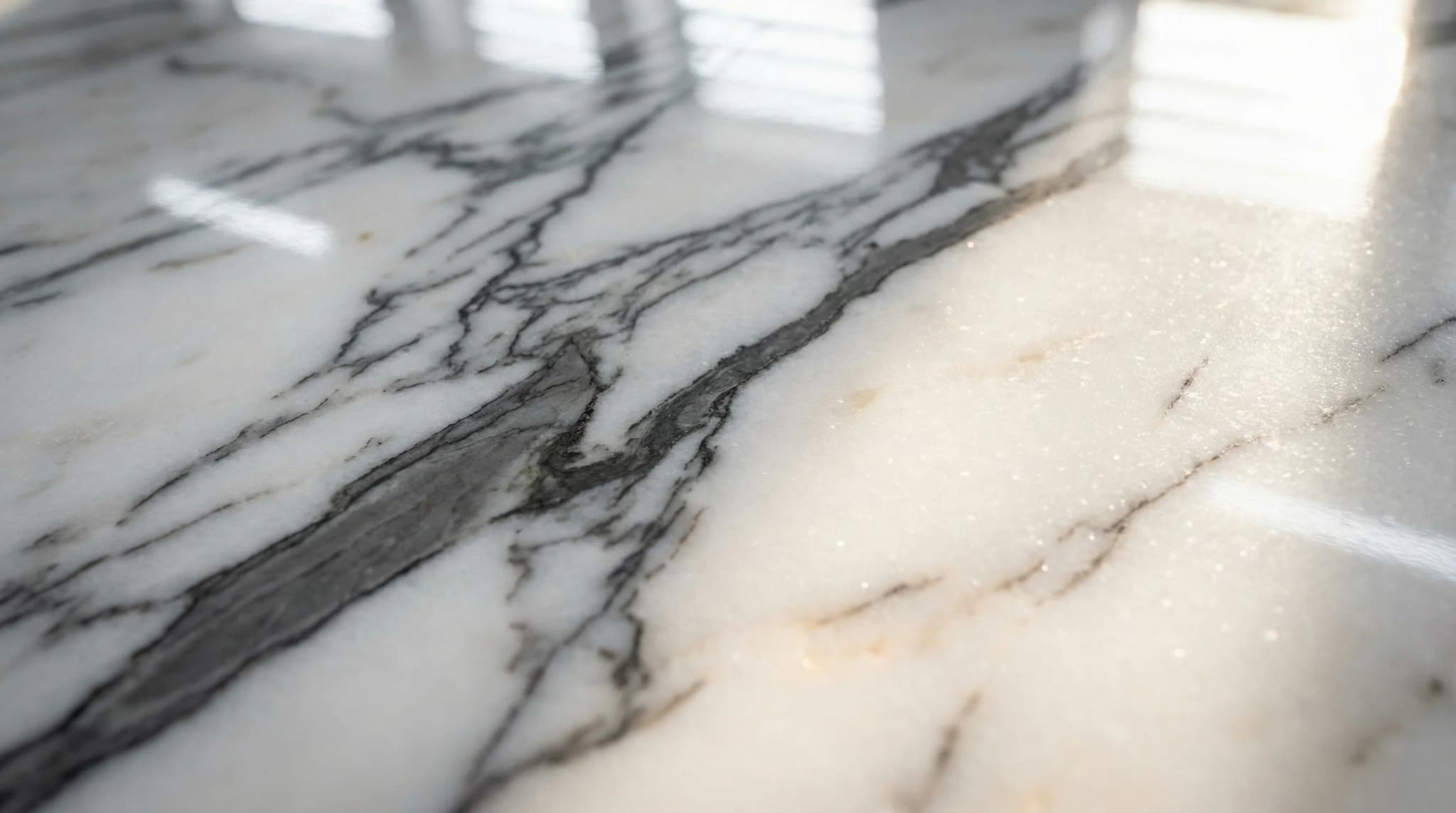
Marble ranges from quiet, nearly uniform selections to strongly veined white, grey, black, green and coloured varieties. Polishing can increase light reflection, while honed finishes create a softer appearance. Select from current slabs or control samples because veining, background colour and fissures vary by quarry, block and cutting direction.
Compare physical samples from the available lot under project lighting. Photography cannot reliably show colour range, translucency, fill, polish, fissures or the variation expected across an order.
Application Comparison
The intended use determines which tests, finish details and installation conditions matter. Neither stone wins every application.
Both stones can work for flooring. Compare abrasion resistance, wet and dry slip performance for the supplied finish, tile format, traffic, substrate and cleaning plan. Travertine's texture and marble's polish are design choices, not universal performance guarantees.
Do not choose a pool surround by stone name alone. Compare tested wet slip resistance, solar heat in a site mock-up, pool-chemical exposure, drainage, freeze-thaw requirements and the installed assembly. Polished finishes are generally unsuitable for wet walking areas. See the travertine pool-deck specification guide.
Either material can suit bathrooms. Floors need documented wet slip performance and drainage; walls and vanity surfaces need a compatible waterproofing, fixing, joint and maintenance system. Review absorption, staining and acid sensitivity for the exact finish.
Both are commonly calcite-rich and can etch when exposed to acids. Choose either only if the client accepts the maintenance and patina, and approve a finish and sample first. Where low maintenance dominates, compare other countertop materials separately.
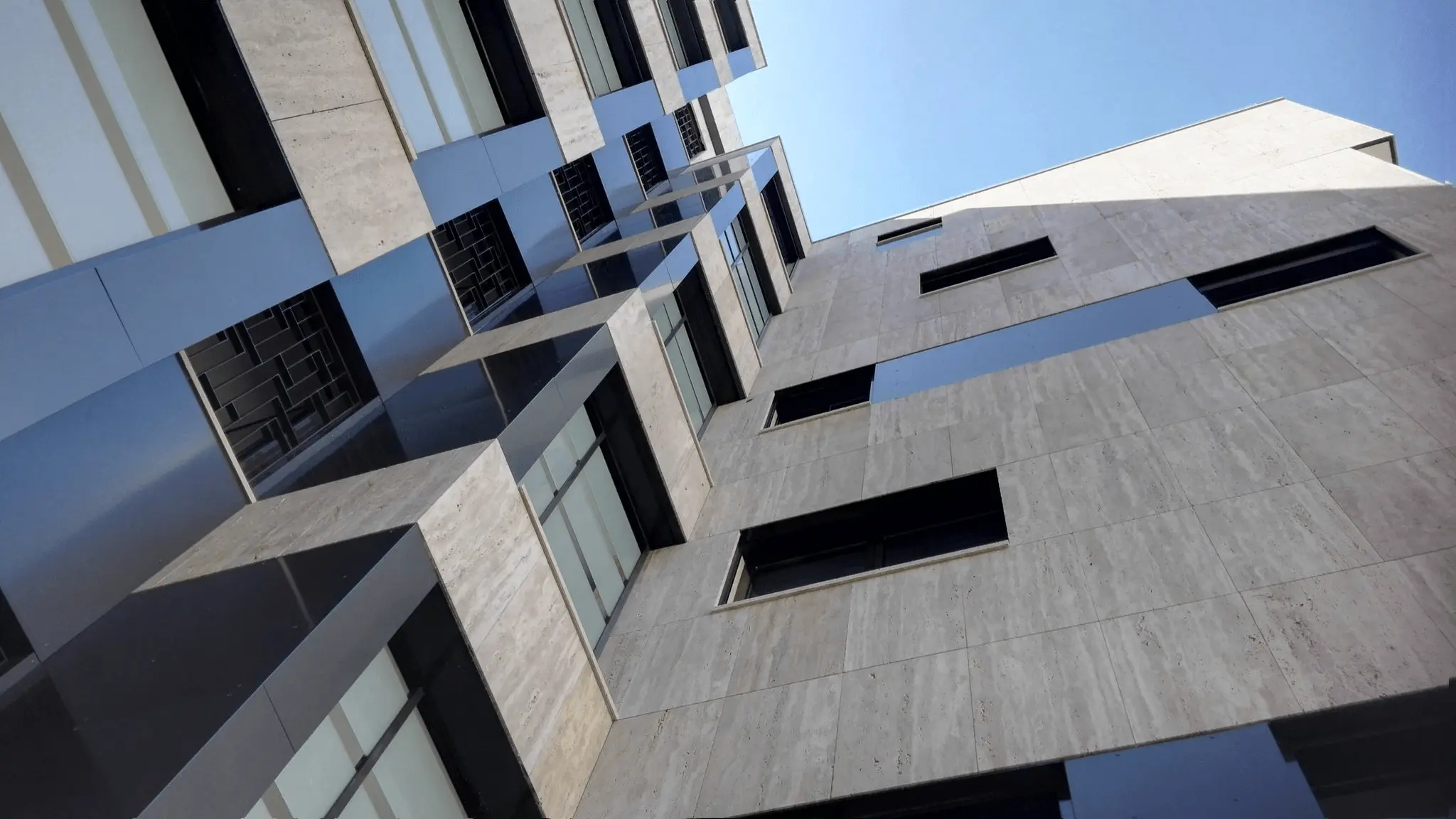
Facade suitability depends on panel size, thickness, anchorage, orientation, flexural performance, freeze-thaw or salt exposure and the wall-system design. The facade engineer should approve current test reports for the exact stone; neither category is a blanket structural winner. See the natural-stone facade guide.
For interior feature walls and fireplace surrounds outside the firebox, the decision is mainly visual. Confirm substrate, fixing method, panel weight, heat clearances, finish and expected variation, then approve current samples or a dry layout.
Request paired travertine and marble samples with the intended finish and current technical documents.
Landed Cost
There is no durable global price per square metre for either category. Compare current offers with the same stone schedule, grade, thickness, finish, edge work, quantity, packing, Incoterm, freight basis and installation scope.
| Cost Factor | Travertine | Marble | Difference |
|---|---|---|---|
| Material - Tiles (per m2) | Current scope-specific figure | Current scope-specific figure | Compare the same specification |
| Material - Slabs (per m2) | Current scope-specific figure | Current scope-specific figure | Compare the same specification |
| Installation (per m2) | Current scope-specific figure | Current scope-specific figure | Compare the same specification |
| Annual Maintenance (per m2) | Current scope-specific figure | Current scope-specific figure | Compare the same specification |
| Sealing (per application, per m2) | Current scope-specific figure | Current scope-specific figure | Compare the same specification |
| Replacement and Repair Allowance | Current scope-specific figure | Current scope-specific figure | Compare the same specification |
Best buying method: issue one schedule for both alternatives and compare accepted selection, net usable area, packing, freight, duties, lead time and exclusions. Request a like-for-like quotation.
A valid quote should identify the commercial stone, quarry or selection where available, dimensions, tolerance, finish, fill, quantity, packing, Incoterm, currency, validity period and delivery assumptions.
Longevity & Care
Durability belongs to the specified product and assembly, not to the category label. Compare current evidence for the exposure and maintenance regime that the project will actually impose.
Both materials are commonly calcite-rich and can be marked by abrasive grit. Compare abrasion testing, finish, traffic and cleaning controls; do not rank a commercial stone using Mohs hardness alone.
Staining depends on absorption, pore and fissure structure, fill, finish, contaminant, sealer and cleaning response. Test the proposed stone and treatment with likely project contaminants before approval.
Calcite-rich travertine and marble can etch under acids such as citrus, vinegar and acidic cleaners. A sealer may reduce staining but does not make calcite acid-proof. Approve the expected patina and maintenance method.
Outdoor suitability requires evidence for the actual climate and exposure. Review freeze-thaw, salt crystallisation, strength after conditioning, anchorage or bedding, drainage and movement joints for the supplied product and system.
Absorption and moisture movement vary by selection and finish. Design drainage, waterproofing, ventilation and compatible bedding or anchoring; sealing is not a substitute for a correct wet-area assembly.
A fixed service life cannot be assigned from the words travertine or marble. Detailing, exposure, support, workmanship, cleaning and repairability determine whether an installation performs for years or generations.
Evidence & Sustainability
Do not infer environmental performance from the stone name. Compare current product-specific documentation and the complete route from quarry to installed project.
Request a current product-specific environmental product declaration or equivalent verified data. Quarry energy, block yield, factory yield, finish, electricity mix, packaging and transport can materially change the result.
Processing demand varies with cutting yield, thickness, resin or fill, surface finish, water treatment and waste recovery. A polished marble is not automatically higher impact than every travertine product, or vice versa.
Quantify origin, factory, port route, container utilisation and final-mile delivery. Combining compatible items may improve container utilisation, but the effect should be calculated for the actual shipment rather than claimed as a fixed saving.
Reuse and recycling may be possible when dimensions, fixing method, contamination and demolition practice allow it. Ask how offcuts, slurry, damaged pieces and packaging are handled for the specific order.
There is no credible category-wide winner without comparable system boundaries and verified data. Compare product-specific declarations for natural stone and manufactured alternatives on the same functional unit and service-life assumptions.
Decision Guide
Use the intended application and current product evidence, not a category-wide winner, to make the final choice.
| Your Priority | What to Verify |
|---|---|
| Budget matters | Compare current landed quotes using one accepted specification and net usable quantity. |
| Outdoor / pool use | Verify wet slip, heat, chemical exposure, drainage and climate performance for the finish. |
| Luxury indoor statement | Approve current slabs or control samples under project lighting; both can deliver premium interiors. |
| Low maintenance | Compare acid sensitivity, staining tests, finish, sealer system and cleaning plan. |
| Maximum durability | Match current strength, abrasion and exposure tests to format, support and traffic. |
| Warm / organic aesthetic | Travertine commonly offers layered warm tones and visible texture; approve the actual lot. |
| Cool / elegant aesthetic | Marble commonly offers crystalline backgrounds and veining; approve the actual slabs. |
| High-traffic commercial | Specify abrasion, slip, thickness, substrate and maintenance; category alone is insufficient. |
| Mediterranean / biophilic design | Use the aesthetic that fits the design, then verify the required technical performance. |
| Maximum colour range | Review current quarry and slab availability rather than relying on a generic palette. |
Design Flexibility
Yes. Travertine and marble can be combined as design materials, but visual compatibility does not prove system compatibility. Use approved samples and coordinate thickness, calibration, finish, joints, support and movement detailing.
Marmol Turco can source both materials in Turkey and prepare them against one project schedule. Consolidation depends on production timing, packing compatibility, weight limits and the agreed shipment plan.
Marble Feature Wall + Travertine Flooring
Use marble as a visual accent and travertine across larger floor areas when approved samples, thickness, finish and installation details work together.
Marble Vanity + Travertine Shower
A marble vanity and travertine shower can work together when both stones, wet-area finishes, waterproofing, joints and maintenance treatments are approved for the assembly.
Technical note: Confirm movement, anchorage or bedding, filler, adhesive, grout, sealer and cleaning compatibility for each supplied product. Test both stones rather than assuming one treatment suits both. Browse current stone selections.
Our stone specialists can recommend the best material for your specific application and budget.
Our Collection
Each stone is sourced directly from Denizli quarries. Click to explore finishes, specs, and pricing.
Common Questions
Answers to the most common questions about travertine vs marble, sourced from 20+ years of industry experience.
Marmol Turco supplies Turkish travertine and marble. Request paired samples in the intended finish and a like-for-like project quotation through our stone collection.
Sample availability and quotation timing are confirmed for each current selection and project specification.
Project enquiry
Share the material, format, quantity, destination, and timing.
What helps us answer accurately
Stone · Format and finish · Quantity · Destination city or port
You can expect a reply within
One business day
Need a quick answer? Ask Selim in the chat.

