
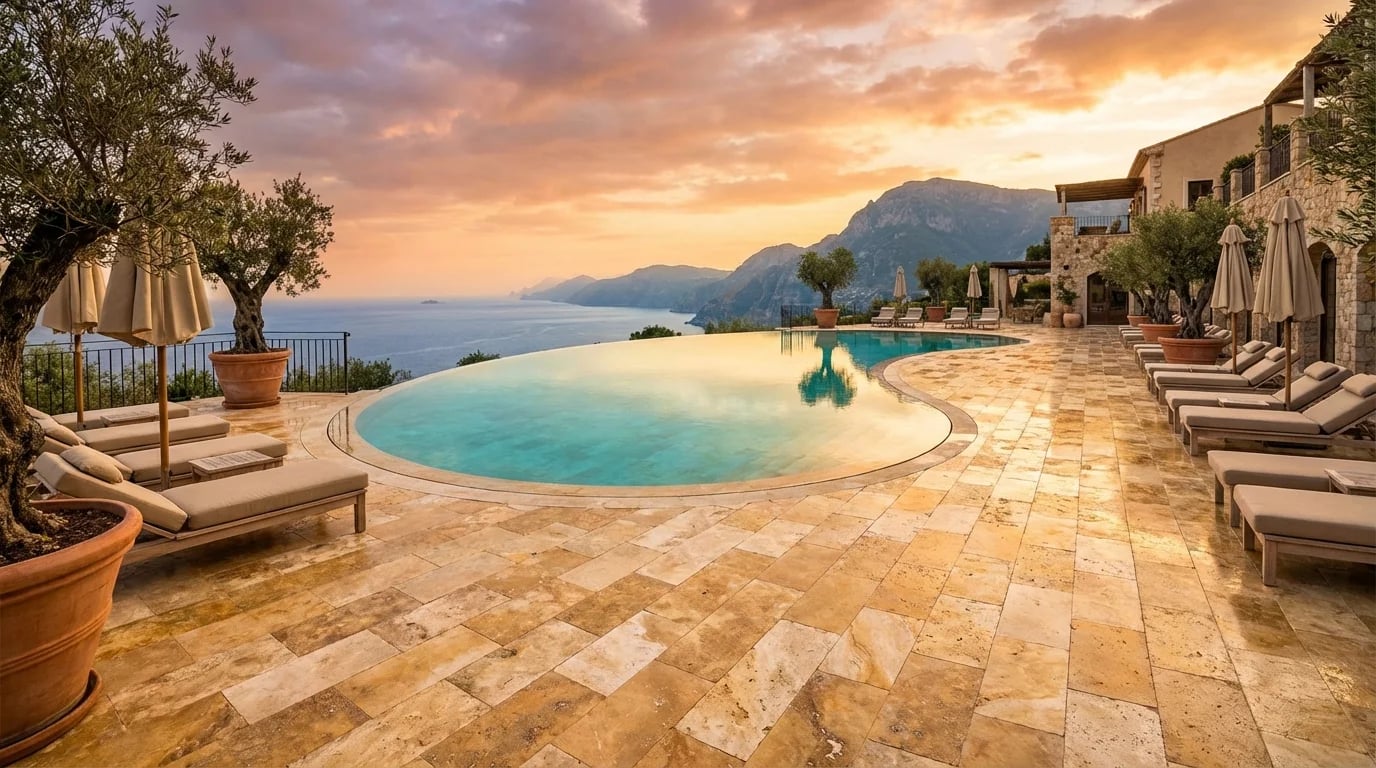
Turkish travertine stays cool underfoot, resists slipping when wet, and weathers gracefully for 50+ years. This guide covers finishes, installation, maintenance, and sourcing—everything you need for a pool deck that performs as well as it looks.
20+
Years Experience
40+
Countries Served
500K+
m2 Delivered
100%
Direct from Turkey
Last updated: · Reviewed by Sezai Suda
Quick Answer
Travertine is the top-rated natural stone for pool decks because it stays 10–20 °C (20–36 °F) cooler than porcelain, achieves a wet slip coefficient (SCOF) of 0.75–0.95 in tumbled finish (ASTM C1028), and lasts 50+ years with proper sealing. Quarried in Denizli, Turkey, it combines safety, durability, and timeless aesthetics at a competitive price point.
Performance & Beauty
From ancient Roman baths to modern resort pools, travertine has remained the gold standard for wet environments. Its unique cellular structure delivers thermal comfort, slip resistance, and structural integrity that engineered alternatives struggle to match.
The open, porous micro-structure of travertine (2–6 % porosity per EN 1936) allows heat to dissipate rather than build up on the surface. On a midsummer afternoon, a travertine pool deck registers just 35–45 °C (95–113 °F) while porcelain pavers beside it climb to 55–70 °C (131–158 °F). That 10–20 °C difference means bare feet stay comfortable all day—no scalding, no rushing to the pool edge. For families with children or hotel guests walking between loungers and the water, thermal safety is non-negotiable.
Tumbled travertine achieves a wet Static Coefficient of Friction (SCOF) of 0.75–0.95 per ASTM C1028, well above the 0.60 threshold required by most building codes. The naturally textured surface—created by millions of years of mineral deposition—grips wet feet without feeling abrasive. EN 14231 pendulum tests confirm these values even after years of foot traffic. For pool decks, this means reliable traction from the first season to the fiftieth.
With a compressive strength of 7,800 psi (53.8 MPa per ASTM C170) and a flexural strength between 750–1,842 psi (5.2–12.7 MPa per ASTM C880), travertine handles heavy foot traffic, patio furniture, and freeze-thaw cycles without cracking. Its density of 2,410–2,720 kg/m³ (ASTM C97) gives each paver substantial mass, keeping it stable on the substrate. Properly installed and sealed, a travertine pool deck can serve 50+ years with only periodic re-sealing.
Every travertine slab carries unique veining and warm earth tones that complement any architectural style from Mediterranean to contemporary minimalism. The range spans from the ivory tones of Light Travertine to the walnut depth of Noce Travertine, with Silver Travertine and Classic Travertine offering versatile mid-tones in between. The colour palette ages gracefully, developing a patina that adds character rather than looking worn. Compared to concrete pavers that fade or porcelain that chips at the glaze, travertine integrates naturally with landscape elements like water features, garden walls, and outdoor kitchens.
Travertine is calcium-carbonate-based, which makes it naturally alkaline—a close match to the pH range of most treated pool water (7.2–7.8). When properly sealed with a penetrating silane-siloxane sealer, it tolerates both chlorinated and saltwater splash-out without pitting or discolouration. Water absorption stays between 1.6–2.6 % (ASTM C97), meaning the stone absorbs just enough moisture to dry rapidly while remaining structurally sound.
More than 80 % of the world’s premium travertine originates from the Denizli basin in southwestern Turkey, where geothermal activity has created deposits with exceptional density and colour consistency. Go2Stone sources directly from these quarries, cutting out intermediaries and passing the savings on to you. Ordering factory-direct also means custom dimensions, surface finishes, and edge profiles can be specified per project—something stock distributors rarely offer. Browse our full travertine collection to find the right stone for your project.
Our Collection
Each stone is sourced directly from Denizli quarries. Click to explore finishes, specs, and pricing.
Get factory-direct pricing on premium Turkish travertine—custom sizes and finishes available.
Finish Comparison
The finish you choose determines slip resistance, maintenance frequency, and cost. Below is a side-by-side comparison of the three most popular options for pool decks.
Tumbled travertine is the industry standard for pool zones because its naturally rough surface maximises wet grip. Brushed (antiqued) travertine offers a similar tactile experience with a slightly more uniform appearance, making it popular for decks and coping where aesthetics and safety must both be high. Honed travertine, with its smooth surface, is best reserved for coping or dry areas; its lower slip coefficient means it should not be used on submerged steps or splash zones.
| Finish | Wet Slip (SCOF) | Maintenance | Best For | Price vs. Tumbled |
|---|---|---|---|---|
| Tumbled | 0.75–0.95 | Seal 1–2x/year | All pool zones | Baseline |
| Brushed | 0.70–0.90 | Seal annually | Decks, coping | +5–15 % |
| Honed | 0.45–0.65 | Seal 2–3x/year | Coping only | +20–40 % |
SCOF values measured per ASTM C1028 and validated with EN 14231 pendulum tests. Prices are indicative; request a quotation for project-specific rates.
Applications
Travertine adapts to every element of a pool environment. Below are the four core applications, each with specific best practices.
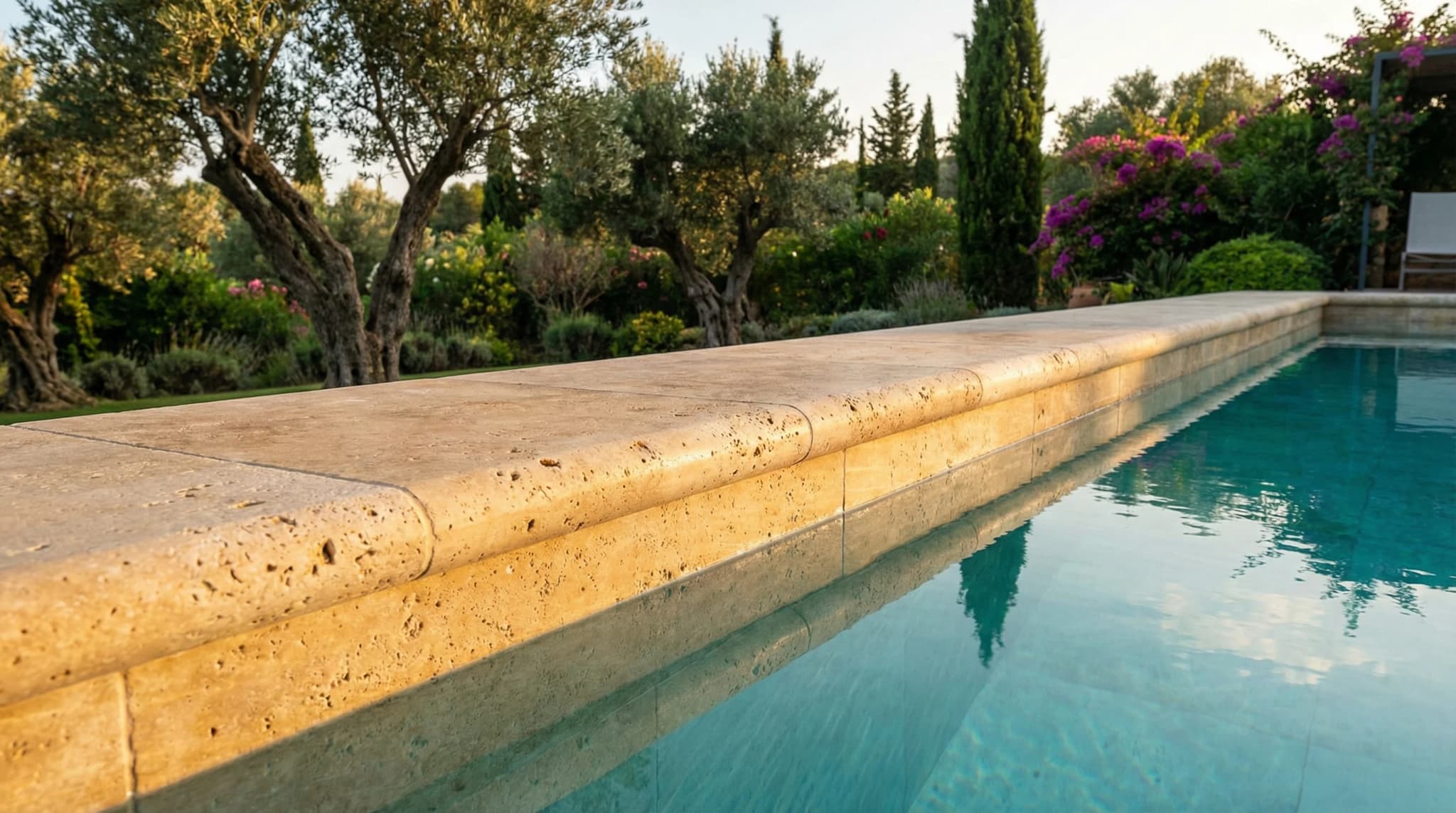
Coping is the capstone that crowns the pool shell wall. Travertine coping comes in bullnose, drop-face, and square-edge profiles, typically 30 mm (1.2 in) thick with a 50–60 mm overhang. The overhang directs splash water away from the bond beam, protecting the structural edge. Tumbled or brushed finishes are recommended for coping because swimmers grip the edge when exiting the pool. EN 1341 specifies minimum flexural requirements for external paving, and travertine coping comfortably exceeds those values.
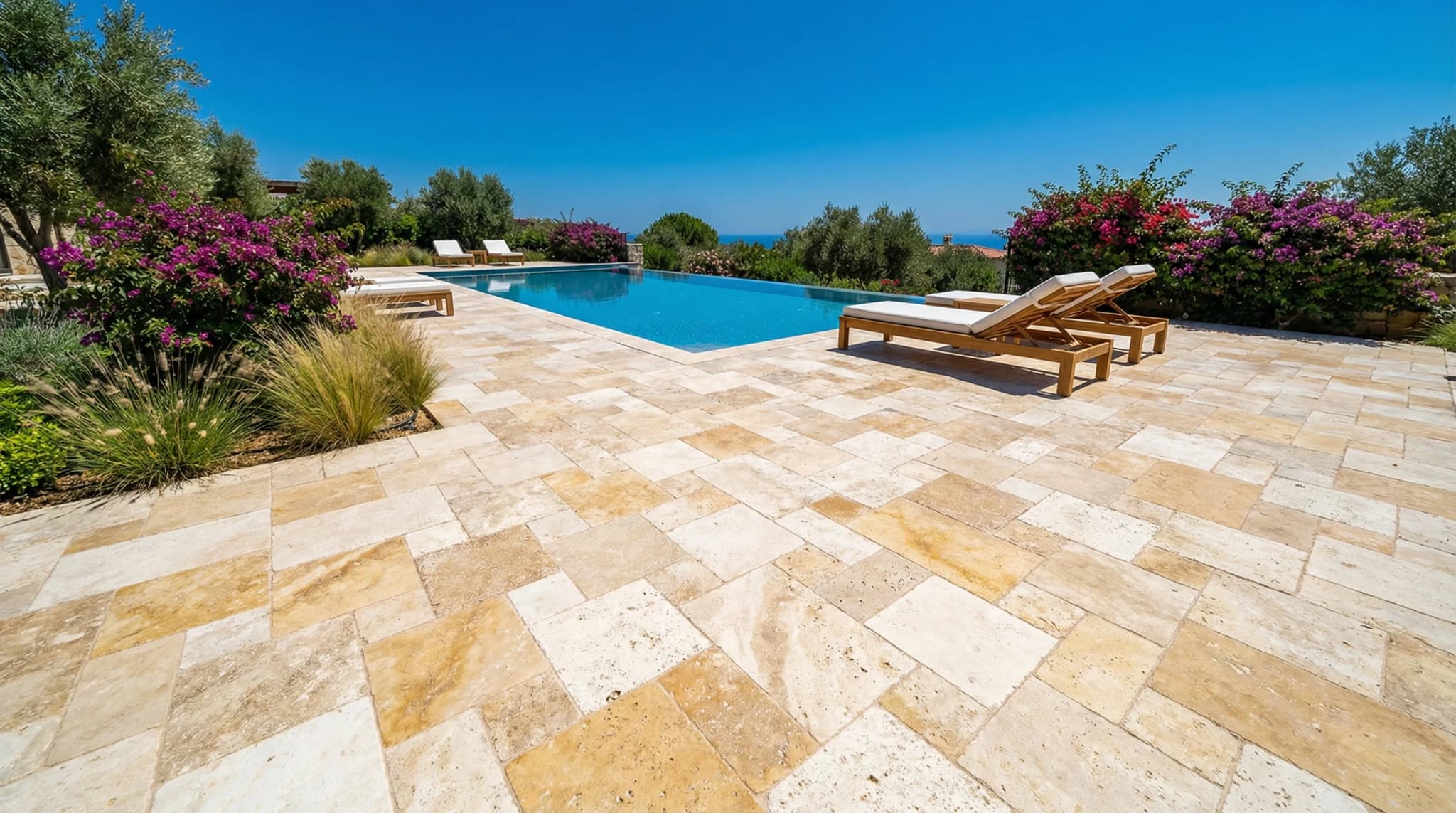
Deck pavers cover the largest surface area around a pool. French pattern (Versailles) layouts combine four tile sizes (20×20, 20×40, 40×40, 40×60 cm) for an organic, non-repeating look that disguises joints and adds visual depth. Standard 30 mm pavers work for pedestrian decks; 40–50 mm pavers are advised for vehicular or heavy-furniture areas. Tumbled pavers with 3–5 mm joints allow for slight movement, which reduces the risk of cracking in regions with thermal expansion.
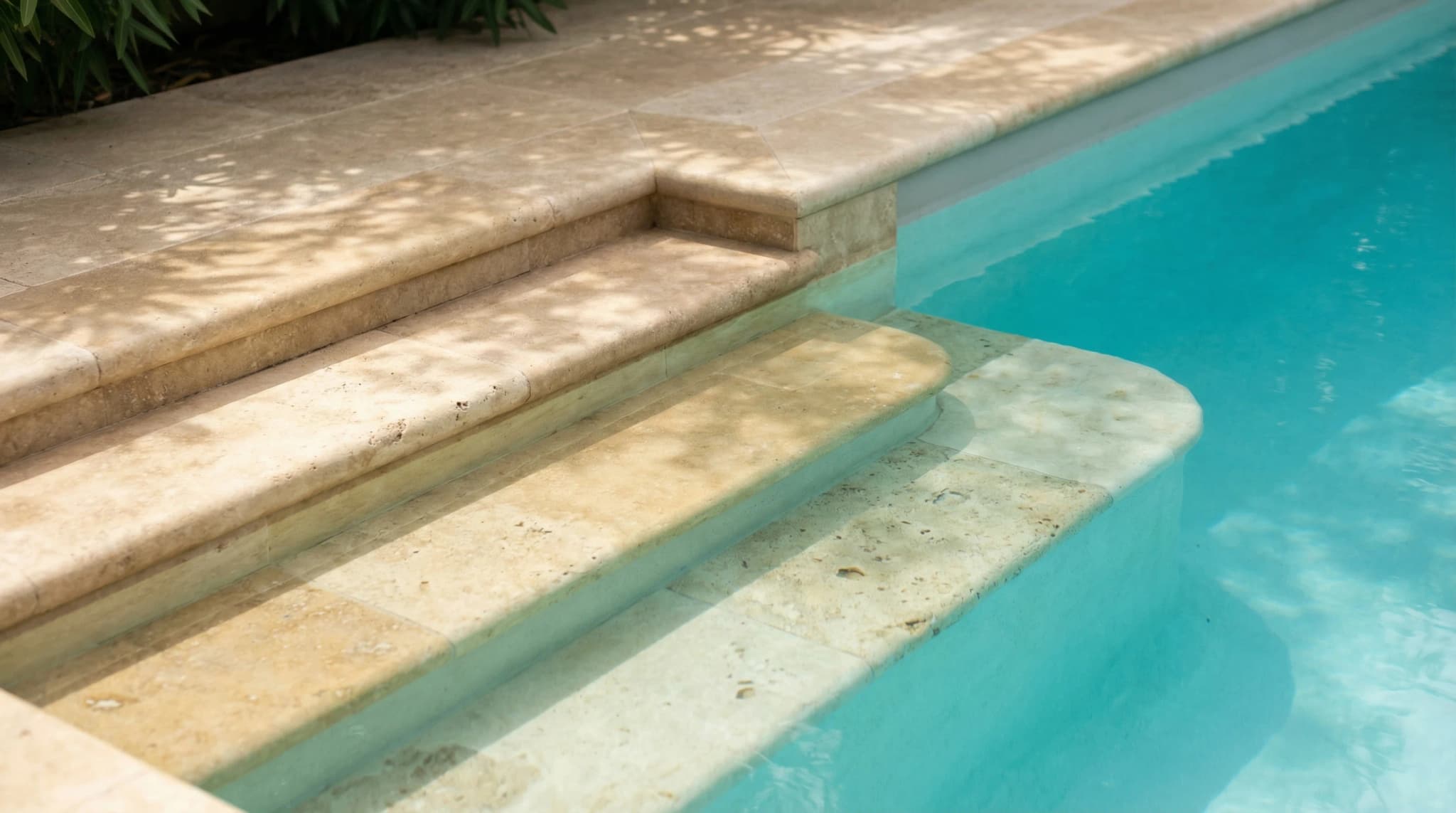
Pool steps demand the highest slip resistance because users navigate them with wet feet and limited visibility underwater. Tumbled treads paired with a non-slip nosing ensure safety, and 30 mm or thicker slabs provide the structural rigidity needed for cantilevered steps. For zero-edge (beach entry) pools, travertine can be cut into thin strips (15–20 mm) that follow the slope, giving the entry a seamless natural appearance.
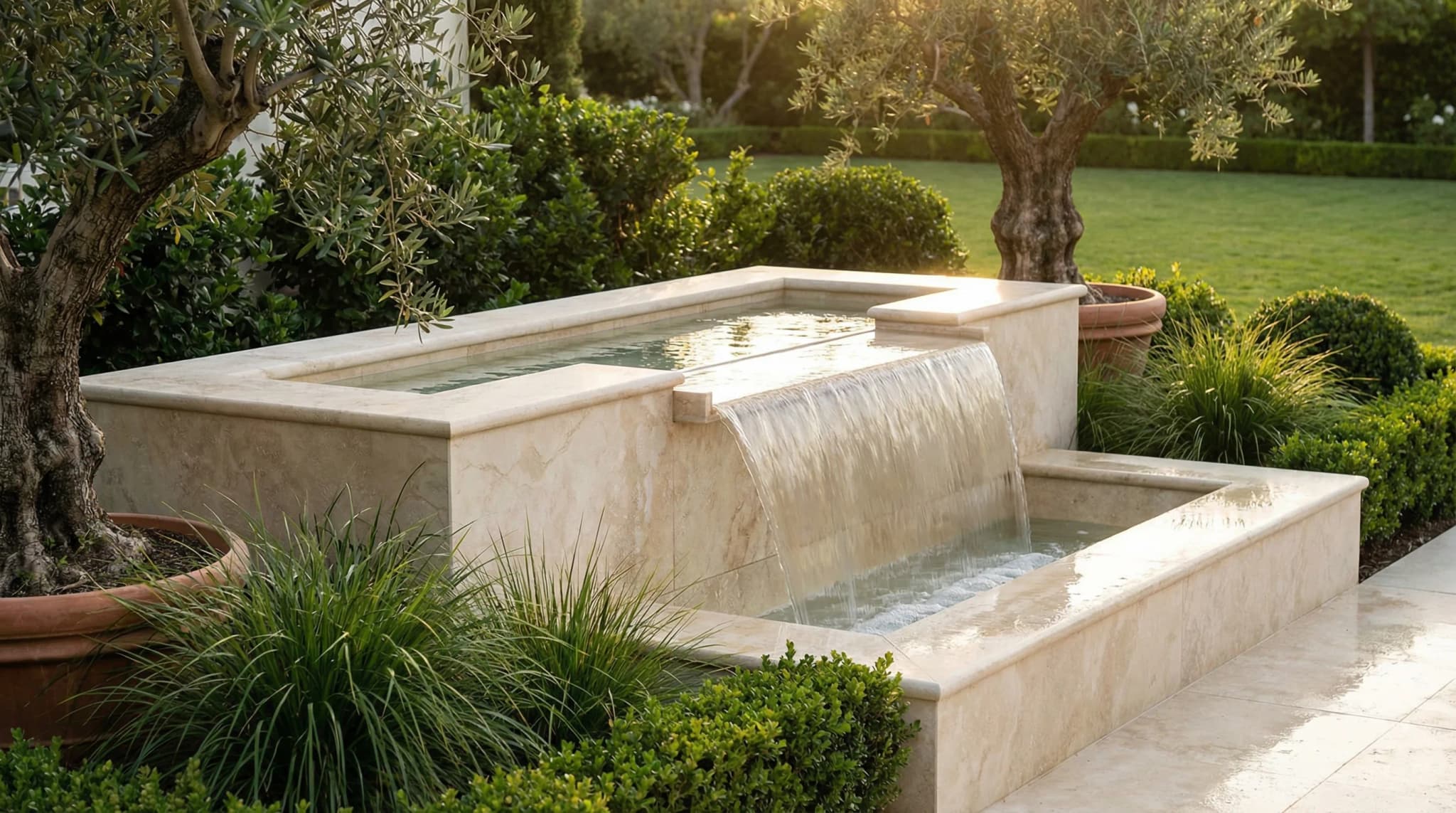
Spillways, scuppers, and fountain surrounds benefit from travertine's natural compatibility with water. Its slightly porous surface allows water to sheet evenly rather than bead, creating a smooth curtain effect. For raised walls and water features, travertine veneers (10–15 mm) bonded to concrete block offer the look of solid stone at a fraction of the weight. Custom waterjet cutting can produce curved and radiused pieces for circular fountain basins.
Our stone specialists can recommend the best travertine solution for your specific project.
Material Comparison
Every pool deck material has trade-offs. The table below compares Turkish travertine against the four most common alternatives across the metrics that matter most for pool installations.
Turkish travertine occupies a unique position — see our full travertine vs marble comparison — and is the only natural stone that combines high slip resistance with low surface temperature, a 50-plus-year lifespan, and a mid-range installed cost. Porcelain pavers are cheaper upfront but run significantly hotter. Concrete pavers require more frequent maintenance. Limestone is thermally similar but softer and more porous. Sandstone, while attractive, absorbs water rapidly and needs aggressive sealing schedules.
| Material | Surface Temp °C (°F) | Slip Resistance | Lifespan | Maint./yr | Price (installed/m²) |
|---|---|---|---|---|---|
| Turkish Travertine | 35–45 (95–113) | High (SCOF >0.75) | 50+ yrs | $1–2 | $80–150 |
| Porcelain Pavers | 55–70 (131–158) | High (R11-R12) | 40–50 yrs | $0.5–1 | $50–100 |
| Concrete Pavers | 50–65 (122–149) | High (textured) | 30–40 yrs | $2–4 | $40–80 |
| Limestone | 40–50 (104–122) | Medium-High | 40+ yrs | $2–3 | $60–120 |
| Sandstone | 45–55 (113–131) | Medium | 30–50 yrs | $3–5 | $50–110 |
Prices are indicative for material + professional installation. Actual costs vary by region, project scale, and finish selection. Contact us for a project-specific quotation.
Installation
A travertine pool deck is only as good as the substrate beneath it. The following four areas cover the most critical installation decisions.
The ideal substrate is a 100–150 mm reinforced concrete slab with a minimum 28-day cure. The surface must be clean, flat to within 3 mm over 2 m, and free of curing compounds. For retrofit projects over existing concrete, scarify the surface to improve mortar bond. A slope of 1–2 % away from the pool shell ensures water drains off the deck rather than ponding against the coping.
Use a polymer-modified thin-set mortar rated for exterior natural stone (C2 TE class per EN 12004). Apply to both the substrate and the back of each paver (back-buttering) to achieve full coverage—voids beneath the stone can trap water and cause freeze-thaw spalling. A white mortar is preferred for lighter travertine to prevent grey bleed-through.
Maintain 3–5 mm joints between pavers to allow for thermal expansion. Use a flexible, polymer-modified grout rated for outdoor and wet environments. Sanded grout in a colour close to the stone creates a seamless appearance. Movement joints (10 mm minimum) should be placed every 3–4 m and at every change of plane or material.
In climates where temperatures drop below 0 °C, proper drainage is critical to prevent water from saturating the stone and expanding as ice. Select travertine with a water absorption below 3 % (ASTM C97) and apply a penetrating silane-siloxane sealer before grouting. Ensure the substrate has adequate drainage and that all joints remain flexible. Travertine rated for EN 12371 freeze-thaw cycling will withstand 50+ cycles without structural degradation.
Care & Longevity
Travertine is low-maintenance by natural stone standards, but a simple care routine dramatically extends its appearance and lifespan. For exterior wall applications, see our stone facades guide.
Apply a penetrating silane-siloxane sealer within 48 hours of installation and re-apply every 12–24 months depending on traffic and climate. Penetrating sealers protect from within without altering the stone’s natural appearance or creating a slippery film. Avoid topical sealers (acrylic, polyurethane) in pool areas—they peel, yellow, and reduce slip resistance over time.
Weekly hosing with clean water removes most debris. For stubborn stains (leaf tannins, sunscreen, food), use a pH-neutral stone cleaner diluted per the manufacturer’s instructions. Never use acidic cleaners (vinegar, muriatic acid) on travertine—they etch the calcium carbonate surface. A pressure washer set below 1,500 psi with a wide fan nozzle is safe for annual deep cleaning.
Salt-chlorinated pools are fully compatible with sealed travertine. The salt concentration in pool water (typically 3,000–4,000 ppm) is far below sea water (35,000 ppm) and poses no risk to the stone. However, salt can crystallise in unsealed pores during dry spells, so consistent sealing is especially important for saltwater installations. Rinse splash zones weekly during peak season.
Before the first freeze, ensure all joints are intact and the sealer is current. Clear standing water from low spots. Pool covers reduce splash-out and keep the deck drier. In regions with heavy snowfall, avoid metal shovels and de-icing salts—use a plastic shovel and sand for traction instead.
With regular sealing (every 12–24 months) and basic cleaning, a travertine pool deck can last 50+ years without replacement. Unsealed travertine will still endure 10–20 years but will show staining, efflorescence, and surface roughening sooner. The cost of annual sealing ($1–2 per m²) is a fraction of the replacement cost, making it the single best investment in deck longevity.
Common Questions
Answers to the most common questions about travertine pool decks, sourced from 20+ years of industry experience.
Get factory-direct Turkish travertine pricing, custom cut to your specifications. Free quotation with shipping estimate included.
Most pool deck orders ship within 3–4 weeks from our Denizli facility.
Project enquiry
Share the material, format, quantity, destination, and timing.
What helps us answer accurately
Stone · Format and finish · Quantity · Destination city or port
You can expect a reply within
One business day
Need a quick answer? Ask Selim in the chat.

