
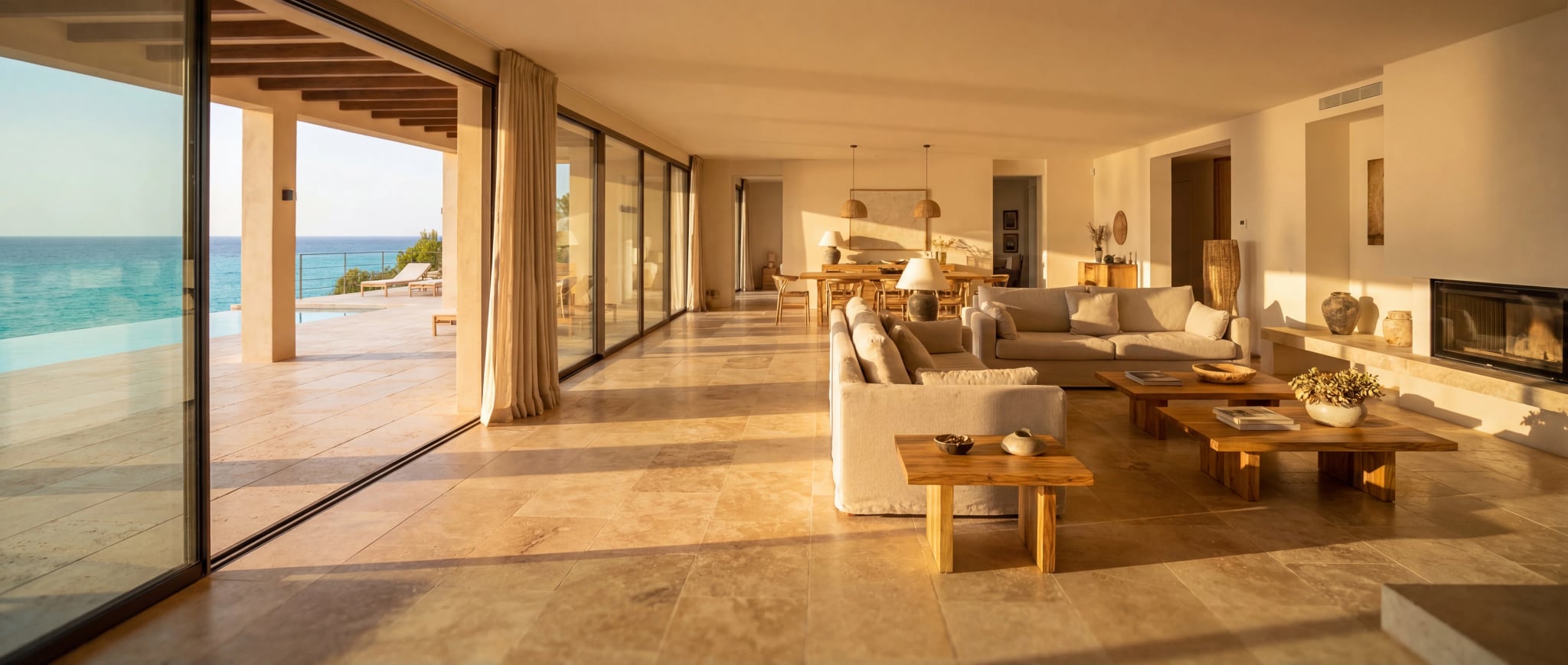
From the Colosseum in Rome to modern luxury resorts, travertine has endured as the natural stone of choice for over 2,000 years. This guide covers 6 color varieties, 8 surface finishes, technical specifications, applications, and how to source premium travertine directly from Turkey's Denizli quarries.
20+
Years Experience
40+
Countries Served
50%
Global Reserves in Denizli
$1.4B+
Annual Stone Exports
Last updated: · Reviewed by Sezai Suda
Quick Answer
Travertine is a sedimentary limestone formed by mineral-rich thermal springs, prized for its warm tones, natural texture, and exceptional versatility. Turkey's Denizli region holds roughly 50% of global travertine reserves and exports 750,000+ tonnes annually. Available in 6+ color varieties and 8+ surface finishes, travertine is used for flooring, pool decks, facades, countertops, and exterior cladding. Marmol Turco sources premium Turkish travertine directly from Denizli quarries.
Geology & Composition
Travertine is one of nature's most distinctive building stones, formed over millennia through a unique geological process that gives it the warm tones and characteristic porous texture prized by architects worldwide. Understanding its formation explains why Turkish travertine from the Denizli basin is the global benchmark for quality.
Travertine forms when calcium-rich groundwater, superheated by geothermal activity, rises to the surface and rapidly releases dissolved CO2. This shifts the chemical equilibrium (CaCO3 + H2O + CO2), precipitating layers of calcite that build up over thousands of years. Unlike standard limestone, which forms from marine sediment accumulation, travertine's thermal spring origin (groundwater above 30-50 degrees C) creates its distinctive banded structure and natural voids. The Denizli basin in southwestern Turkey sits atop one of the world's most active geothermal zones, producing travertine deposits with exceptional density and color consistency.
Travertine is primarily composed of calcite (CaCO3), with purity typically exceeding 95-98%. Aragonite, another calcium carbonate polymorph, occurs preferentially in high-temperature deposits. Trace minerals create the stone's color variations: iron oxides produce warm golden and reddish tones, manganese contributes to darker hues, and the near-absence of impurities yields the sought-after ivory and cream hues of Classic Travertine. This high mineral purity gives travertine its structural integrity and consistent performance across architectural applications.
The natural voids and pores in travertine are not defects but the defining characteristic that gives the stone its distinctive beauty and practical advantages. These pores form as CO2 gas escapes during mineral deposition. Commercial-grade porosity ranges from 2% in dense, ancient formations to 10-15% in more recent deposits. Buyers can choose between open-pore (unfilled) travertine for a rustic, textured aesthetic or filled-and-honed surfaces for a smooth, contemporary finish. The porous structure also provides thermal insulation benefits, keeping surfaces cooler in direct sunlight than denser stones like marble or granite.
Travertine combines warm, earth-toned aesthetics with genuine structural performance. Thermal conductivity of 1.5-2.2 W/m·K (EN 12524) means it stays comfortable underfoot in warm climates. Compressive strength of 50-120 MPa (EN 1926) handles heavy commercial foot traffic. It carries an A1 non-combustible fire classification (EN 13501-1), making it compliant for facade cladding and public buildings. With 8+ available surface finishes, a single stone variety can serve flooring, walls, pool decks, and exterior cladding across an entire project. Browse our full travertine collection to see the range of possibilities.
Industry & Origin
Turkey is the world's leading travertine producer and among the top 3 global natural stone exporters, with total stone exports reaching $1.43 billion in the first nine months of 2024. The Denizli basin is the epicenter of this industry, and understanding Turkey's dominance helps buyers make informed sourcing decisions.
Turkey consistently ranks among the top 2 global natural stone exporters, shipping over 4.5 million tonnes of stone in the first nine months of 2024. The United States imported $319.8 million worth of Turkish stone during this period (+10.8% year-on-year), followed by China ($289M), India ($103M), and Saudi Arabia ($84.5M). Travertine is Turkey's flagship stone product, with the Turkish stone industry targeting $500 million in US exports alone.
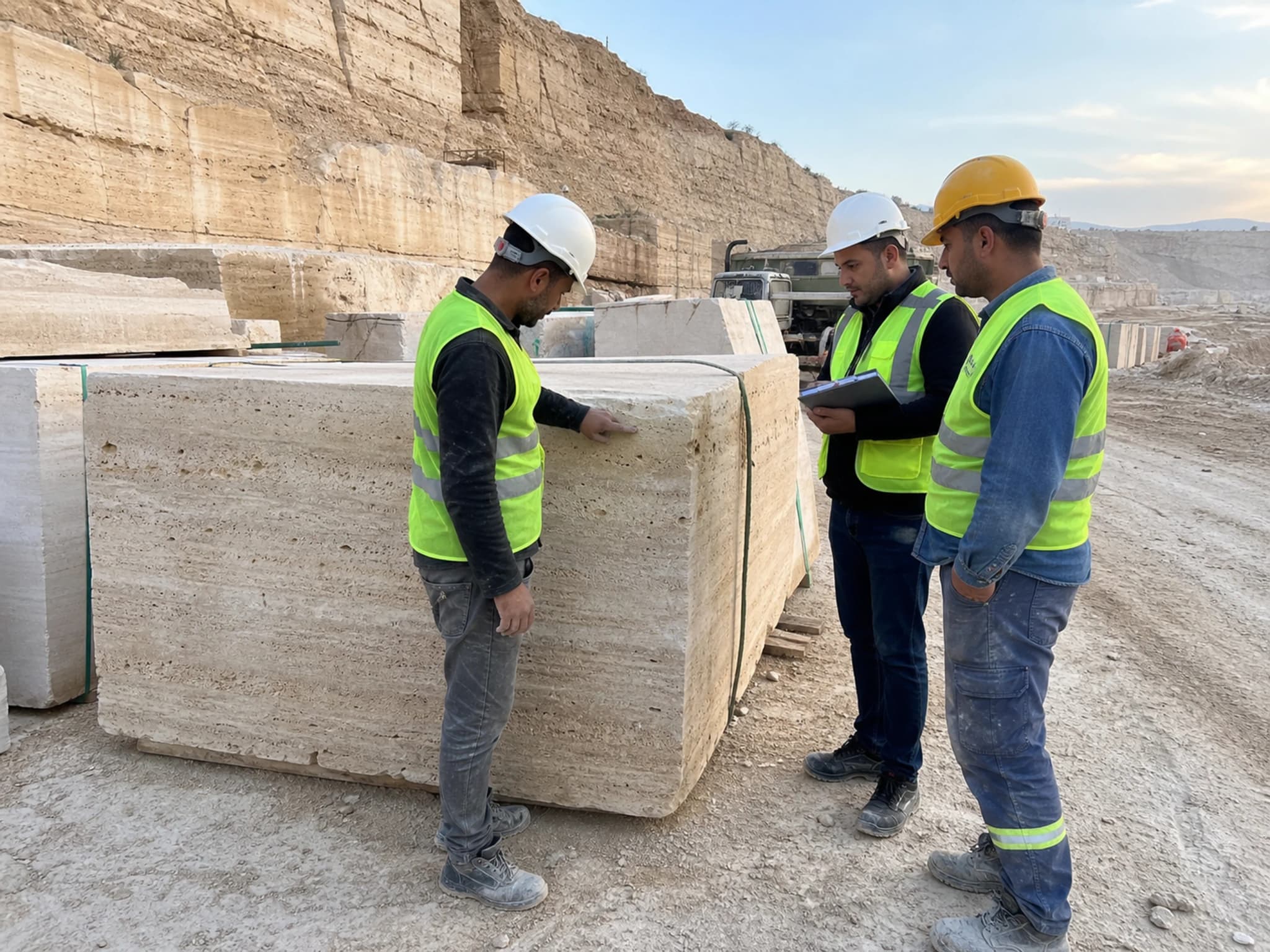
The Denizli province in southwestern Turkey sits above one of the planet's most significant geothermal zones, producing travertine deposits of unmatched scale and variety. The region holds approximately 50% of the world's known travertine reserves and sustains hundreds of active quarries. Denizli travertine is prized for consistent coloring across large production runs, a critical factor for commercial-scale architectural projects. The same geothermal system that created the famous Pamukkale terraces produced the full spectrum of colors, from Light to deep Noce.
Turkey's stone export infrastructure is world-class, with modern processing facilities offering CNC cutting, calibration, and surface finishing to international standards. Key export ports include Izmir (closest to Denizli), Mersin, and Antalya. Full-year 2023 exports reached $1.8 billion (6 million tonnes). The industry supports 5,000+ active quarries nationwide and employs hundreds of thousands of workers across extraction, processing, and logistics. For detailed shipping information, see our import and shipping guide.
Turkish travertine offers 30-50% cost savings compared to Italian equivalents at comparable quality grades. This is a structural advantage, not a quality compromise: Turkey's massive reserves reduce extraction costs, competitive labor costs improve processing economics, and proximity to key markets keeps shipping affordable. All Marmol Turco stone ships with CE marking, full EN test documentation, and TSE certification, meeting or exceeding European quality standards.
Color Guide
Travertine's color palette ranges from cool silver to warm walnut, with six primary varieties available from Turkish quarries. Color is determined by trace mineral content and geological conditions at the point of formation. Always request physical samples before specifying, as colors vary between quarry blocks.
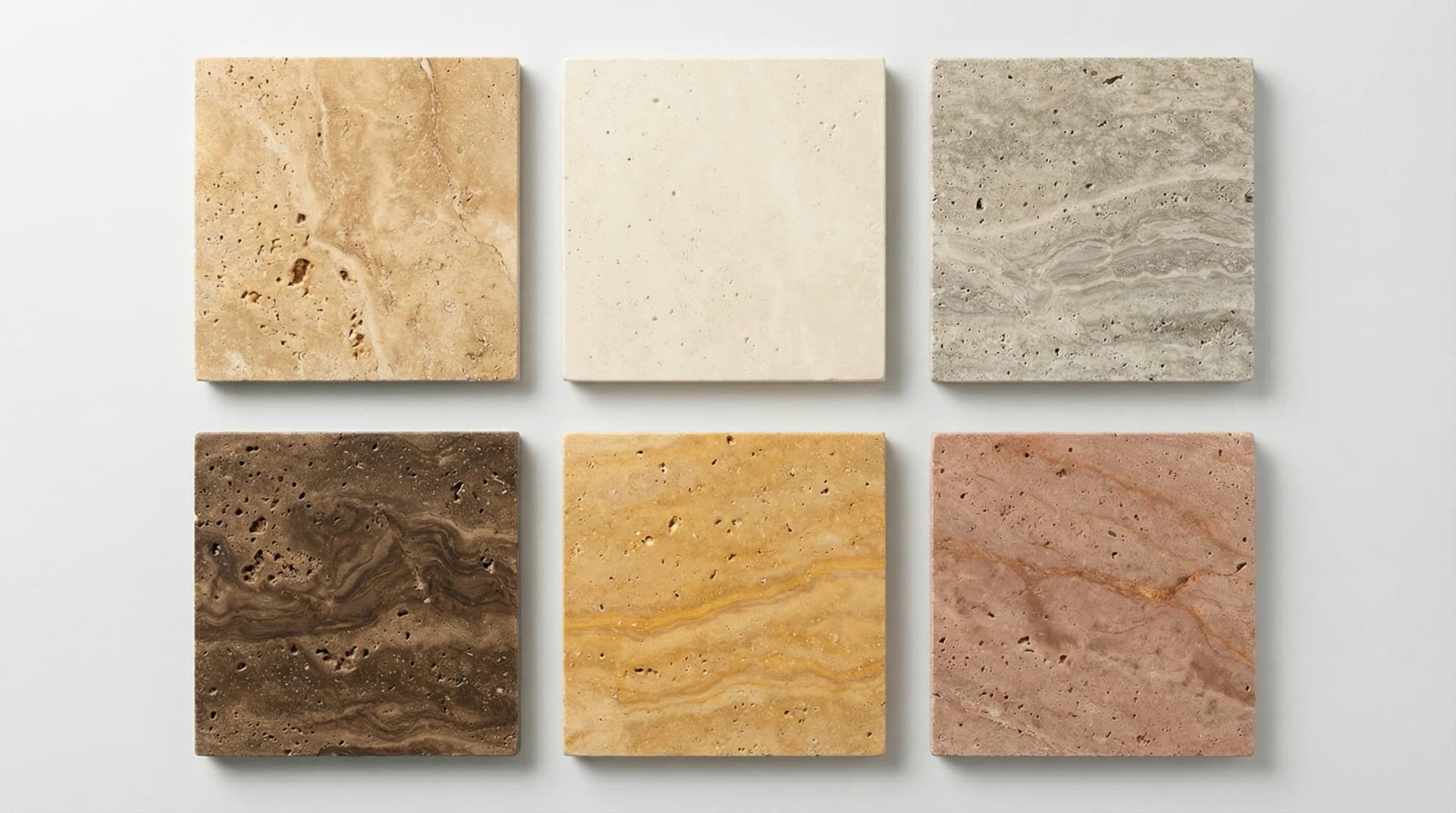
| Color Variety | Tone | Density (kg/m3) | Water Absorption | Best Applications | Availability |
|---|---|---|---|---|---|
| Classic (Ivory) | Warm cream / beige | 2,300-2,500 | 1.5-3% | All-purpose: floors, walls, facades, pools | Abundant |
| Light (White) | Cool cream | 2,400-2,600 | 1.2-2.5% | Modern interiors, bathrooms, contemporary design | Good |
| Silver | Grey with cool undertones | 2,400-2,550 | 1.5-2.8% | Contemporary facades, feature walls | Limited |
| Noce (Walnut) | Rich brown | 2,350-2,500 | 2-4% | Accents, warm interiors, borders | Good |
| Gold / Yellow | Warm gold / amber | 2,300-2,500 | 1.8-3.5% | Mediterranean projects, exterior paving | Good |
| Red | Rust-red / terra cotta | 2,300-2,450 | 2-4% | Accent features, specialty installations | Limited |
Values are typical ranges for Denizli-origin travertine. Exact properties vary by quarry block. Density tested per EN 1936; water absorption per EN 13755. Always request a test certificate for your specific production run.
Finish Specification
The surface finish you choose determines slip resistance, maintenance requirements, aesthetic character, and cost. Below is a comprehensive comparison of the eight primary travertine finishes available from Turkish producers.
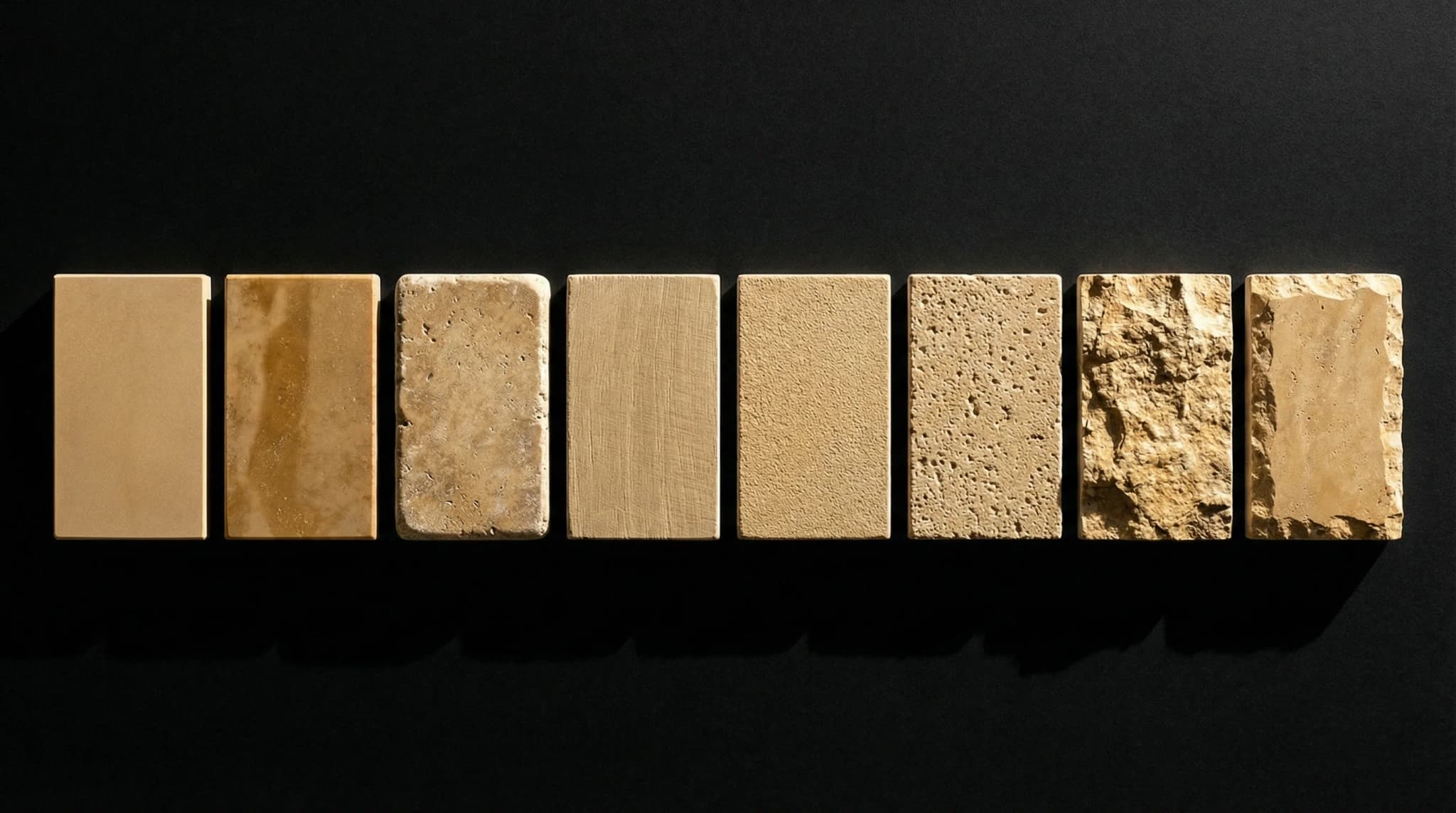
| Finish | Slip Resistance (SCOF) | Maintenance | Best For | Price vs. Honed |
|---|---|---|---|---|
| Honed | 0.45-0.65 | Seal 2x/year | Indoor floors, walls | Baseline |
| Polished | 0.35-0.50 | High - seal frequently | Walls, countertops, low-traffic | +20-30% |
| Tumbled | 0.75-0.95 | Seal 1-2x/year | Pool decks, patios, rustic interiors | -5-10% |
| Brushed | 0.70-0.90 | Low-Medium | Exterior floors, walkways | +10-15% |
| Sandblasted | 0.80-0.95 | Low - seal annually | Heavy-traffic exterior, facades | +15-25% |
| Bush-Hammered | 0.85-0.95+ | Low | Facades, driveways, steps | +25-40% |
| Split-Face | 0.90+ | Very low | Exterior cladding, feature walls | +20-30% |
| Filled & Honed | 0.45-0.65 | Seal 2x/year | Residential floors, uniform finish | +10-15% |
SCOF values measured per ASTM C1028 / EN 14231 pendulum test. Prices are indicative relative to honed baseline; actual pricing depends on volume, thickness, and project specifications. Contact us for a project-specific quotation.
Engineering Data
The following laboratory-tested values enable architects and engineers to specify travertine with confidence. All values are tested per the referenced EN and ASTM standards.
| Property | Value Range | Testing Standard |
|---|---|---|
| Density | 2,200-2,700 kg/m3 | EN 1936 / ASTM C97 |
| Compressive Strength | 50-120 MPa | EN 1926 / ASTM C170 |
| Flexural Strength | 8-15 MPa | EN 12372 / ASTM C880 |
| Water Absorption | 1.0-4.0% | EN 13755 / ASTM C97 |
| Thermal Conductivity | 1.5-2.2 W/m·K | EN 12524 |
| Mohs Hardness | 3-4 | Mineral property |
| Open Porosity | 2-12% | EN 1936 |
| Fire Classification | A1 (non-combustible) | EN 13501-1 |
Ranges represent typical values across Turkish travertine varieties. Classic/Ivory varieties tend toward the higher-density, lower-porosity end; Noce and Silver toward higher porosity. Always request a quarry-specific test certificate for structural applications.
Use Cases
From residential interiors to large-scale commercial projects, travertine adapts to virtually any architectural application. Below are the five primary use cases with specification guidance for each.
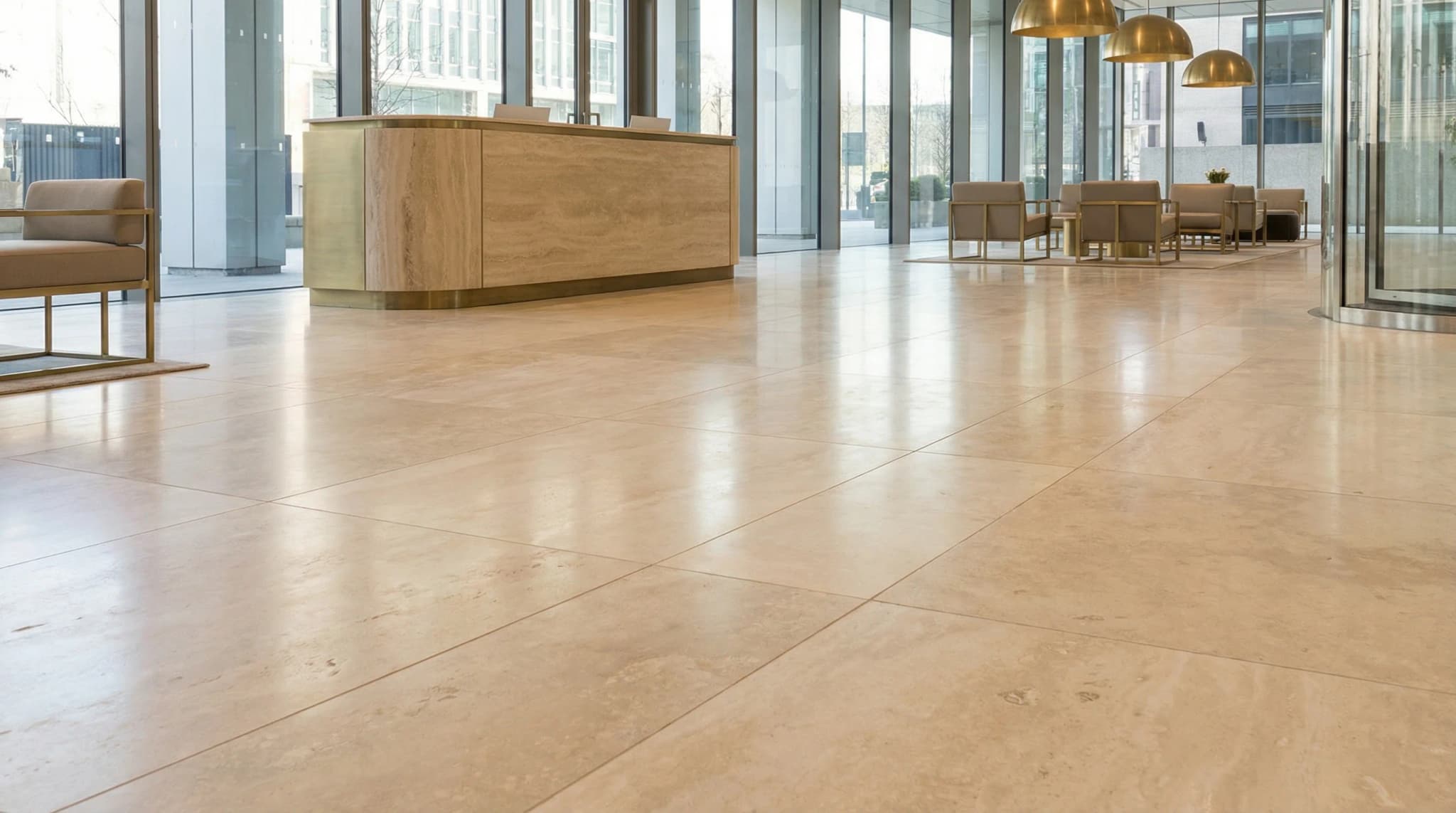
Travertine flooring is specified for both residential and commercial interiors at thicknesses of 10-20 mm for standard tiles (305x305 to 610x610 mm formats) and up to 30 mm for heavy commercial traffic. Honed or filled-and-honed finishes are standard for interior floors, delivering a smooth, elegant surface with manageable maintenance. For high-traffic commercial spaces, brushed finishes offer better wear resistance. French pattern (Versailles) layouts using four tile sizes create organic, non-repeating surfaces popular in Mediterranean and contemporary design. Expansion joints should be placed every 4.5-9 m per TCNA guidelines.
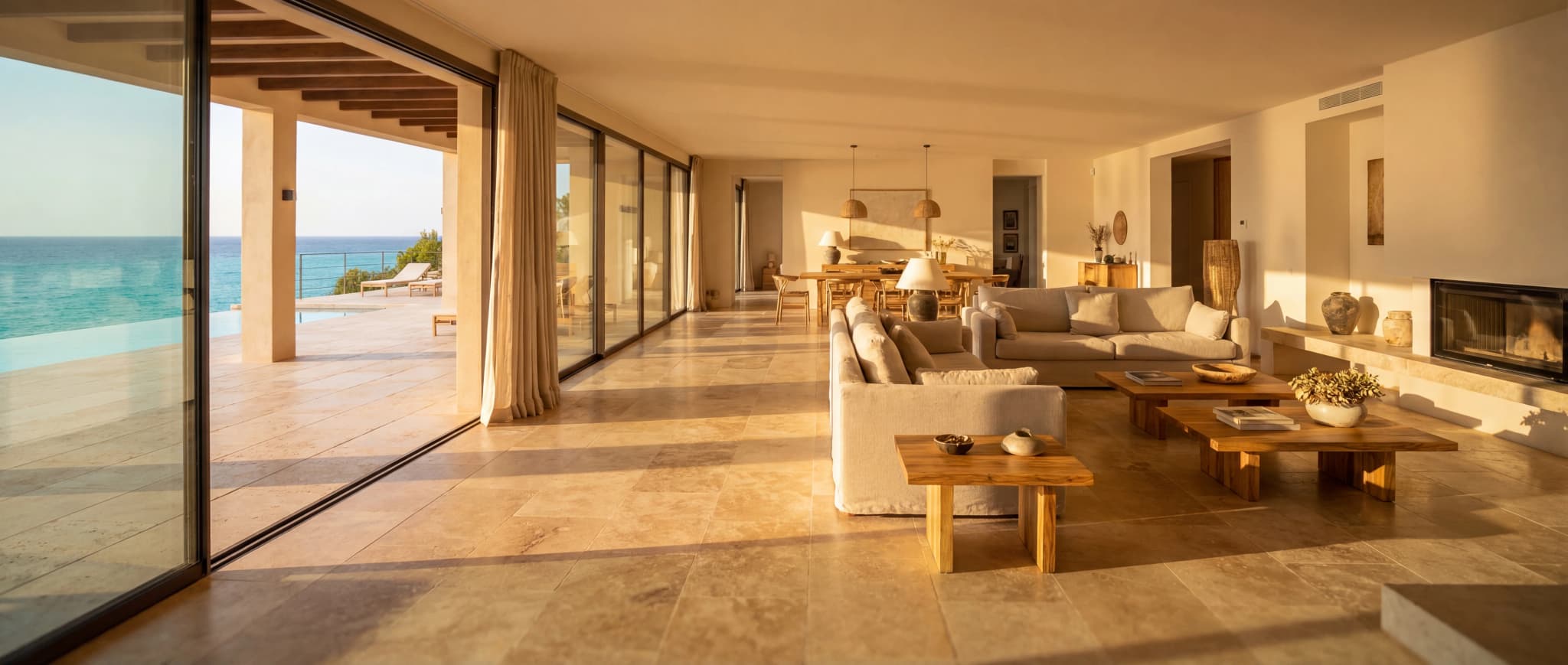
Travertine is the premier natural stone for pool environments because it stays 10-20 degrees C cooler than porcelain or concrete alternatives in direct sunlight. Tumbled travertine achieves wet slip resistance (SCOF) of 0.75-0.95, well above the 0.60 safety threshold required by most building codes. Standard pool deck pavers are 30 mm thick; freeze-thaw zones require 40-50 mm. For comprehensive pool specification guidance, see our dedicated travertine pool deck guide.
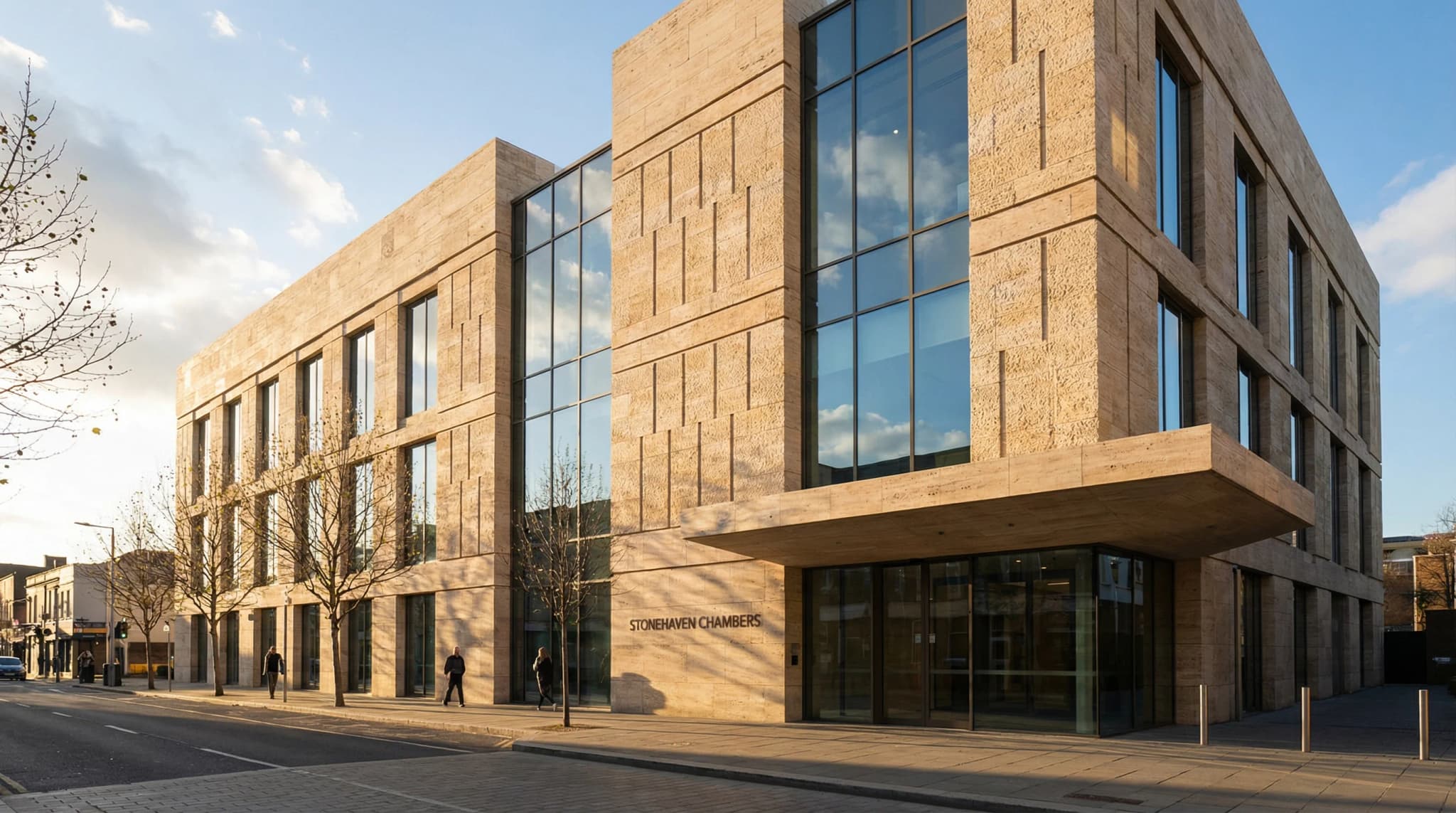
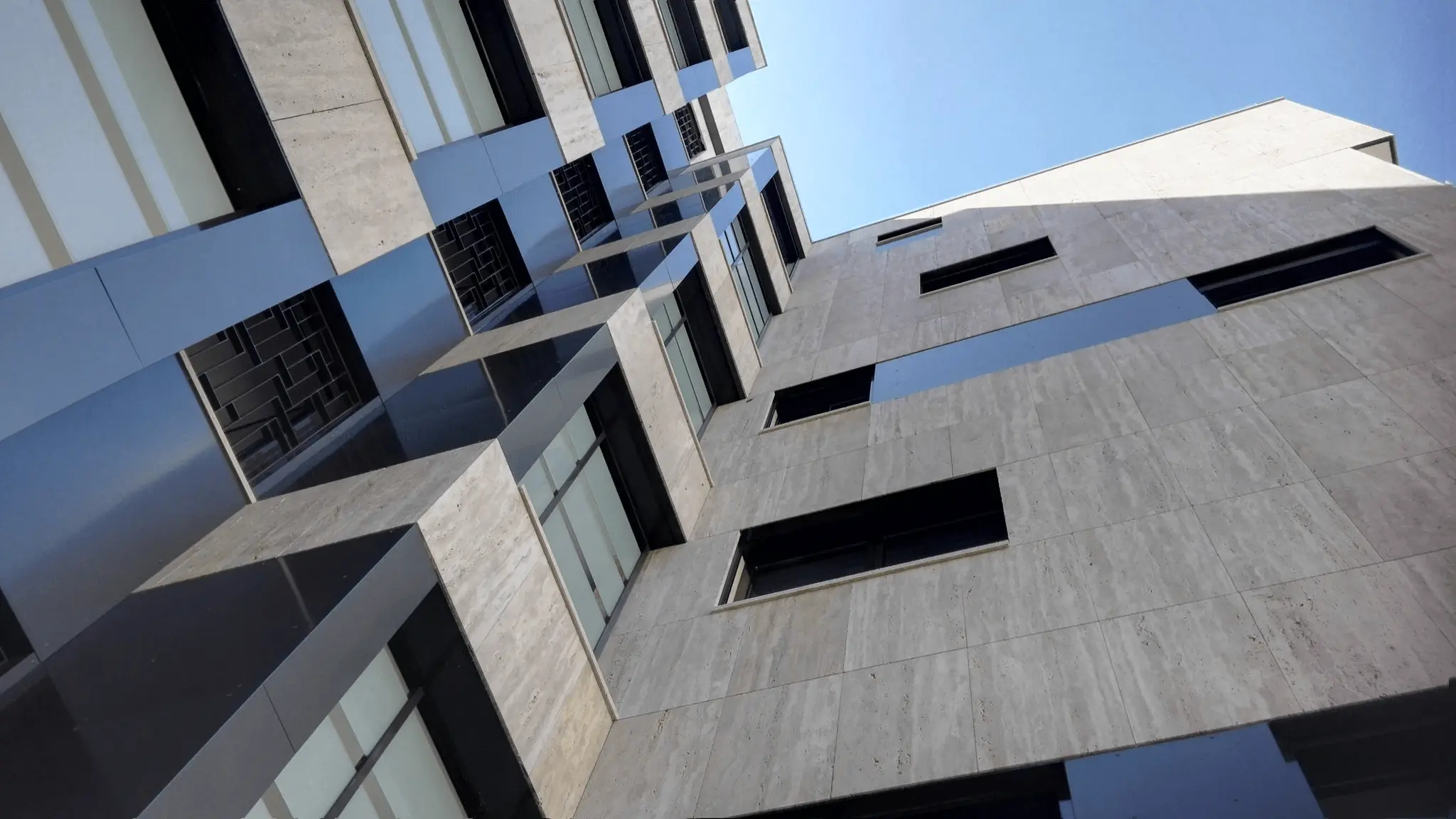
Travertine facade panels (20-40 mm thick, approximately 48-78 kg/m2) provide excellent thermal insulation at 1.5-2.2 W/m·K, superior to marble's 2.8-3.2 W/m·K. Anchoring systems include undercut, dowel, and kerf types per EN 1469 requirements. Flexural strength of 8-15 MPa (EN 12372) ensures structural integrity under wind loads. Bush-hammered and split-face finishes are popular for exterior applications due to weather resistance and textural depth. See our natural stone facades guide for detailed system specifications.
Travertine countertops at 20-30 mm thickness offer a warm, natural alternative to engineered surfaces. Filled-and-honed or polished finishes are standard for countertop applications. Sealing with a food-safe impregnating sealer is essential, as the stone's porosity makes it vulnerable to oil and acid staining without protection. Both travertine and marble are CaCO3-based and sensitive to citrus and acidic substances, so buyers should weigh this for kitchen installations. Bathroom vanities and surrounds are an excellent application where acid exposure is minimal.
Interior wall applications use thinner panels (10-15 mm) installed with thin-set adhesive per TCNA standards or mechanical fixing for heavier panels. Split-face travertine creates dramatic texture walls in lobbies, restaurants, and residential living spaces. Honed and polished finishes deliver clean, contemporary wall surfaces. The growing biophilic design movement has increased demand for natural stone feature walls, with travertine's organic texture and warm tones aligning perfectly with this trend. Browse our collection to explore available varieties for wall applications.
Get factory-direct pricing with all colors, finishes, and custom cutting available from our Denizli quarries.
Material Comparison
How does travertine stack up against the other major natural stone and engineered options? This data-driven comparison covers the metrics that matter most for specification decisions. For a detailed head-to-head analysis, see our travertine vs marble comparison.
| Material | Mohs Hardness | Water Absorption | Expected Lifespan | Price Installed (/m2) | Best Application |
|---|---|---|---|---|---|
| Travertine | 3-4 | 1-4% | 50-100+ years | $40-150 | Versatile: floors, pools, facades |
| Marble | 3-5 | 0.1-0.5% | 50-100+ years | $60-300 | Luxury indoor surfaces |
| Limestone | 3-4 | 1-12% | 40-80 years | $30-120 | Rustic exteriors, landscaping |
| Granite | 6-7 | 0.1-0.4% | 100+ years | $50-200 | High-traffic, countertops |
| Porcelain (Engineered) | 7-8 | <0.5% | 40-60 years | $20-80 | Budget-conscious, low maintenance |
Prices represent typical installed costs including material and labor (2024-2025 market rates). Exact pricing varies by region, project scale, and finish. Turkish-origin travertine direct from Marmol Turco can reduce material costs by 20-40% vs. local distributors.
Procurement Guide
Whether you are an architect specifying for a project or a builder sourcing directly, understanding the Turkish stone procurement process helps you get better pricing, consistent quality, and on-time delivery. For a comprehensive logistics guide, see our Turkish stone import and shipping guide.
A 20-foot container holds approximately 18 tonnes (~300 m2 of 20 mm tiles); a 40-foot container holds ~26 tonnes (~500 m2). Stone is loaded in wooden crates requiring ISPM 15 fumigation certificates. Lead times typically run 3-6 weeks from quarry to port (extraction, processing, quality control) plus 2-4 weeks sea freight depending on destination. Key Turkish export ports include Izmir (closest to Denizli), Mersin, and Antalya.
Standard payment terms are T/T (telegraphic transfer) with a typical 30% deposit and 70% balance before shipment. Letters of Credit (L/C) are common for first orders or large volumes. Established relationships may qualify for trade credit. All transactions are typically denominated in USD or EUR. Marmol Turco offers flexible payment structures tailored to project requirements and scale.
Always request CE marking documentation (mandatory for EU import under CPR 305/2011), EN test certificates for properties relevant to your application (EN 1936 for density, EN 1926 for compressive strength, EN 12372 for flexural strength, EN 13755 for water absorption), and TSE (Turkish Standards Institute) certification. Verify that certificates match your specific quarry block and production run, not generic company-wide documents.
From initial inquiry to delivery: sample request and approval (1-2 weeks), quotation and order confirmation (1 week), production and quality control (3-6 weeks), sea freight shipping (2-4 weeks). Total typical lead time: 7-13 weeks. For urgent projects, stock items may ship within 2-3 weeks. Marmol Turco provides dedicated project management with real-time tracking from quarry to job site.
Care & Longevity
Travertine is low-maintenance compared to many natural stones, but a simple care routine dramatically extends its appearance and structural lifespan. The investment in proper maintenance is minimal relative to the stone's value and longevity.
Apply a penetrating silane-siloxane sealer after installation and re-apply on a schedule based on application: indoor floors every 1-2 years, outdoor paving annually, and pool decks twice per year. Penetrating sealers protect from within without altering the stone's natural appearance or creating a slippery surface film. Avoid topical sealers (acrylic, polyurethane) in wet areas, as they peel, yellow, and reduce slip resistance over time.
Use pH-neutral stone cleaners diluted per manufacturer instructions. Never use acidic cleaners (vinegar, citrus-based products, muriatic acid) on travertine, as they etch the calcium carbonate surface. Weekly hosing with clean water removes most exterior debris. For interior floors, dust-mopping followed by damp-mopping with a pH-neutral cleaner is sufficient. A pressure washer set below 1,500 psi with a wide fan nozzle is safe for annual deep cleaning of exterior installations.
For oil-based stains, apply a poultice of baking soda and acetone, cover with plastic wrap, and leave for 24-48 hours. For organic stains (coffee, wine, tea), use hydrogen peroxide in a similar poultice. Rust stains require a commercial rust remover formulated for natural stone. Over decades, travertine develops a natural patina that adds character. If desired, the stone can be professionally re-honed to restore its original appearance. With proper sealing and cleaning, a travertine installation lasts 50-100+ years.
Our stone specialists can recommend the ideal color, finish, and thickness for your specific project requirements.
Common Questions
Answers to the most common questions about travertine, drawn from 20+ years of industry experience and EN/ASTM testing data.
Our Collection
Each stone is sourced directly from Denizli quarries with full EN test documentation. Click to explore finishes, specifications, and request pricing.
Marmol Turco offers direct quarry sourcing from Denizli for all travertine colors, finishes, and custom cutting. Browse our collection or request free samples and a project quotation.
Most orders ship within 3-6 weeks from our Denizli facility. Free samples available worldwide.
Project enquiry
Share the material, format, quantity, destination, and timing.
What helps us answer accurately
Stone · Format and finish · Quantity · Destination city or port
You can expect a reply within
One business day
Need a quick answer? Ask Selim in the chat.
