
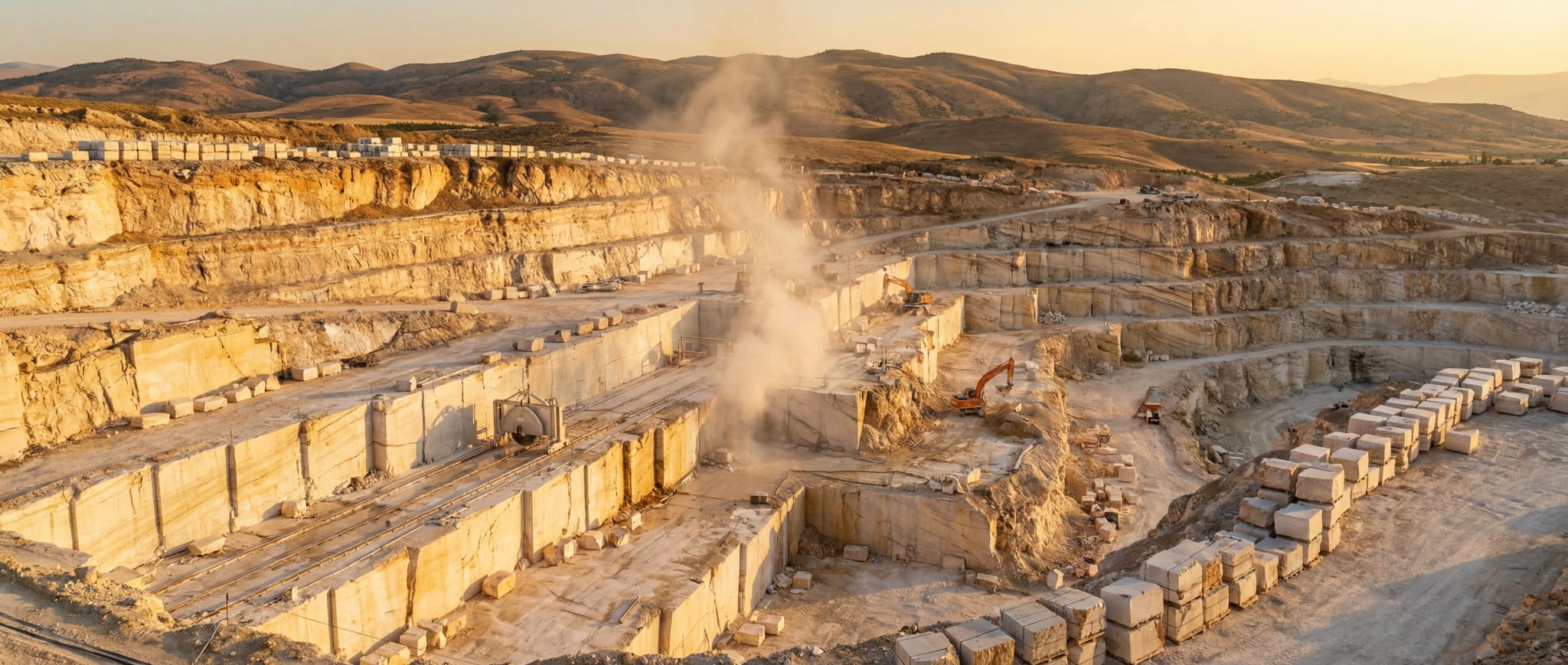
Turkey is the world's 2nd-largest natural stone exporter, shipping $1.43 billion of marble, travertine, and limestone to 180+ countries. This guide covers quarry regions, stone types, quality standards, import logistics, and direct sourcing — everything B2B buyers need.
#3
Global Stone Exporter
$1.4B+
Annual Exports
180+
Countries Served
30-50%
vs. Italian Pricing
Last updated: · Reviewed by Sezai Suda
Quick Answer
Turkey is the world's 2nd-largest natural stone exporter, shipping over $1.4 billion worth of marble, travertine, and limestone to 180+ countries annually. The Denizli region alone holds roughly 50% of global travertine reserves. Turkish stone offers 30–50% cost savings over Italian equivalents at comparable quality, with full CE marking and EN certification. Go2Stone provides direct quarry sourcing from Turkey's premier stone regions with full logistics support.
Industry Overview
From ancient quarries that built Hagia Sophia and Ephesus to modern CNC processing facilities, Turkey's stone industry combines millennia of tradition with cutting-edge technology. Today it ranks among the world's top three natural stone exporters.
Turkey exported $1.43 billion of natural stone in the first nine months of 2024, with the United States ($319.8M, +10.8%), China ($289M), India ($103M), and Saudi Arabia ($84.5M) as top destinations. Processed marble accounts for $667 million, while processed travertine shows the strongest growth at $231.1 million (+11.8% year-over-year). The average export price rose 3.9% to $319.06 per tonne.
The industry operates across 1,500+ quarries concentrated in western Anatolia, with over 2,000 processing facilities nationwide. Key trade bodies include TIM (Turkish Exporters Assembly), ISTIB (Istanbul Mineral Exporters Association), and IMIB, which organises international trade events and tracks monthly export data. Turkey's stone exports to Europe grew 15.46% in 2024, with North America up 10.27% and Africa up 12.23%.
Quarry Origins
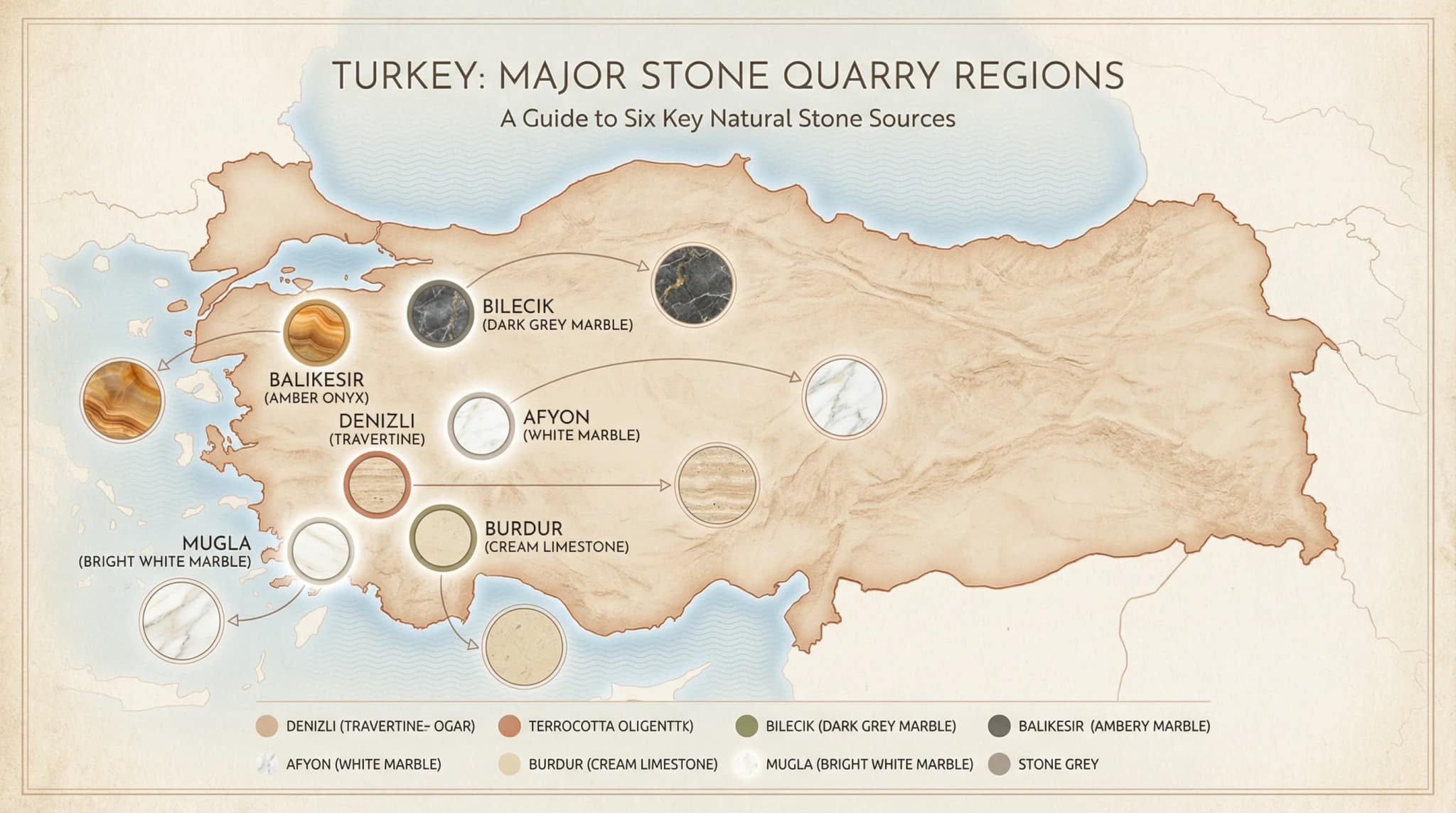
Over 90% of Turkey's stone quarries are concentrated in western Anatolia. Each region produces distinctive stone types with unique geological characteristics, colour palettes, and commercial applications.
Home to roughly 50% of the world's premium travertine reserves, Denizli produces Classic, Silver, Noce, and Gold varieties from geothermal hot spring deposits. The region's quarries supply the global pool, flooring, and facade markets, with direct port access via Izmir for efficient container loading.
Afyonkarahisar produces Turkey's finest white marbles — Afyon White, Afyon Sugar, and Afyon Lilac — from crystalline metamorphic limestone. Known for exceptional whiteness, low porosity, and high polishability, Afyon marble is the material of choice for luxury interiors and high-end architectural projects.
Burdur specialises in beige-cream travertines and limestones, with Burdur Beige as its flagship product. Dense lacustrine deposits yield stone with natural fissures ideal for rustic finishes and strong weather resistance. Processing facilities and proximity to Antalya port support large-volume Mediterranean exports.
Mugla produces Milas White (Lilac), Mugla White, and Rosa Mugla from Paleozoic-Mesozoic metamorphic formations. These fine-grained marbles achieve exceptional gloss after polishing, making them favourites for sculpture, countertops, and high-end interior cladding.
In the Marmara Region, Bilecik produces Bilecik Beige, Bilecik Grey, and specialty limestones. The crystalline marble shows uniform texture and strong frost resistance, making it ideal for exterior facades and landscape applications. Access to Gemlik and Istanbul ports provides efficient logistics.
Balikesir's quarries produce Cloudite White, Balikesir Beige, and light grey marbles with distinctive cloudy veining patterns. The Alpine metamorphic formations yield highly durable stone suitable for large-format slabs and tiles. Nearby Bandirma and Gemlik ports serve as key export hubs.
Product Range
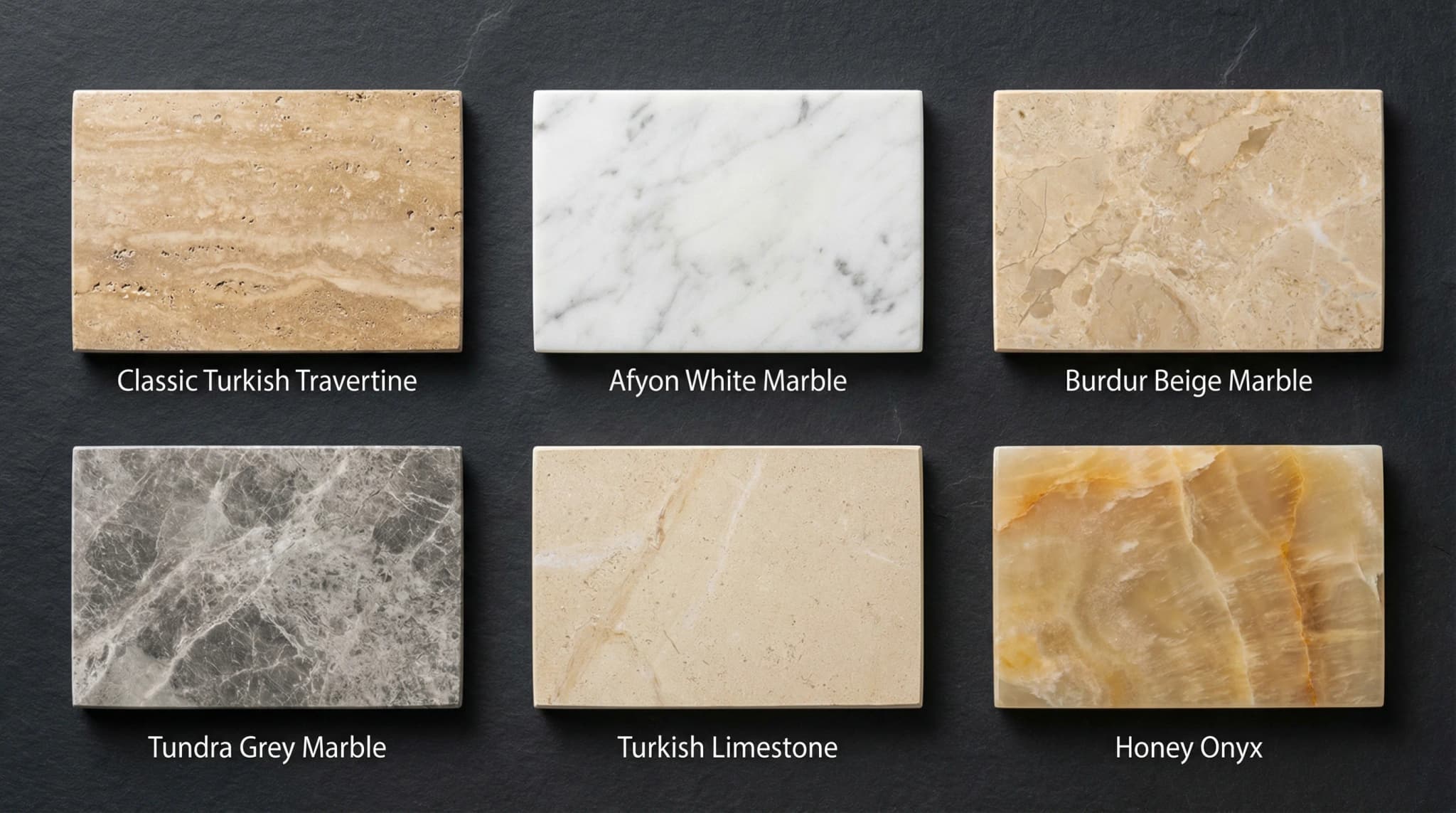
Turkey produces a diverse range of natural stones across its quarry regions. The table below summarises the major types, their commercial varieties, pricing, and primary applications — helping buyers match the right stone to their project requirements. Browse our full collection for detailed specifications.
| Stone Type | Key Varieties | Primary Region | FOB Price ($/t) | Main Applications |
|---|---|---|---|---|
| Travertine | Classic, Silver, Noce, Gold | Denizli | $150–400 | Floors, pools, facades |
| White Marble | Afyon White, Mugla White, Milas Lilac | Afyon, Mugla | $200–600 | Luxury interiors, facades |
| Beige / Cream Marble | Burdur Beige, Cappuccino | Burdur, Denizli | $150–350 | Floors, walls, commercial |
| Dark Marble | Tundra Grey, Emperador | Bilecik, Balikesir | $250–700 | Accents, luxury interiors |
| Limestone | Various regional | Multiple | $100–300 | Exterior, landscaping |
| Onyx | Honey, Green | Balikesir, Eskisehir | $500–2,000 | Feature walls, backlighting |
FOB prices are indicative based on 2024 average export data. Actual pricing varies by finish, thickness, quantity, and market conditions. Contact us for project-specific quotations.
Get factory-direct pricing with full CE certification and logistics support.
Competitive Advantage
Turkey's combination of geological abundance, modern processing infrastructure, strategic location, and competitive pricing makes it the world's most compelling origin for natural stone sourcing.
Turkey's average stone export price is $319/tonne compared to Italy's $1,096/tonne — a 70% price difference at the FOB level. Even factoring in comparable quality grades and finishes, Turkish stone consistently delivers 30–50% savings. This margin allows projects to upgrade material specifications or increase coverage area without exceeding budget.
With 1,500+ active quarries and 2,000+ processing facilities, Turkey offers a depth of inventory that few countries can match. Whether you need 500 m² of Classic Travertine tiles or 5,000 m² of white marble slabs for a commercial facade, Turkish suppliers can fulfil orders from stock or production within standard lead times.
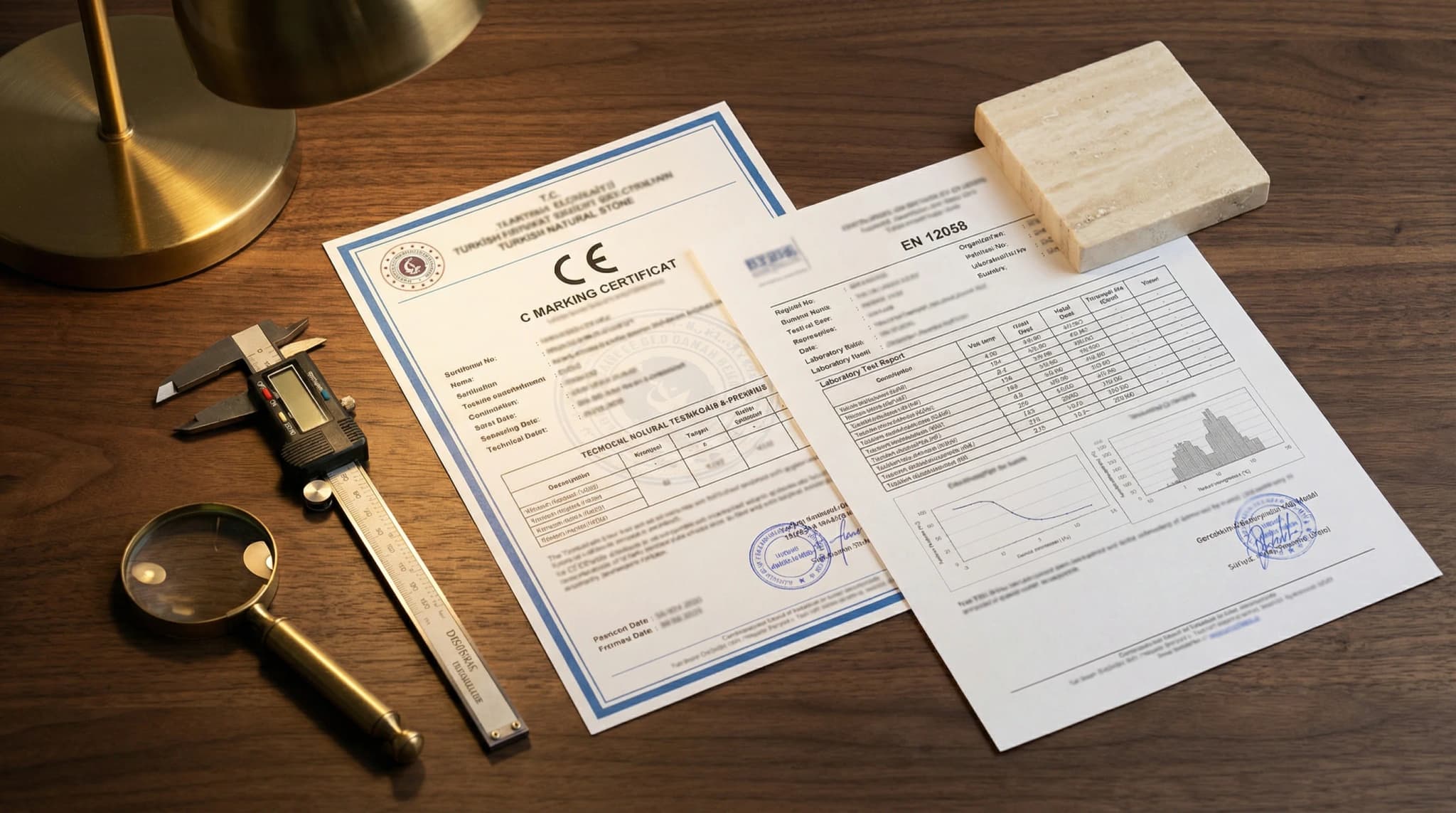
Turkish stone exporters operate under CPR 305/2011 with full CE marking for EU markets. EN testing (EN 1936 density, EN 1926 compressive, EN 12372 flexural, EN 13755 absorption) is standard for export-grade stone. TSE (Turkish Standards Institute) provides additional oversight, and ISO 9001/14001 certifications are common among leading producers.
Turkey sits at the crossroads of Europe, Asia, and the Middle East. Sea freight from major ports (Izmir, Mersin, Antalya, Gemlik) reaches EU ports in 15–25 days, US East Coast in 30–40 days, and Middle Eastern destinations in 10–20 days. This geographic advantage reduces transit times and shipping costs compared to Asian origins.
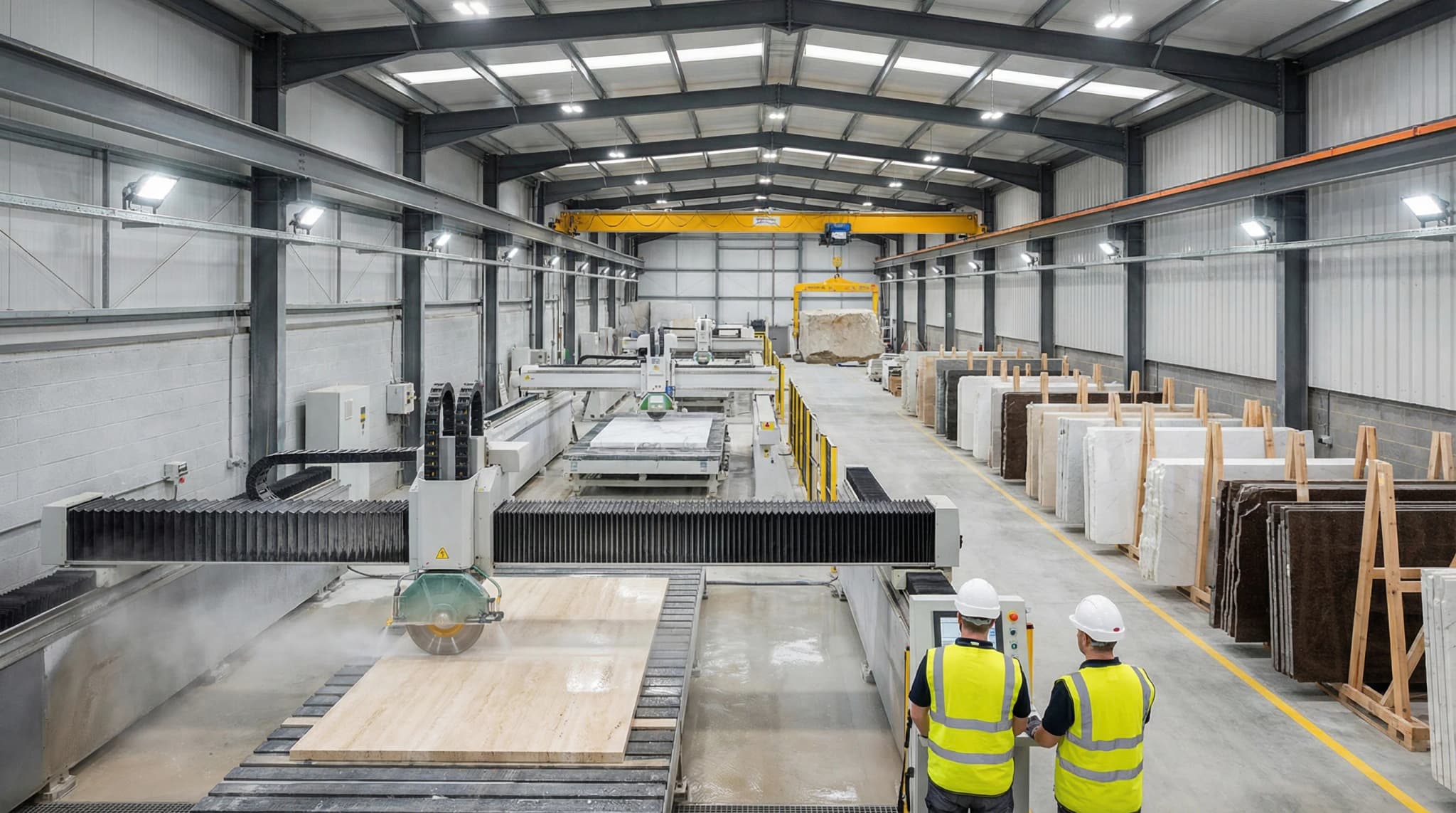
Turkish stone facilities feature CNC cutting, automated calibration lines, and precision finishing equipment capable of producing tiles, slabs, cut-to-size pieces, and custom profiles to international tolerances. Honed, polished, tumbled, brushed, and sandblasted finishes are all available at factory level.
Turkish stone has been used in construction for over 2,000 years — from the travertine of Hierapolis to the marble of Ephesus and Hagia Sophia. Today, Turkish stone features in modern landmarks, luxury hotels, and commercial developments across 180+ countries, attesting to both its beauty and structural longevity.
European EN standards, CE marking, and Turkish TSE certification ensure that exported stone meets rigorous performance requirements.
CE marking under CPR 305/2011 is mandatory for all natural stone construction products entering the EU market. It certifies compliance with declared performance characteristics based on harmonised EN standards. Buyers should request a Declaration of Performance (DoP) and verify third-party test reports from accredited laboratories.
| Standard | Scope | Key Tests / Values |
|---|---|---|
| EN 1469 | Natural stone cladding slabs | Flexural strength >= 6–10 MPa; water absorption <= 0.5–5% |
| EN 12057 | Modular tiles (walls/floors) | Flexural >= 8 MPa; absorption <= 0.4%; tolerance +/-0.5–1 mm |
| EN 12058 | Slabs for floors & stairs | Flexural >= 7–12 MPa; thickness +/-2 mm; R-value >= 36 |
| EN 1341 | External paving slabs | Flexural >= 10 MPa; absorption <= 5%; 25 freeze-thaw cycles |
| EN 1936 | Density & porosity | Apparent density >= 2.5–2.8 g/cm3; porosity <= 2–5% |
| EN 12372 | Flexural strength (bending) | Mean >= 10–20 MPa; min individual >= 8 MPa |
| EN 13755 | Water absorption | <= 0.5% (interior marble) to <= 5% (exterior limestone) |
| EN 14231 | Slip resistance (SRV) | SRV >= 36 (low slip); R10–R12 for ramps |
Importing stone from Turkey follows a structured process. These six steps cover supplier selection through customs clearance. For a comprehensive walkthrough, see our complete import and shipping guide.
Attend trade shows (Marble Izmir, Verona Stone+Tec), search online B2B platforms, or work with an established importer like Go2Stone. Look for suppliers with multiple quarries, export references, EN/CE certifications, and ISO 9001 quality management. Request a factory audit or virtual quarry tour before committing.
Always request physical samples before placing an order — photos alone cannot capture colour variation, surface texture, or finish quality. Specify exact requirements: stone type, finish, dimensions, thickness, calibration tolerances, and quantity. Samples typically arrive within 2–4 weeks. Compare multiple suppliers on price, lead time, and sample quality.
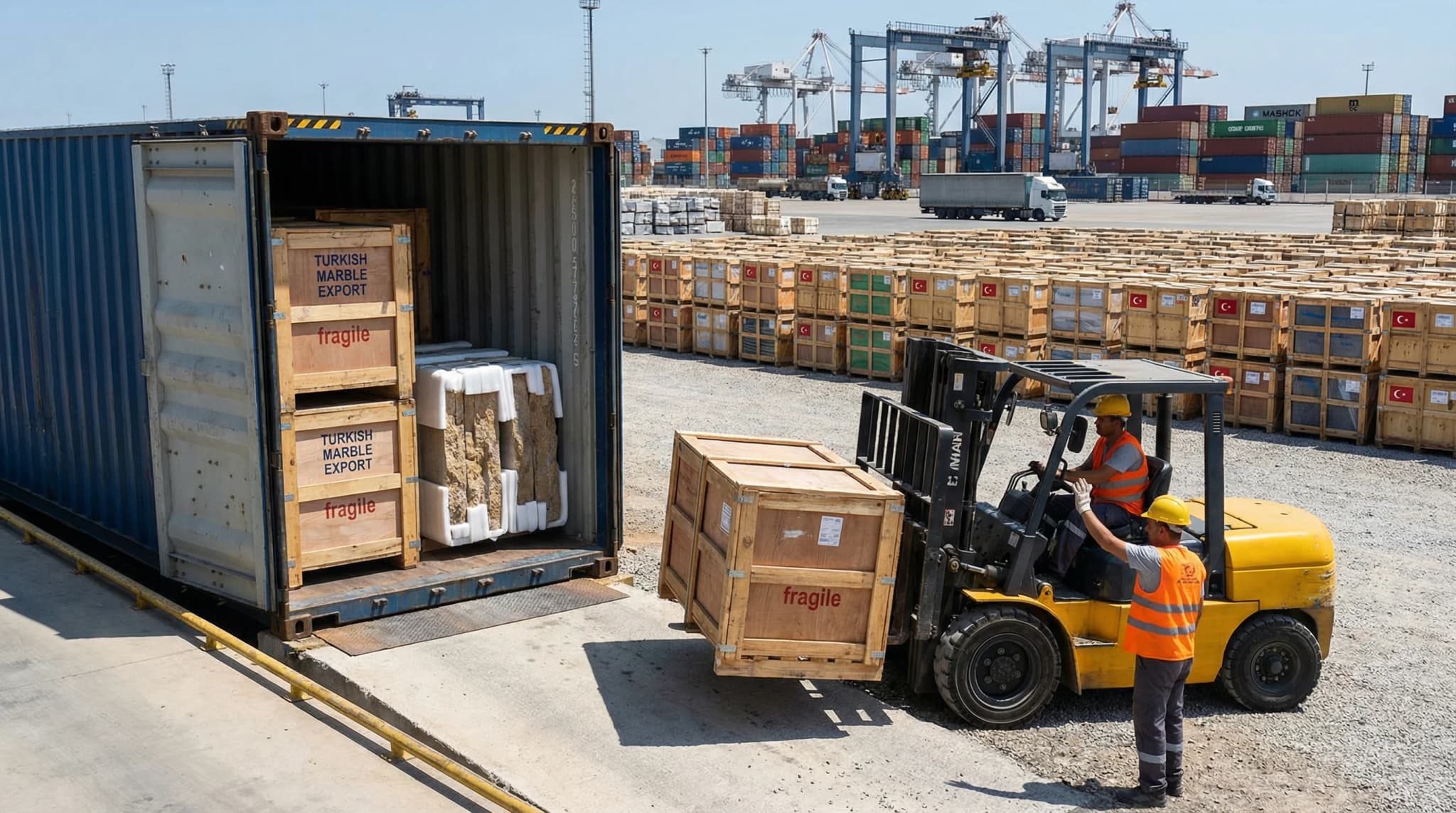
Standard loading: 20ft containers hold ~18 tonnes (~300 m2 of 2 cm tiles), 40ft containers hold ~26 tonnes (~500 m2). Stone is packed in wooden crates with internal bracing. Slabs ship in A-frame bundles. All wooden packaging must comply with ISPM 15 (fumigation/heat treatment). Request loading photos before dispatch.
Major Turkish export ports include Izmir, Mersin, Antalya, and Gemlik. Sea freight times: EU major ports 15–25 days, US East Coast 30–40 days, US West Coast 35–45 days, Middle East 10–20 days. Total order-to-delivery time is typically 8–12 weeks including production, quality inspection, and transit.
First orders typically use Letter of Credit (L/C) or a 30/70 T/T split (30% deposit, 70% against pre-shipment inspection). Established relationships move to 50/50 T/T or D/P (Documents Against Payment) terms. Pricing is usually quoted in USD or EUR. Factor in currency fluctuation risk for TRY-denominated costs.
Essential documents: commercial invoice, packing list, certificate of origin, bill of lading (B/L), CE Declaration of Performance, and ISPM 15 fumigation certificate. HS codes fall under 6802.xx series (6802.10 for travertine, 6802.21 for marble slabs). Work with a licensed customs broker familiar with stone imports in your destination market.
Attend trade shows (Marble Izmir, Verona Stone+Tec), search online B2B platforms, or work with an established importer like Go2Stone. Look for suppliers with multiple quarries, export references, EN/CE certifications, and ISO 9001 quality management. Request a factory audit or virtual quarry tour before committing.
Always request physical samples before placing an order — photos alone cannot capture colour variation, surface texture, or finish quality. Specify exact requirements: stone type, finish, dimensions, thickness, calibration tolerances, and quantity. Samples typically arrive within 2–4 weeks. Compare multiple suppliers on price, lead time, and sample quality.
Standard loading: 20ft containers hold ~18 tonnes (~300 m2 of 2 cm tiles), 40ft containers hold ~26 tonnes (~500 m2). Stone is packed in wooden crates with internal bracing. Slabs ship in A-frame bundles. All wooden packaging must comply with ISPM 15 (fumigation/heat treatment). Request loading photos before dispatch.
Major Turkish export ports include Izmir, Mersin, Antalya, and Gemlik. Sea freight times: EU major ports 15–25 days, US East Coast 30–40 days, US West Coast 35–45 days, Middle East 10–20 days. Total order-to-delivery time is typically 8–12 weeks including production, quality inspection, and transit.
First orders typically use Letter of Credit (L/C) or a 30/70 T/T split (30% deposit, 70% against pre-shipment inspection). Established relationships move to 50/50 T/T or D/P (Documents Against Payment) terms. Pricing is usually quoted in USD or EUR. Factor in currency fluctuation risk for TRY-denominated costs.
Essential documents: commercial invoice, packing list, certificate of origin, bill of lading (B/L), CE Declaration of Performance, and ISPM 15 fumigation certificate. HS codes fall under 6802.xx series (6802.10 for travertine, 6802.21 for marble slabs). Work with a licensed customs broker familiar with stone imports in your destination market.
After 20+ years of exporting Turkish stone, these are the eight most costly mistakes we see buyers make — and how to avoid them.
Natural stone varies significantly between blocks. Always request and evaluate physical samples before committing to a production order. Match samples against your design intent under the project's actual lighting conditions.
Without explicit dimensional tolerances (e.g., +/-0.5 mm for tiles, +/-1 mm for slabs), you risk receiving material that doesn't fit your installation pattern. Include tolerances in your purchase order and verify during pre-shipment inspection.
The cheapest quote often means lower grade stone, inconsistent colour matching, or poor calibration. Quality variation between Turkish suppliers is real. Always compare price alongside sample quality, test certificates, and export track record.
Once stone is loaded into a container and shipped, returns are impractical. A third-party pre-shipment inspection verifies dimensions, finish quality, colour consistency, and packaging integrity before the container is sealed.
Breakage during transit is the single most common claim in stone imports. Insist on ISPM 15-compliant wooden crates, internal foam padding, proper A-frame loading for slabs, and corner protectors. Request loading photographs as evidence.
Stone is heavy — 2.5 to 2.8 tonnes per cubic metre. Freight costs are weight-based, so underestimating volume leads to budget overruns. Calculate total shipped weight accurately and get binding freight quotes before confirming the order.
Natural stone cutting yields variable output. Wastage during installation (cuts, breakage, fitting) adds up. Order 5–10% more material than the measured area to avoid costly supplementary orders that may not colour-match the original batch.
Stone from different quarry faces or blocks can vary in colour, veining, and density even within the same quarry. Specify block traceability and request that production orders are cut from the same batch of blocks for visual consistency.
Our team has 20+ years of experience managing stone imports from quarry to job site.
Common Questions
Answers to the most common questions about sourcing, importing, and using Turkish natural stone.
Our Collection
Sourced directly from Turkey's premier quarry regions. Each stone comes with full technical specifications, EN test data, and CE certification.
Go2Stone offers direct quarry access across Denizli, Afyon, Burdur, and Mugla — with full quality control, CE certification, and logistics support. Request a catalog and project quote.
Free samples shipped worldwide. Most production orders deliver within 8–12 weeks.
Project enquiry
Share the material, format, quantity, destination, and timing.
What helps us answer accurately
Stone · Format and finish · Quantity · Destination city or port
You can expect a reply within
One business day
Need a quick answer? Ask Selim in the chat.
