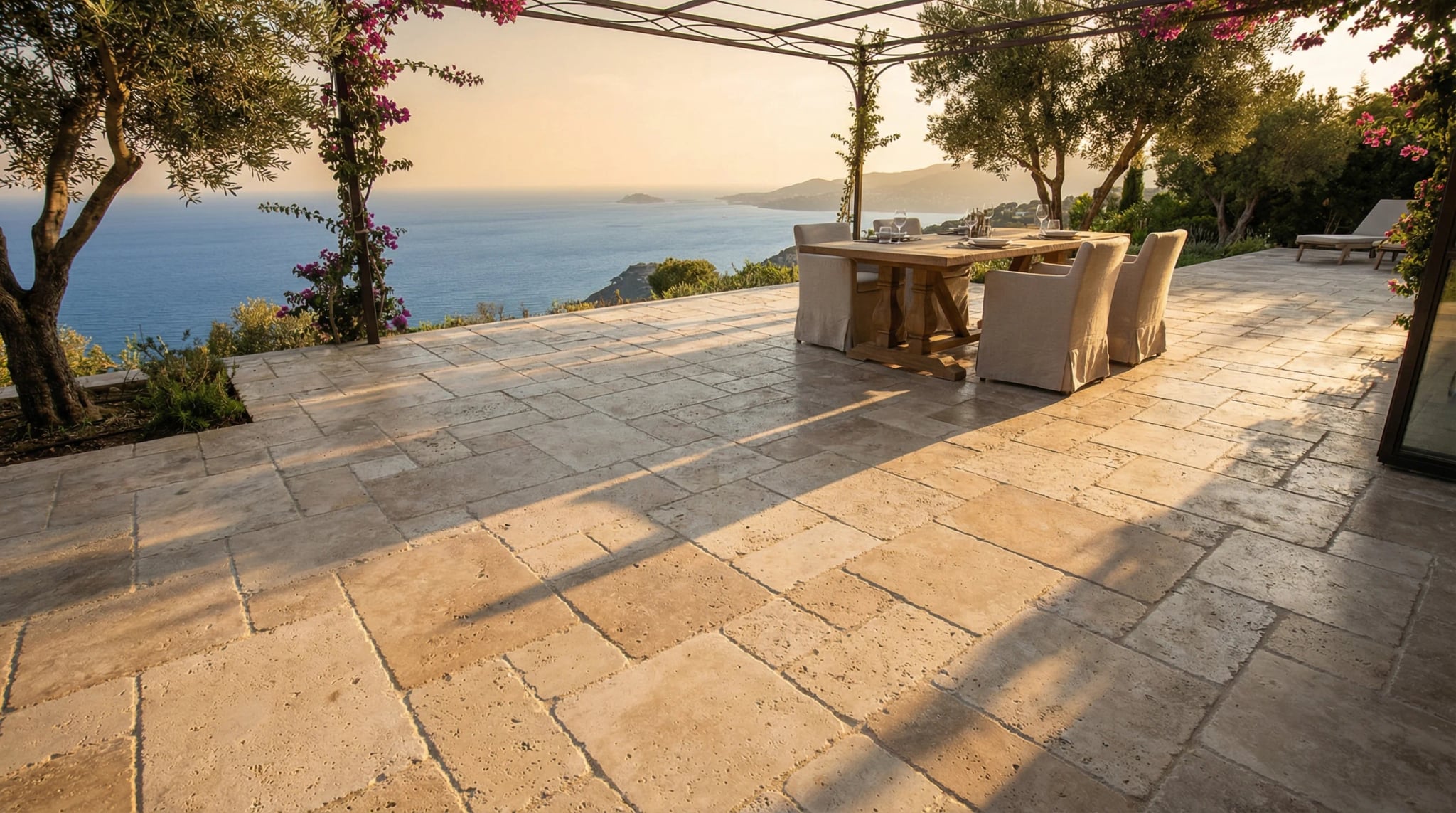
Naturally cool, slip-resistant, and built to last decades. Turkish travertine pavers are the preferred choice of architects and builders for pool decks, patios, and driveways worldwide.
20+
Years Experience
40+
Countries Served
500K+
m2 Delivered
100%
Direct from Turkey
Last updated: · Reviewed by Sezai Suda
Quick Facts
Key Advantages
Travertine is not just beautiful — it outperforms concrete, porcelain, and brick pavers on the metrics that matter most for outdoor applications. Here is the data behind the reputation.
Travertine's natural porosity creates micro air pockets that insulate the stone, reducing thermal conductivity to 1.5-2.2 W/mK compared to concrete's 1.7-2.5 W/mK. In direct summer sunlight, travertine surfaces measure 35-45°C (95-113°F) while concrete reaches 55-65°C (131-149°F). This makes travertine the safest and most comfortable paving choice for pool decks, patios, and any barefoot area.
Tumbled and brushed travertine finishes achieve a wet static coefficient of friction (SCOF) of 0.75-0.95, well above the 0.60 safety threshold set by ADA guidelines and EN 14231. The natural pores and textured surface create micro-drainage channels that disperse water on contact. Unlike polished porcelain or smooth concrete, travertine becomes safer when wet, not more dangerous.
Turkish travertine pavers with a density of 2,300-2,500 kg/m3 withstand 300+ freeze-thaw cycles without structural degradation when properly sealed (tested to EN 12371). The stone's porosity allows trapped moisture to expand and contract without building destructive pressure. This makes travertine pavers suitable for cold climates where concrete and brick often crack after 10-15 years.
Every travertine paver is unique — formed over millennia by thermal springs in the Denizli basin of Turkey. The natural colour palette ranges from warm ivory and cream (Light Travertine) through rich beige (Classic Travertine) to contemporary grey-silver (Silver Travertine) and deep walnut (Noce Travertine). Unlike manufactured pavers, travertine develops a beautiful patina over time.
Travertine pavers are available in multiple sizes and thicknesses that can be combined into French Pattern (Versailles), running bond, herringbone, and stack bond layouts. They work equally well for pool decks, patios, garden paths, driveways, and exterior cladding. Browse our full travertine collection to see the range.
Turkey produces over 40% of the world's travertine, with the Denizli basin hosting the largest and highest-quality reserves. By sourcing direct from Turkish quarries through Go2Stone, you eliminate distributor markups and access factory pricing. Our import guide covers the complete logistics process.
Layout Design
The right laying pattern can transform the same pavers into dramatically different aesthetics. Here are the four most popular options for travertine installations.
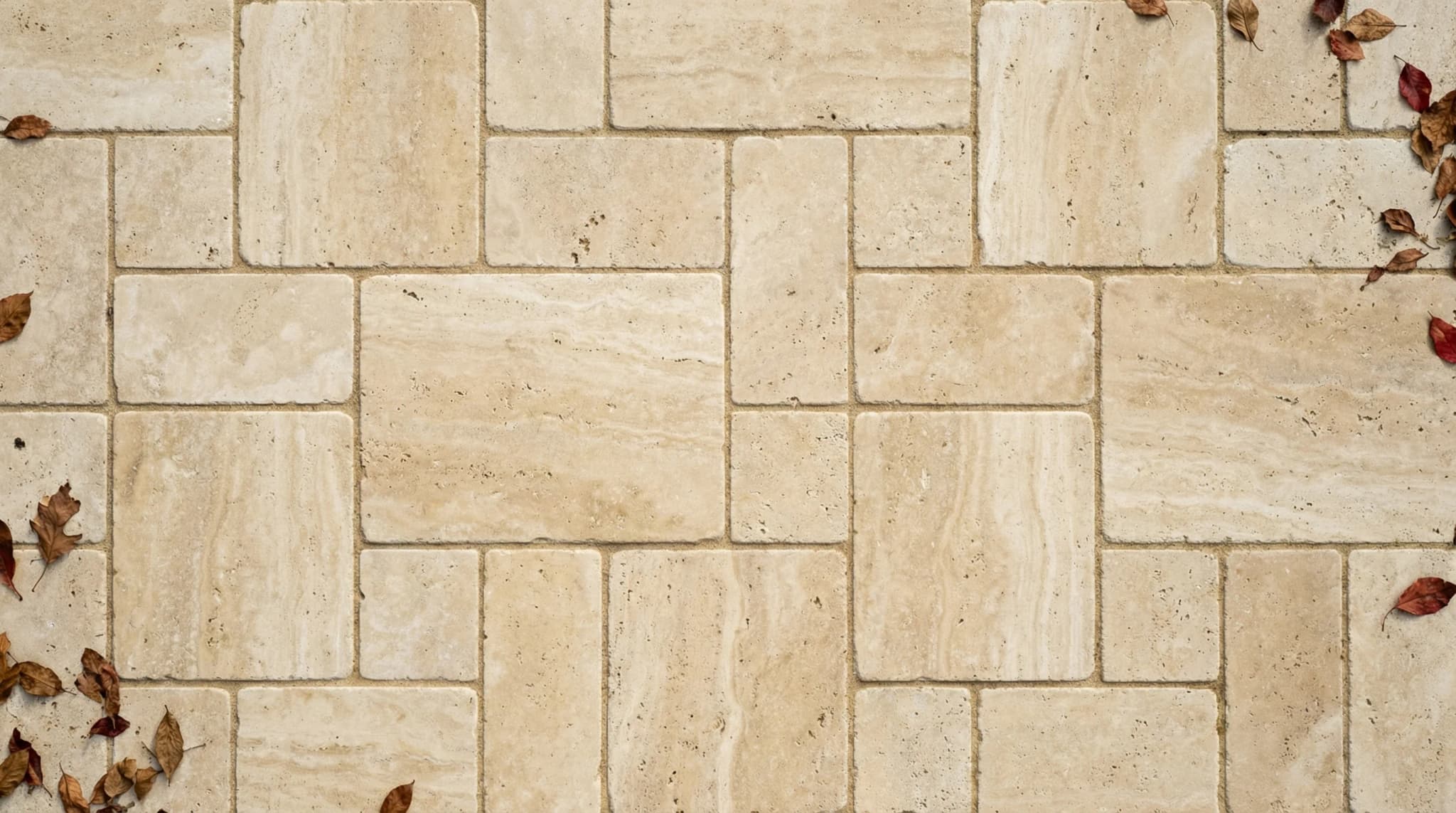
The most popular travertine layout, combining four different paver sizes (6x12, 12x12, 12x24, 24x24 inches) in a repeating modular design. Creates an organic, non-repetitive surface that highlights the natural colour variation of travertine. Requires careful planning during ordering to get the correct size ratios.
Best for: Pool decks, large patios, Mediterranean-style exteriors
Each paver is offset by half its length from the row below, creating a classic brick-like pattern. Simple to install, structurally strong, and visually effective at making narrow spaces appear wider. Works best with a single paver size, typically 12x24 or 16x24 inches.
Best for: Walkways, narrow patios, driveways
Pavers are laid at alternating 45° or 90° angles to create a zigzag pattern. Provides exceptional interlock and load distribution, making it the strongest pattern for vehicular traffic. Requires more cuts at the edges and takes longer to install, but delivers a premium, high-end aesthetic.
Best for: Driveways, high-traffic commercial areas, accent zones
Pavers are laid in a simple grid with joints aligned vertically and horizontally. Creates a clean, modern, minimalist look that suits contemporary architecture. Easier to install than herringbone but slightly less structurally interlocked. Works best with square pavers (12x12 or 24x24 inches).
Best for: Modern patios, courtyard designs, indoor-outdoor transitions
Technical Specifications
Choosing the right paver size and thickness depends on your application, traffic load, and design intent. Below are the standard sizes available from Turkish quarries.
All travertine pavers from Go2Stone are available in tumbled, brushed, and honed finishes. Standard thicknesses are 3 cm (1.2 in) for pedestrian areas and 5 cm (2 in) for vehicular traffic. Custom sizes and thicknesses are available for orders above 200 m2.
| Size (inches) | Size (cm) | Thickness | Best Application |
|---|---|---|---|
| 6 x 12" | 15 x 30 cm | 3 cm / 5 cm | French Pattern component, borders, accents |
| 12 x 12" | 30 x 30 cm | 3 cm / 5 cm | French Pattern, stack bond, small patios |
| 12 x 24" | 30 x 60 cm | 3 cm / 5 cm | Running bond, French Pattern, walkways |
| 16 x 24" | 40 x 60 cm | 3 cm / 5 cm | Large patios, pool decks, driveways |
| 24 x 24" | 60 x 60 cm | 3 cm / 5 cm | French Pattern, modern grid, large-format installations |
Custom sizes available for orders above 200 m2. All dimensions have a standard tolerance of ±1 mm. Contact us for exact availability.
Get factory-direct pricing and free samples shipped to your office within 48 hours.
Professional Installation
Proper installation is critical for long-term performance. Below are the four key stages of a professional travertine paver installation.
Excavate to a minimum depth of 20-25 cm (8-10 in) and compact the subgrade to 95% modified Proctor density. Install a geotextile membrane over the compacted subgrade to prevent migration of fines. The substrate must slope at 1-2% away from structures for proper drainage. For vehicular areas, increase excavation depth to 30-35 cm (12-14 in).
Spread a 15-20 cm (6-8 in) layer of compacted gravel base (MOT Type 1 or equivalent), followed by a 3-4 cm (1.2-1.6 in) layer of sharp sand or grit sand screeded to level. Pavers are placed directly on the sand bed with 3-5 mm joints filled with polymeric sand. This method allows natural drainage and is ideal for patios, pool decks, and garden paths.
Pour a 10 cm (4 in) reinforced concrete slab over the compacted gravel base. Once cured, apply a 10-15 mm cement-based adhesive layer and set pavers with 5-8 mm joints grouted with a flexible, frost-resistant grout. This method provides maximum structural support and is required for driveways, commercial applications, and areas with heavy vehicular traffic.
For sand-set installations, fill joints with polymeric sand and activate with a light water mist. For mortar-set installations, grout joints after 24-48 hours of adhesive curing. Apply a penetrating impregnating sealer to all paver surfaces within 48 hours of completion. Re-seal every 2-3 years for optimal protection, or annually in high-traffic pool areas.
Material Comparison
How does travertine compare to the alternatives? The table below presents measured performance data across the metrics that matter most for outdoor paving.
When evaluating outdoor paving materials, surface temperature, slip safety, lifespan, and total installed cost are the four critical metrics. Travertine consistently outperforms marble, concrete, and porcelain on the first three, while remaining cost-competitive when sourced direct from Turkish quarries through Go2Stone.
| Material | Surface Temp (Full Sun) | Wet Slip (SCOF) | Expected Lifespan | Price Installed (per m2) |
|---|---|---|---|---|
| Travertine Pavers | 35-45°C (95-113°F) | 0.75-0.95 (Excellent) | 50-100+ years | $60-120 |
| Concrete Pavers | 55-65°C (131-149°F) | 0.50-0.70 (Moderate) | 15-25 years | $40-80 |
| Porcelain Pavers | 50-60°C (122-140°F) | 0.40-0.65 (Low-Mod) | 25-40 years | $70-140 |
Surface temperature measured at 35°C ambient. SCOF values for tumbled/textured finishes. Prices are indicative for installed pavers including labour. Contact Go2Stone for project-specific quotes.
Application Gallery
Travertine pavers are specified across three primary outdoor applications. Each demands different paver sizes, thicknesses, and installation methods.
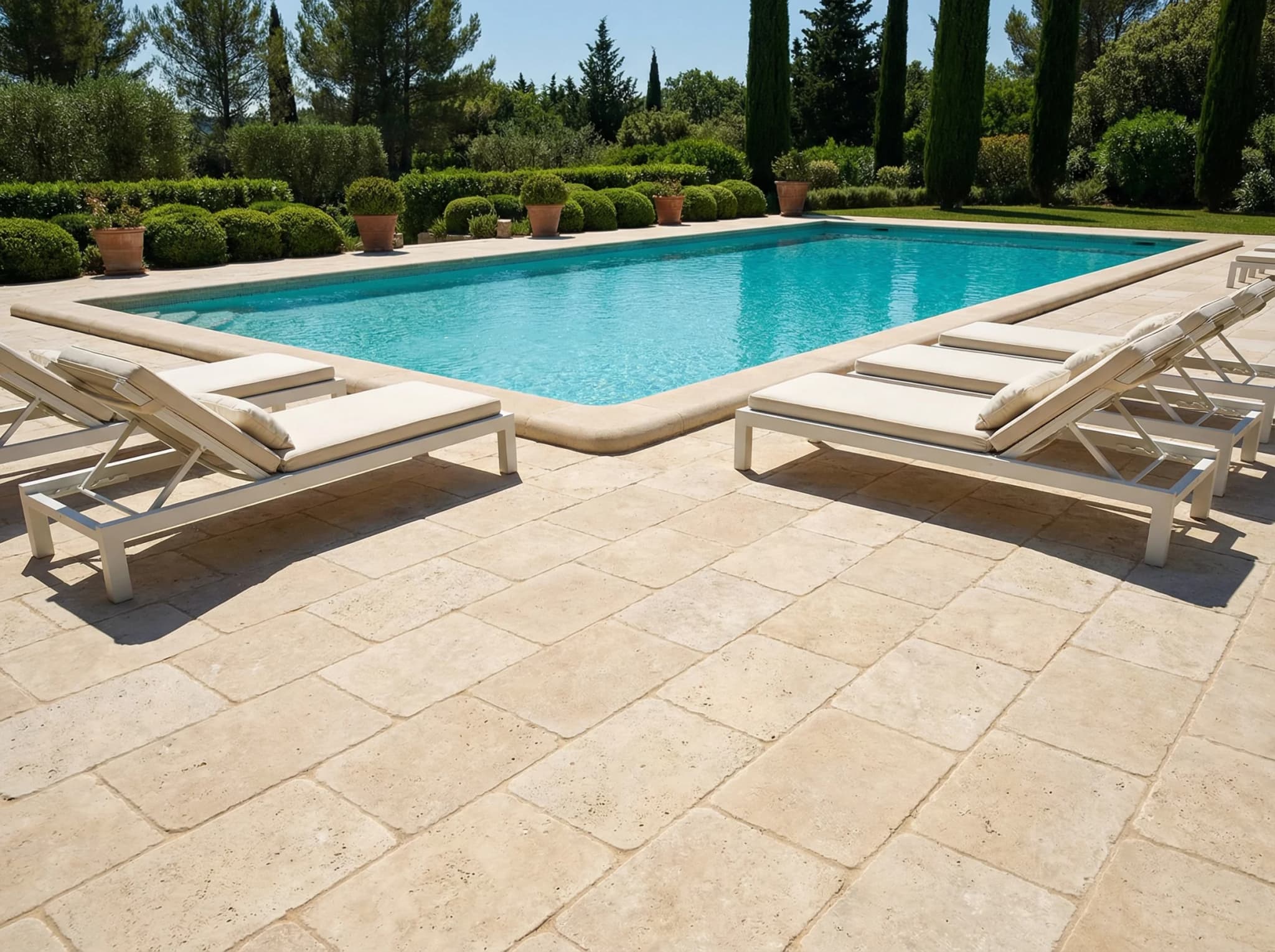
Travertine is the industry standard for pool decks for good reason: it stays cool underfoot in direct sun, provides excellent grip when wet, and resists damage from chlorinated and salt water. Tumbled travertine with its naturally rounded edges is the preferred finish for pool coping and deck areas. Most pool installations use 3 cm thick pavers in French Pattern or running bond, with a bullnose edge profile for coping pieces.
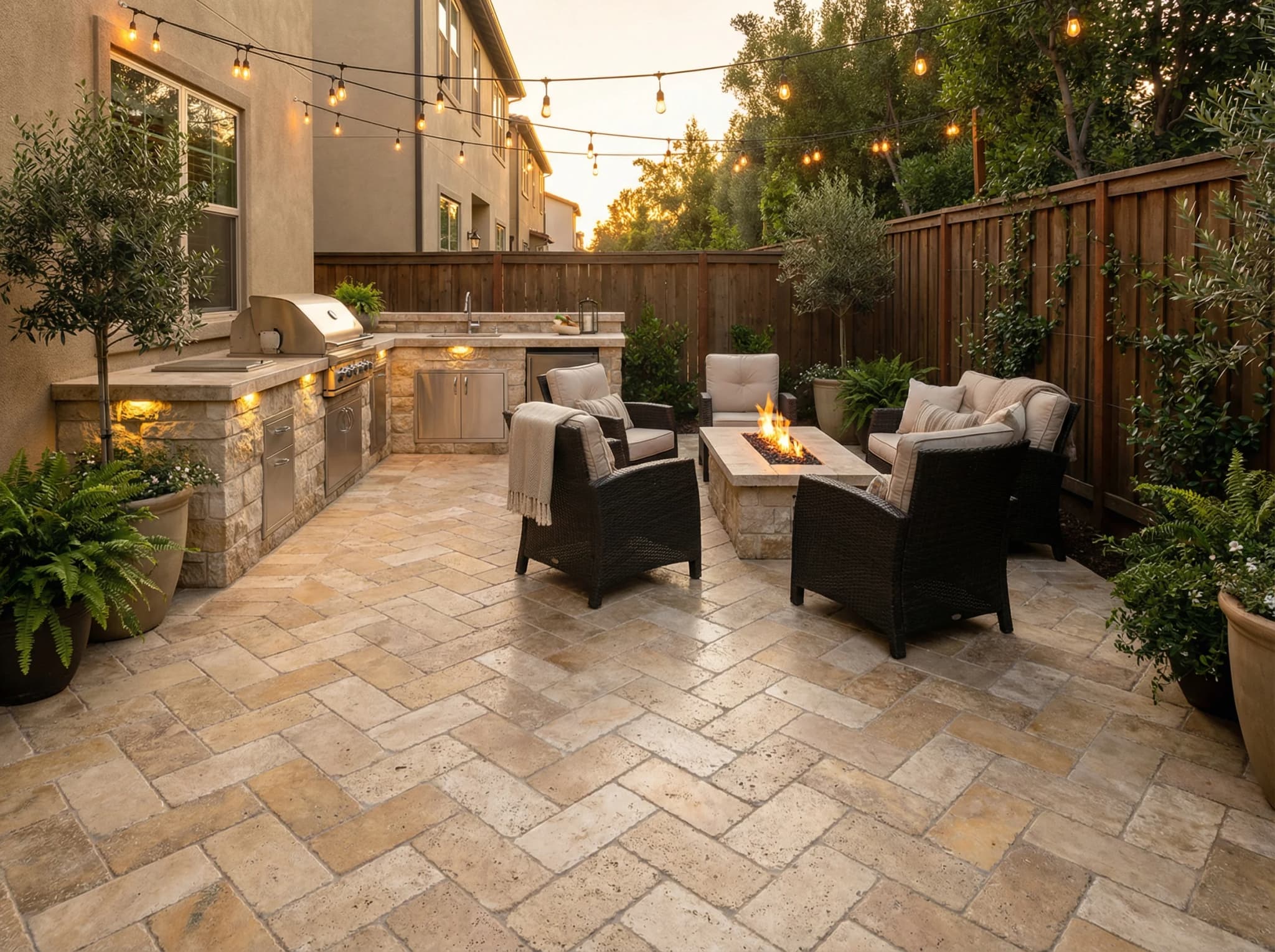
Travertine pavers transform patios into natural extensions of indoor living spaces. Their warm, earth-toned palette complements wood, stone, and greenery while providing a durable, low-maintenance surface for furniture, grills, and foot traffic. For seamless indoor-outdoor transitions, match the patio travertine to interior travertine flooring using the same colour family in different finishes — honed indoors, tumbled outdoors.
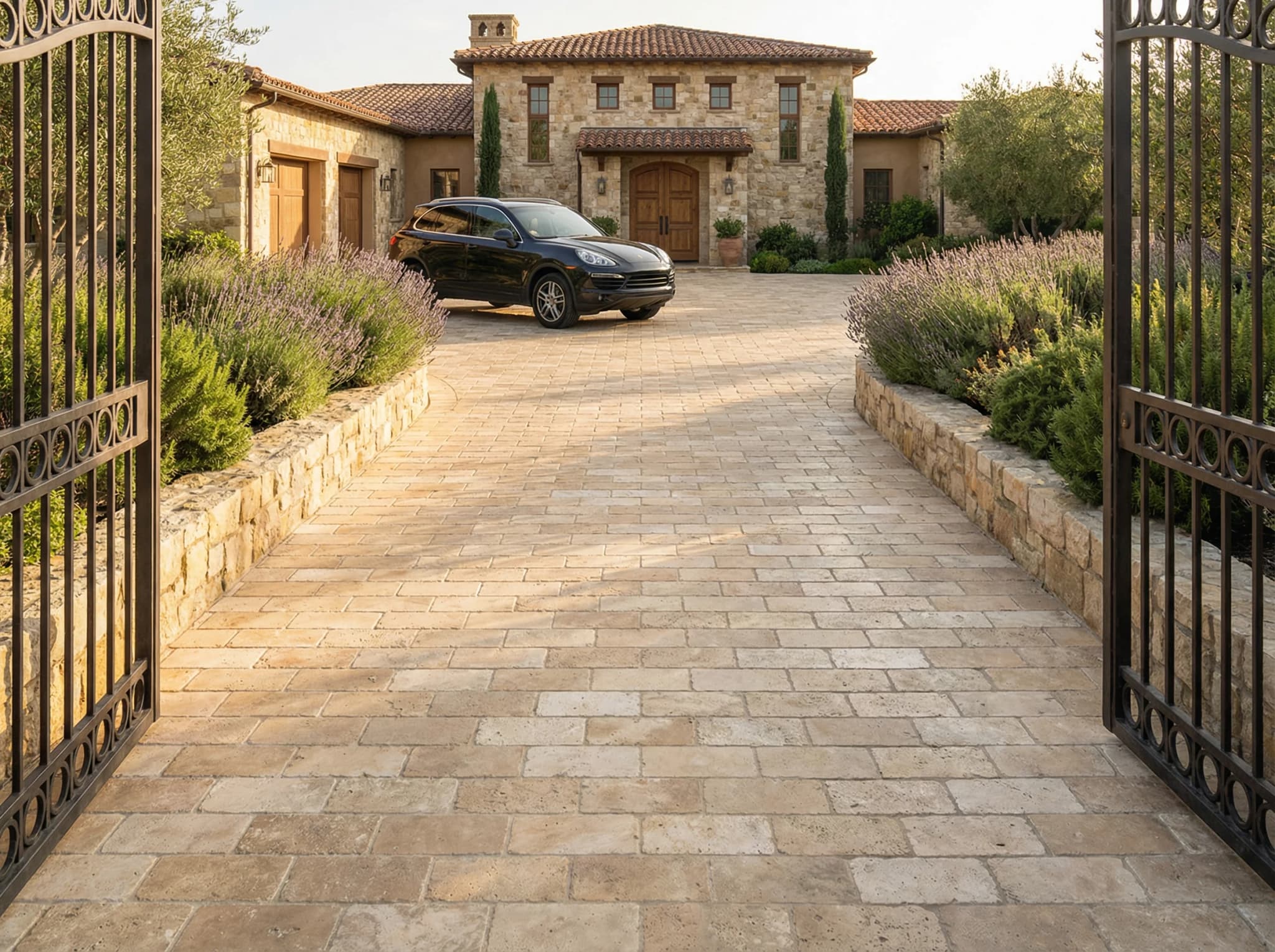
For driveways, use 5 cm (2 in) thick travertine pavers installed on a mortar-set base with reinforced concrete substrate. Herringbone or running bond patterns provide the best load distribution for vehicular traffic. Travertine driveways cost more than concrete initially but last 3-5 times longer, require no expansion joints, and add significant curb appeal and property value. Classic Travertine and Noce Travertine are the most popular choices for driveways.
We ship free travertine paver samples worldwide. See and feel the stone before you commit.
Care and Longevity
Properly maintained travertine pavers require minimal ongoing care. Follow these guidelines to protect your investment for decades. For a comprehensive care programme, see our travertine resource centre.
Apply a penetrating impregnating sealer within 48 hours of installation. This prevents water, oil, and organic stains from penetrating the stone's pores without altering its natural appearance. Re-seal every 2-3 years for patios and walkways, or annually for pool decks exposed to chlorinated water. Avoid topical (film-forming) sealers outdoors — they can become slippery when wet and trap moisture beneath the surface.
Sweep regularly to remove debris and grit that can scratch the surface. For general cleaning, use a pH-neutral stone cleaner diluted in warm water and a soft-bristle brush. Pressure washing is safe at low settings (under 1,500 PSI / 100 bar) with a wide fan nozzle. Avoid acidic cleaners (vinegar, citrus-based products) — travertine is calcium carbonate and will etch on contact with acids.
In climates with regular freezing, ensure pavers are properly sealed before the first frost. Never use rock salt or calcium chloride de-icers directly on travertine — they can cause surface spalling and discolouration. Instead, use sand or non-chloride de-icers rated safe for natural stone. Clear standing water and snow promptly to minimise freeze-thaw stress cycles.
One of travertine's advantages over poured concrete is that individual pavers can be replaced without disturbing the surrounding installation. For sand-set pavers, simply lift the damaged piece, level the sand bed, and set the replacement. For minor chips and cracks, use a colour-matched stone epoxy filler. Entire surfaces can be professionally re-honed and re-sealed to restore their original appearance.
Our Collection
Each stone is sourced directly from Denizli quarries and available in paver formats. Click to explore finishes, specifications, and pricing.
Common Questions
Answers to the most common questions about travertine pavers, based on 20+ years of industry experience.
Go2Stone supplies travertine pavers direct from Denizli quarries with full quality control and global logistics support. Request a quote or browse our travertine collection.
Free samples shipped worldwide. Most production orders deliver within 8-12 weeks.
Project enquiry
Share the material, format, quantity, destination, and timing.
What helps us answer accurately
Stone · Format and finish · Quantity · Destination city or port
You can expect a reply within
One business day
Need a quick answer? Ask Selim in the chat.

