
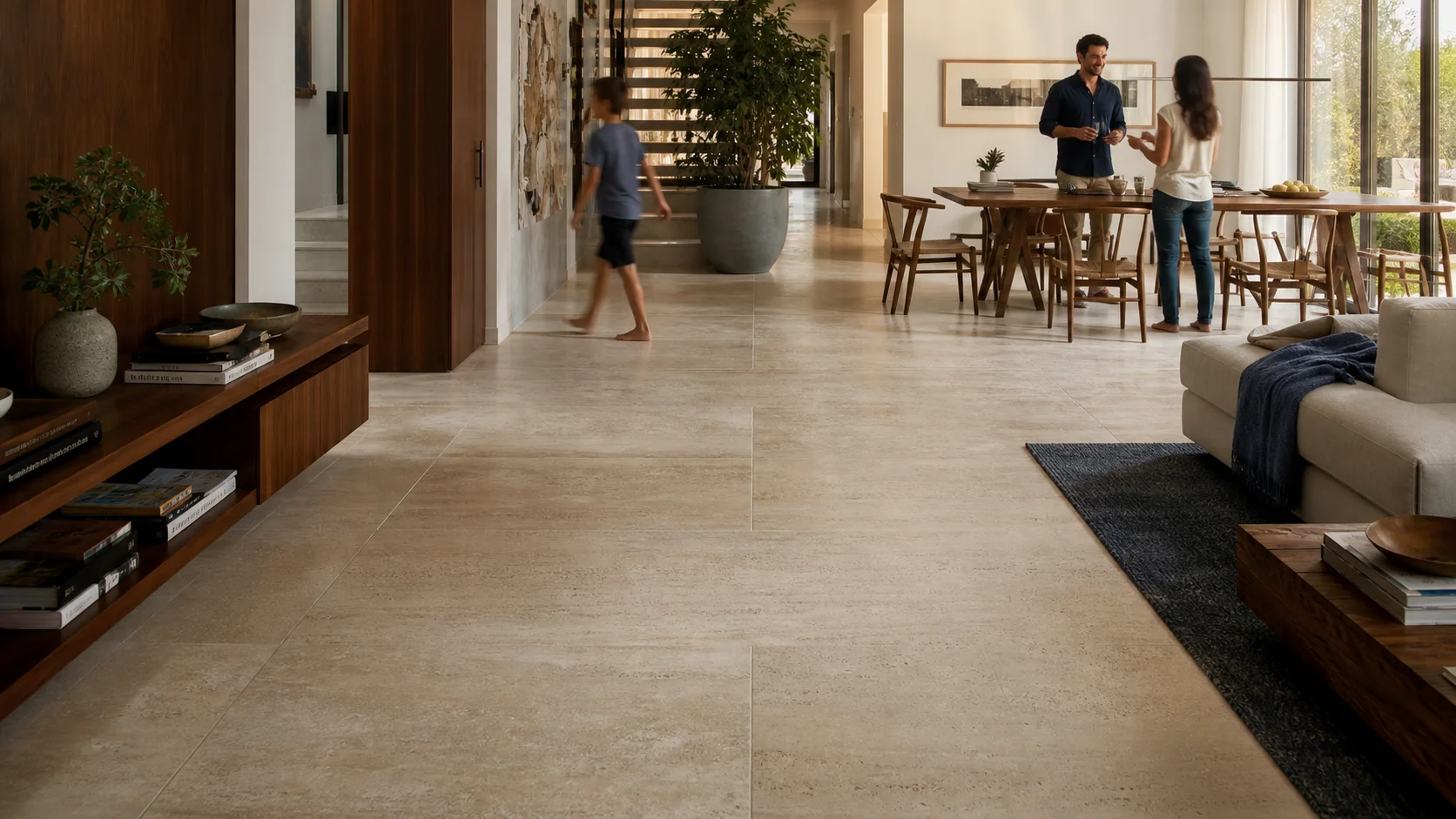
From finish selection to underfloor heating compatibility, everything architects and builders need to specify travertine flooring with confidence. Sourced direct from Turkish quarries.
Decades
Potential Service Life
40+
Countries Served
System
Specified Together
100%
Direct from Turkey
Last updated: · Reviewed by Sezai Suda
Quick Facts
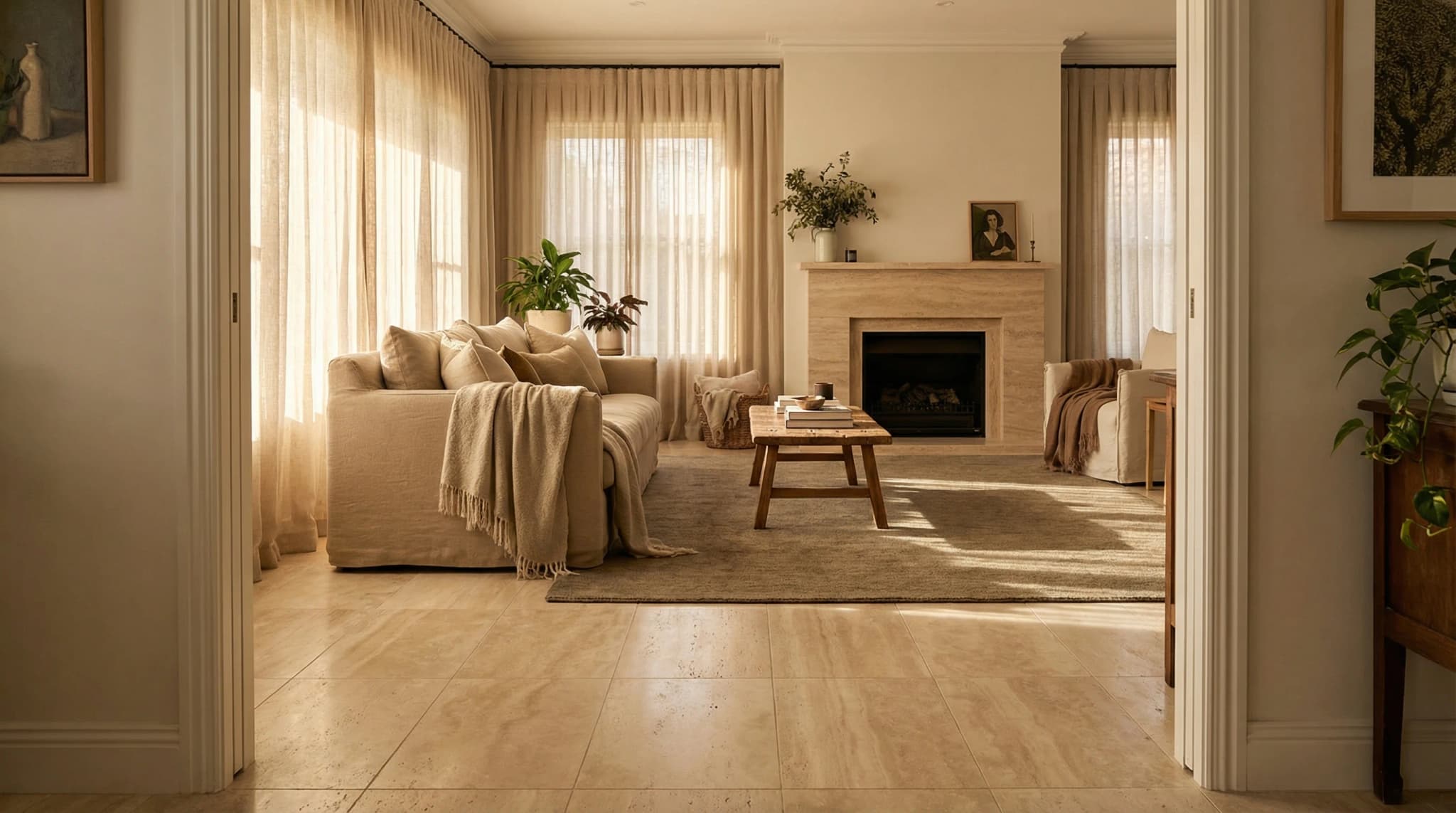
Why Travertine
Travertine has been used as a flooring material for over two millennia. Its combination of thermal performance, durability, and natural beauty makes it one of the most versatile natural stone options for residential and commercial floors alike.
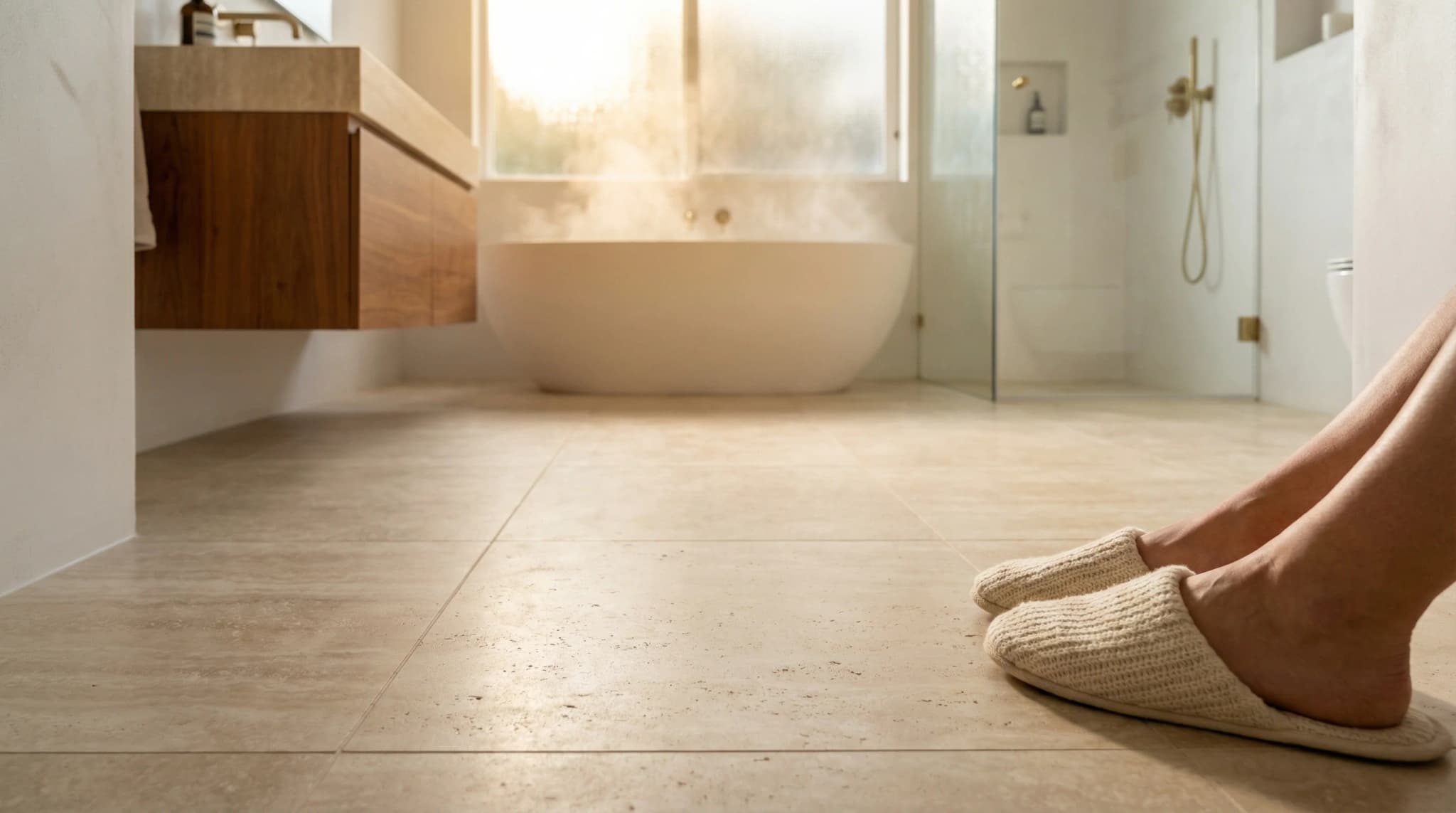
Travertine transfers heat through the floor assembly while its thermal mass helps moderate surface temperature changes. It can work with hydronic or electric underfloor heating, but performance depends on the complete build-up: insulation, screed, membrane, adhesive, tile thickness, controls, and operating temperature. Compare the full assembly rather than selecting stone from a single conductivity number.
Historic use demonstrates the durability potential of travertine, but the service life of a modern floor depends on the selected stone, substrate, installation, traffic, cleaning, and maintenance. Unlike many manufactured finishes, a worn travertine surface can often be re-honed and local chips can be repaired. Request product-specific absorption, abrasion, strength, and slip test data for the intended application.
Each travertine tile has a unique pattern of natural pores, veining, and colour variation that no manufactured material can replicate. The warm earth tones — from ivory and cream through gold, walnut, and silver — complement both contemporary minimalist and traditional Mediterranean interiors. Varieties like Classic Travertine and Light Travertine are perennial choices for residential flooring projects worldwide.
Travertine can be used over hydronic or electric underfloor heating when the complete assembly is designed for natural stone. Confirm tile thickness and temperature limits with the heating-system and adhesive manufacturers, use movement joints where required, and follow the specified commissioning cycle. An uncoupling membrane may be appropriate where substrate movement or differential stresses are expected.
Travertine flooring is available in formats from 10x10 cm mosaic to 120x60 cm large-format planks, and in thicknesses from 10 mm to 30 mm. Combined with four primary finish options — honed, polished, brushed, and tumbled — this versatility allows specifiers to match travertine to virtually any design brief, from pool surrounds to formal reception halls.
The Denizli basin is one of Turkey's established travertine quarrying and processing regions. Through Marmol Turco, buyers can compare quarry selections, finishes, packing, and shipment terms directly with the Turkish supply chain. Request current, product-specific test reports and declarations for the exact stone and intended market. Our import guide covers the logistics process.
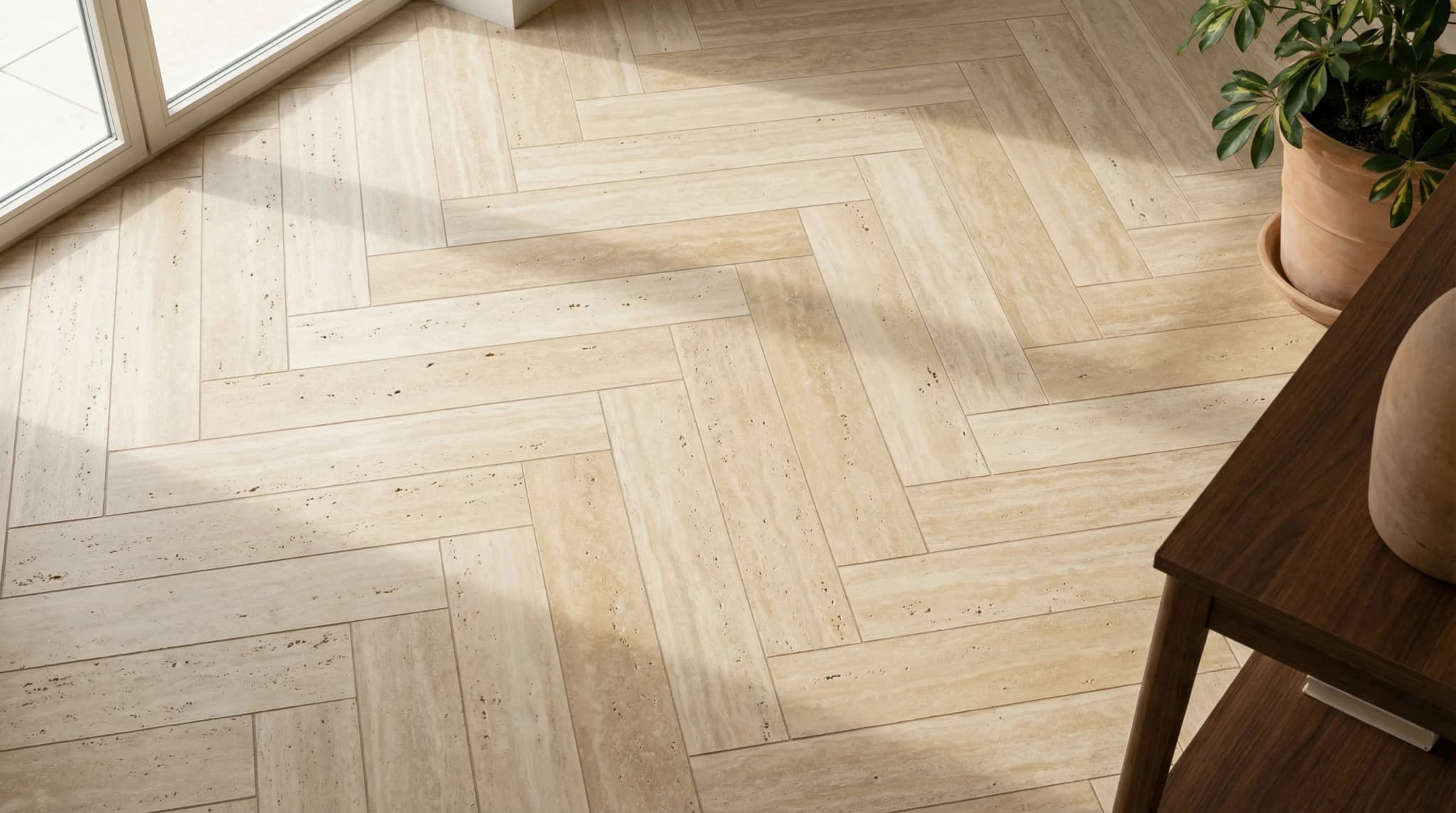
Surface Finishes
The finish you choose determines slip resistance, maintenance requirements, and the overall aesthetic of your travertine floor.
Each finish is achieved through different processing methods at the factory. Honed and polished are created with progressively finer abrasives; brushed uses wire brushes to expose the natural texture; and tumbled involves rotating tiles in a drum to soften edges and create an antiqued appearance. The table below compares all four finishes across the key specification criteria.
| Finish | Slip Performance | Aesthetic | Maintenance | Best For |
|---|---|---|---|---|
| Honed (Matte) | Moderate — verify product test | Smooth matte, subtle veining | Moderate — seal every 18-24 months | Living rooms, hallways, commercial lobbies |
| Polished (Glossy) | Lower when wet — verify test | High-gloss, vivid colour depth | Higher — shows scratches, seal every 12-18 months | Formal interiors, feature areas, low-traffic zones |
| Brushed (Textured) | Textured grip — verify test | Naturally textured, rustic character | Low — texture hides minor wear | Kitchens, bathrooms, high-traffic residential |
| Tumbled (Antiqued) | Textured grip — verify test | Aged, softened edges, organic feel | Lowest — patina improves with age | Outdoor areas, pool decks, Mediterranean interiors |
Finish names do not establish a DIN 51130 rating. Actual slip performance depends on the exact stone, treatment, sealer, wear, contaminants, and test method. Request product-specific results for the intended use.
Tile Formats
Choosing the right tile size affects both the visual scale of your floor and the practical installation requirements.
Smaller formats suit complex patterns like herringbone and Versailles, while larger formats create a seamless, contemporary look with fewer grout lines. French Pattern (Opus) combines four sizes for a classic Mediterranean aesthetic that remains one of the most popular travertine layouts globally. All formats are available from Turkish quarries through our collection.
| Format | Dimensions (cm) | Thickness | Best For |
|---|---|---|---|
| Small / Mosaic | 10x10, 15x15 | 10 mm | Feature strips, shower floors, decorative borders |
| Standard Tile | 30x30, 40x40, 30x60 | 12-15 mm | Residential flooring, bathrooms, kitchens |
| Large Format | 60x60, 80x80 | 15-20 mm | Open-plan living, commercial lobbies, minimal grout lines |
| Plank / Strip | 15x60, 20x80, 30x120 | 15-20 mm | Wood-look layouts, corridors, contemporary interiors |
| French Pattern (Opus) | Mixed: 4 sizes combined | 12-30 mm | Mediterranean style, villa flooring, outdoor terraces |
Custom sizes available on request. Minimum order quantities apply for non-standard dimensions. Contact us for specific format availability.
Get factory-direct pricing, free samples, and technical specifications for your project.
Installation Guide
Proper installation is essential for travertine floor performance and longevity. Follow these four critical steps for a professional result.
The subfloor must be level (max 3 mm deviation over 2 m), clean, dry, and structurally sound. For concrete substrates, ensure a minimum 28-day curing period. Apply a decoupling membrane (e.g., Schluter DITRA) to prevent cracking from substrate movement. For underfloor heating, install and test the heating system before tiling — run a full heat cycle and allow the screed to cool completely.
Use a white, flexible, polymer-modified thin-set adhesive rated S1 or S2 (EN 12004). White adhesive prevents colour bleed-through on lighter travertine varieties. For underfloor heating installations, the adhesive must be rated for thermal cycling. Apply adhesive to both the substrate and tile back (back-buttering) to achieve minimum 95% coverage.
Dry-lay tiles before adhesive application to verify the pattern, check for colour consistency across boxes, and plan cuts at walls and transitions. Use a wet saw with a diamond blade for clean cuts — never snap travertine. Leave a minimum 5 mm expansion gap at perimeter walls and at transitions to other flooring materials. For French Pattern layouts, pre-sort tiles by size to ensure random distribution.
Grout joints should be 3-5 mm for standard tiles and 5-8 mm for tumbled formats. Use unsanded grout for joints under 3 mm and sanded grout for wider joints. Choose a grout colour that complements the travertine — typically a neutral that matches the lightest tone. Apply a penetrating impregnator sealer 24-48 hours after grouting, before the floor sees foot traffic. Reapply sealer every 12-24 months depending on traffic levels.
Cost & Performance
Compare delivered material, installation, and the complete heated-floor assembly rather than treating stone price or conductivity as a standalone decision.
When comparing flooring materials, consider total installed cost together with the complete heated-floor assembly. Stone thickness, insulation, screed depth, controls, operating temperature, and room heat loss all affect response time and energy use; material conductivity alone does not establish a saving. For import logistics and delivered pricing, see our shipping guide.
These are broad reference ranges, not product declarations. Heating response depends on the complete assembly, including insulation, screed, controls, adhesive, tile thickness, and operating conditions.
| Material | Thermal Conductivity (W/mK) | Design Consideration |
|---|---|---|
| Travertine | 1.2-1.7 | Confirm stone thickness and the complete assembly |
| Marble | 2.8-3.2 | Confirm stone type, thickness, and thermal cycling |
| Granite | 2.5-3.5 | Allow for thickness and thermal movement |
| Porcelain Tile | 1.0-1.5 | Follow tile and system manufacturer limits |
| Engineered Wood | 0.14-0.18 | Check flooring manufacturer temperature limits |
| Luxury Vinyl (LVT) | 0.16-0.25 | Check product and adhesive temperature limits |
Use a current declaration or test report for the exact flooring product. The heating-system designer should verify the complete build-up and operating limits.
Specification Scenarios
Illustrative briefs showing how finish, format, traffic, and heating requirements change the specification. These are examples, not Marmol Turco case studies.
Classic Travertine, Honed, 60x60 cm, 450 m2
For open-plan living over hydronic heating, honed Classic Travertine can provide warm colour and a low-sheen finish. Confirm the full heated-floor build-up, movement joints, tile thickness, and commissioning sequence with the project designer and system suppliers.
Light Travertine, Polished, 80x80 cm, 280 m2
Large-format travertine can create a calm entrance with fewer joints. A hospitality specification should prioritise product-specific abrasion and slip data, entrance matting, cleaning procedures, sealer compatibility, and a documented maintenance plan.
Silver Travertine, Brushed, French Pattern, 620 m2
A coordinated Silver Travertine palette can connect interior rooms with a terrace, but interior and exterior pieces may need different thicknesses, textures, treatments, and slip performance. Verify exterior suitability for the climate and intended wet-use zone.
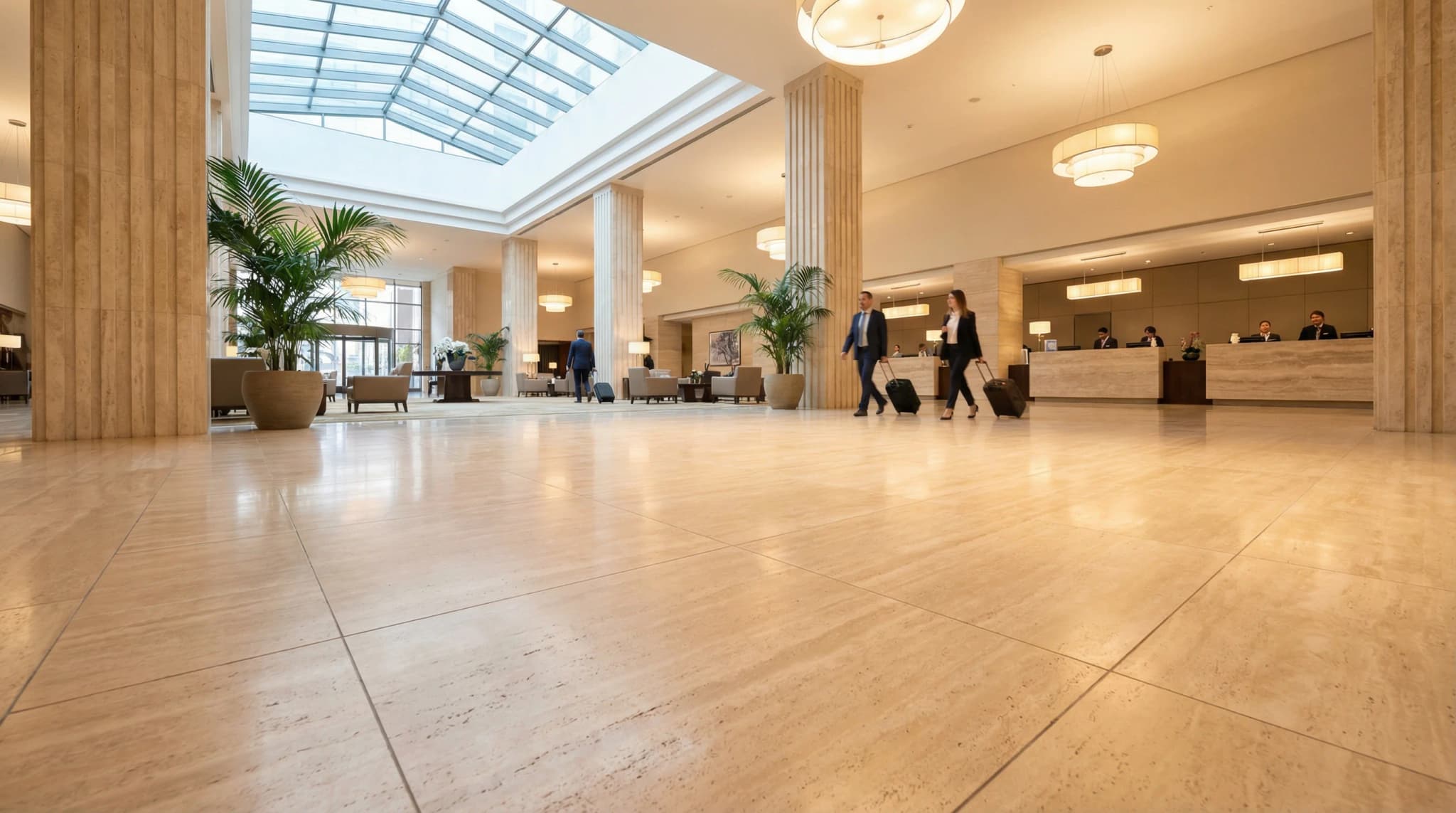
We ship free travertine samples worldwide. Compare finishes and colours in your actual project environment.
Care & Maintenance
With the right care routine, travertine floors maintain their beauty for generations. Here is a practical maintenance guide based on industry best practices and 20+ years of project experience.
Apply a penetrating impregnator sealer (not a topical coating) after installation and reapply every 12-24 months depending on traffic. Penetrating sealers protect from within the stone without altering its appearance or creating a surface film that can peel. Water-based sealers are preferred for indoor use; solvent-based sealers offer superior protection in outdoor and high-moisture environments. Always test the sealer on a sample tile first.
For daily cleaning, dust mop or vacuum with a soft brush attachment to remove grit that can scratch the surface. For weekly cleaning, use a pH-neutral stone cleaner diluted per manufacturer instructions — never use vinegar, bleach, ammonia, or acidic cleaning products, as these will etch the calcium carbonate surface. Microfibre mops are ideal for travertine; avoid abrasive scrub pads.
Use felt pads under furniture legs, place doormats at entryways to trap grit, and clean spills immediately — especially acidic liquids like wine, citrus juice, or coffee. In high-traffic commercial areas, consider runner rugs in the highest-wear zones. These simple preventive measures dramatically extend the time between professional maintenance interventions.
Minor scratches on honed travertine can often be buffed out with a fine-grit diamond pad (800-1500 grit). Chips and deeper damage can be repaired with colour-matched epoxy filler, then re-honed to blend with the surrounding surface. For polished travertine, professional re-polishing may be required. These repairs are straightforward and far less expensive than replacing tiles.
Consistent cleaning, suitable sealing, and periodic professional maintenance can keep a travertine floor in service for many decades. Surface wear can often be re-honed or re-polished, while local chips and fills can be repaired. Actual service life depends on the stone, installation, traffic, environment, and maintenance regime.
Specification References
Natural stone varies by quarry and selection. Use current test reports for the exact material, and coordinate the floor build-up with the adhesive, heating-system, and membrane manufacturers.
Our Collection
Compare Turkish travertine selections for colour, cut, finish, available test data, packing, and delivered pricing.
Common Questions
Answers to the most common questions about travertine flooring, based on 20+ years of industry experience.
Marmol Turco supplies premium Turkish travertine directly from Denizli quarries — with full EN test data, CE marking, and global logistics support. Browse our stone collection or request a project quote.
Free samples shipped worldwide. Project quotations delivered within 24 hours.
Project enquiry
Share the material, format, quantity, destination, and timing.
What helps us answer accurately
Stone · Format and finish · Quantity · Destination city or port
You can expect a reply within
One business day
Need a quick answer? Ask Selim in the chat.

