
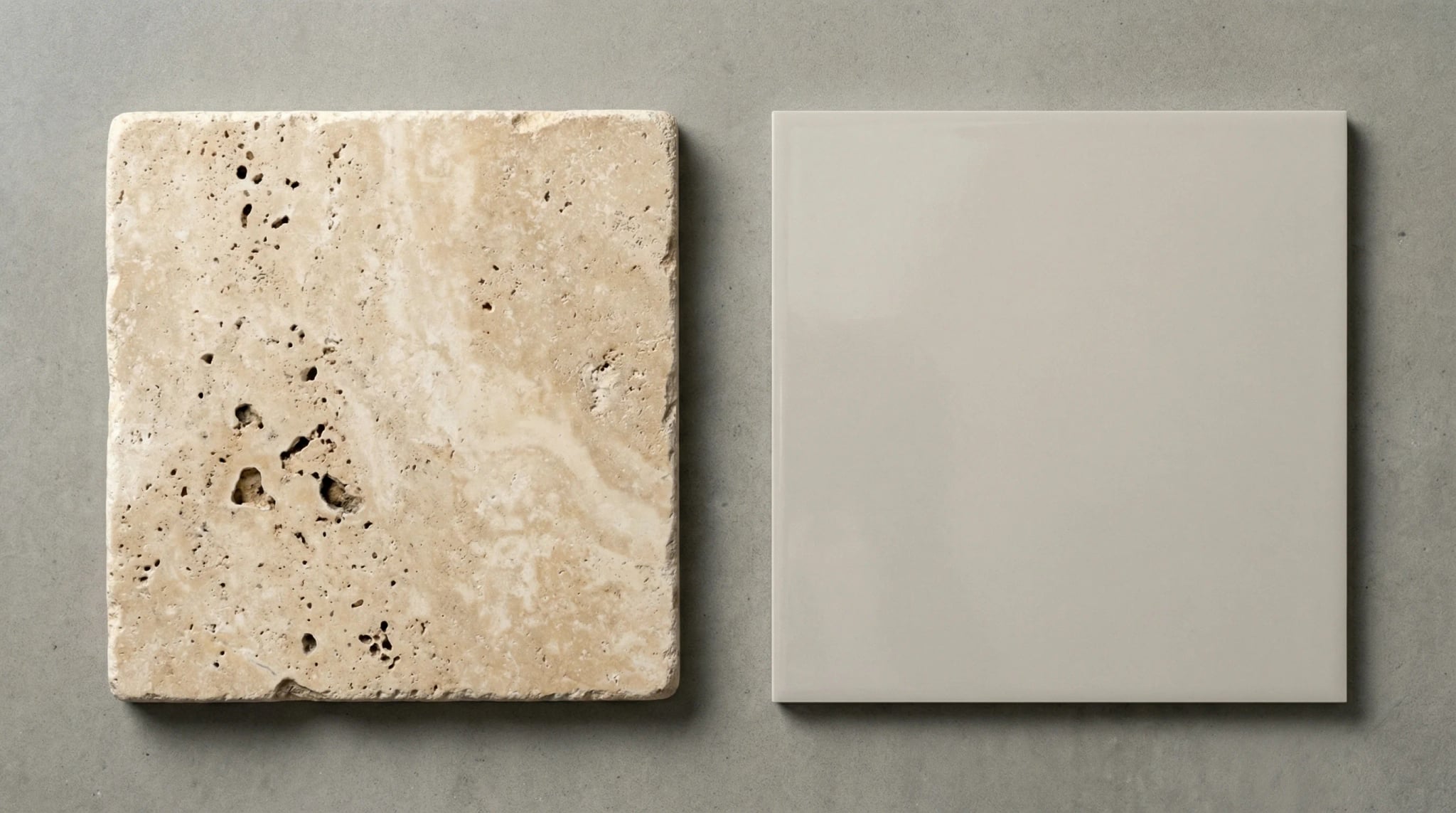
One is a natural stone formed by mineral-rich water; the other is an engineered ceramic tile. This guide compares the trade-offs across appearance, performance, installation, maintenance, and project cost so you can specify the right system.
20+
Years Experience
40+
Countries Served
500K+
m2 Delivered
Test Reports on Request
Last reviewed: - Reviewed by Sezai Suda
Quick Answer
Travertine is a natural stone formed by mineral precipitation; porcelain is an engineered ceramic tile made and tested to a product specification. Travertine brings natural variation and a finish-led design language, while porcelain can bring consistency and simpler routine care. Neither wins every application. Choose from the current test report, finish, installation method, and maintenance brief for the project.
Origin & Formation
Understanding how each material is made helps frame the specification. Travertine is a natural calcium-carbonate stone formed by mineral-rich water; porcelain is a manufactured ceramic product classified and tested by its product standard.
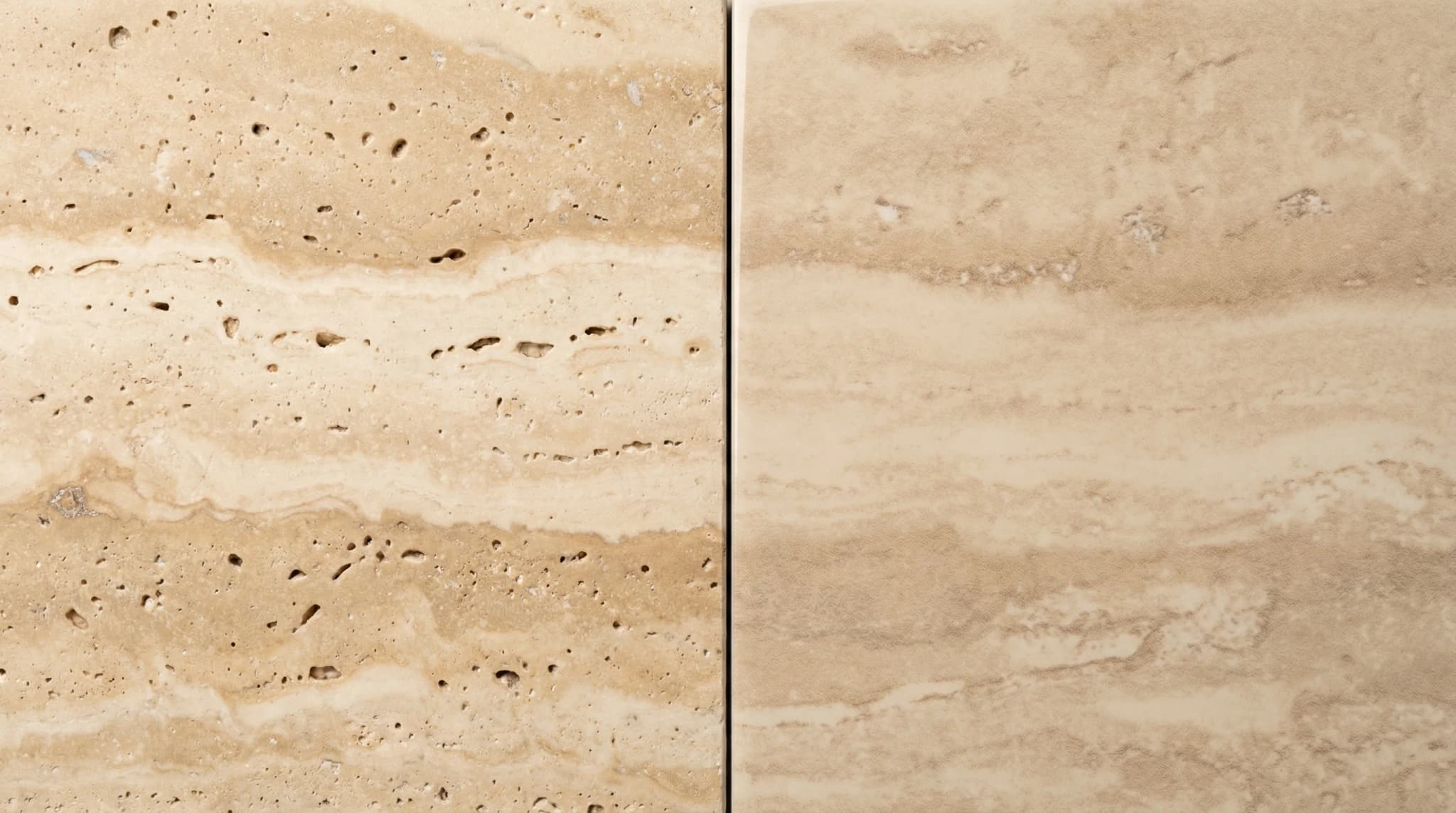
Travertine is a form of limestone associated with mineral precipitation from spring water. The resulting stone can show voids, bands, and other natural variation. Quarry, block, finish, thickness, filling, and sealing all affect the material supplied, so a project should be specified from current samples and test reports rather than from a category average.
Porcelain is a manufactured ceramic tile made from mineral raw materials, formed and fired, then classified by the applicable product standard. ISO 13006:2018 sets ceramic-tile classifications and marking requirements, while ISO 10545 test methods cover properties such as water absorption and strength. Appearance, slip performance, and suitability still depend on the specific product and installation system.
The Key Distinction
This is not a universal winner comparison. Travertine is a natural material with inherent variation and finish-dependent care. Porcelain is a manufactured product designed around a declared product performance and visual repeat. The correct decision depends on exposure, slip and drainage requirements, substrate, detailing, maintenance, budget, and the evidence available for the exact product.
Technical Sources
These sources frame the comparison. Product approval still depends on current reports for the exact stone, finish, porcelain product, format, and installation system.
Technical Specifications
The table below identifies the properties that should be compared for the exact travertine and porcelain products. Published values vary by quarry, finish, format, manufacturer, and installation system.
| Property | Travertine | Porcelain | Winner | Standard |
|---|---|---|---|---|
| Composition | Natural CaCO3 (calcium carbonate) | Fired clay, feldspar, silica blend | Different | - |
| Density | Use current quarry test report | Use current product test report | Compare reports | EN 1936 / ISO 10545-3 |
| Water absorption | Varies by stone and treatment | Use current product classification | Compare reports | EN 13755 / ISO 10545-3 |
| Scratch / wear resistance | Confirm finish and test method | Confirm product test data | Compare use case | Current product data |
| Thermal behaviour | Compare assembly and exposure | Compare assembly and exposure | Test on site | Project-specific assessment |
| Surface temperature in sun | Measure the selected sample | Measure the selected sample | Exposure dependent | Controlled field test |
| Slip resistance | Confirm finish and test result | Confirm finish and test result | Specification dependent | Applicable slip test |
| Colour / UV exposure | Review stone and finish sample | Review manufacturer data | Product dependent | Current product data |
| Fire classification | Verify project classification | Verify project classification | Compare reports | EN 13501-1 |
Do not use generic category values for approval. Request current reports for the exact stone, finish, porcelain product, format, substrate, and intended exposure.
Application Comparison
The right choice depends on exposure, detailing, maintenance, and the evidence for the exact product. Use these application notes to define the questions your supplier and installer must answer.
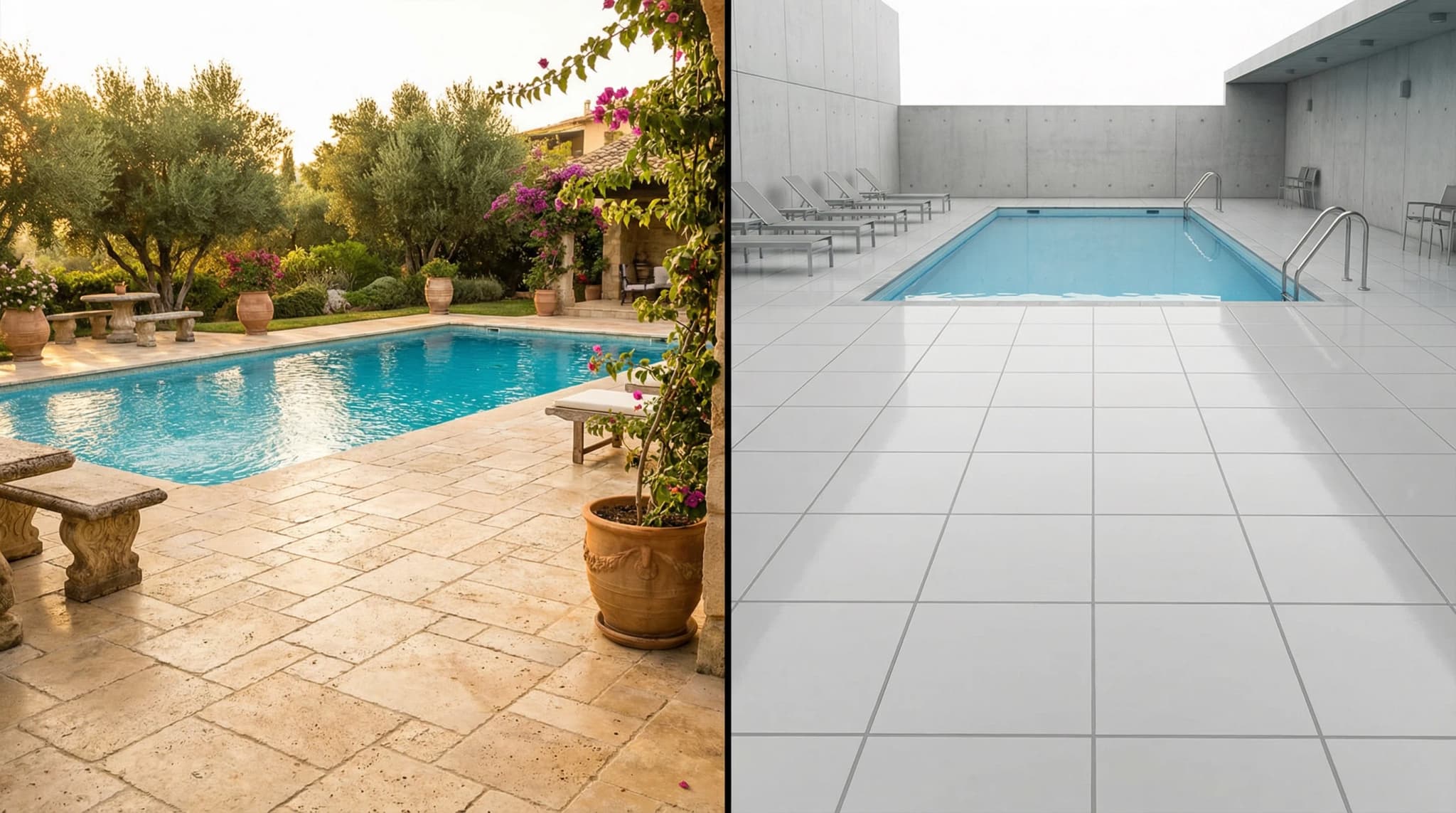
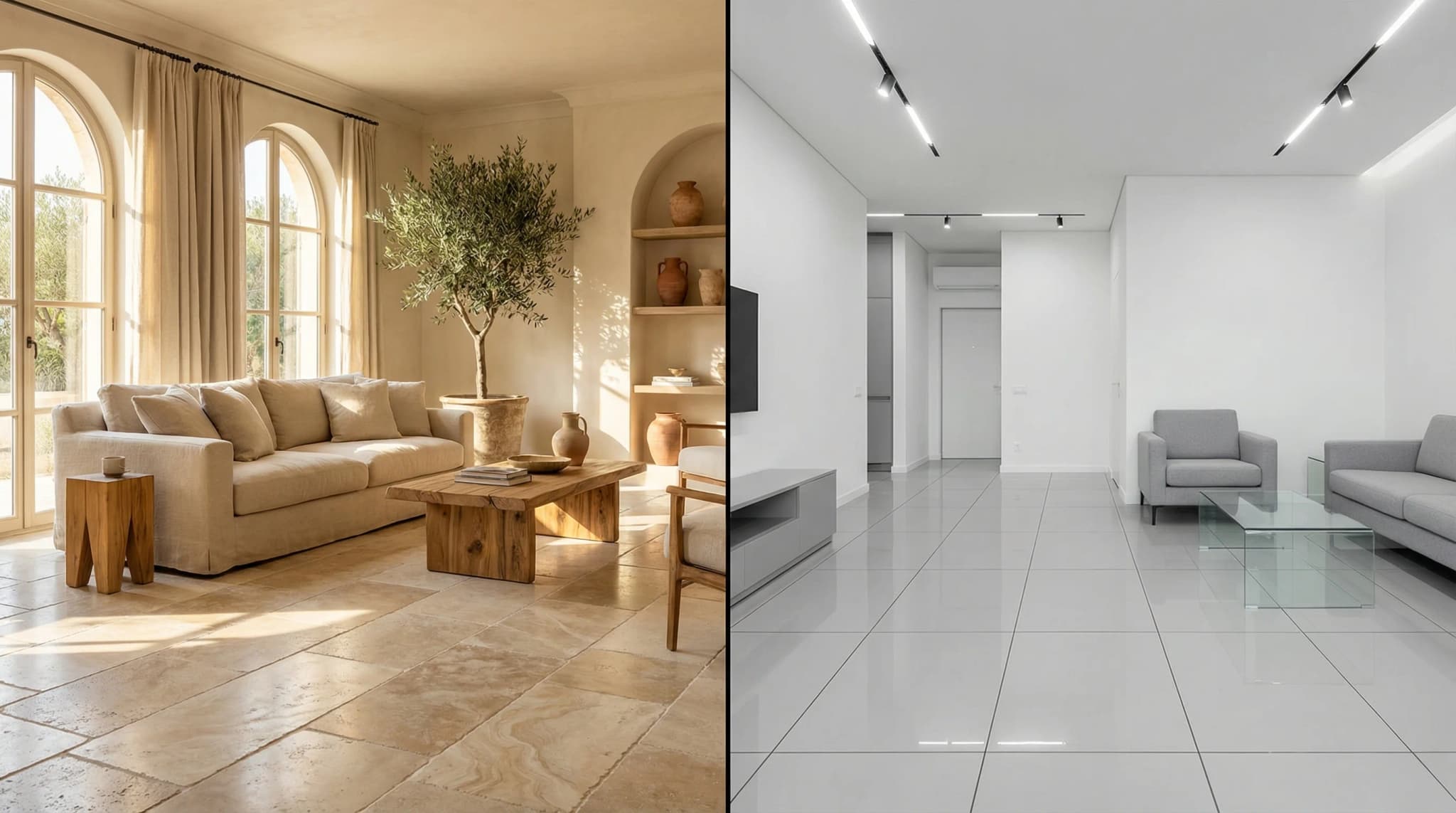
Both materials can work for interior floors. Travertine offers natural variation and a finish-led appearance, but the selected finish, sealing plan, and cleaning regime must suit the traffic. Porcelain offers a declared product specification and consistent sizing, but the selected surface still needs to be checked for wear, slip, grout, and replacement requirements.
For pool decks, compare the selected surface in the actual climate and exposure. Travertine is often chosen for natural variation and tactile finishes; porcelain can work when the product, edge detailing, drainage, and wet-slip performance are specifically rated for the installation. Request a finish sample and the applicable slip, water, thermal, and installation information before approval.
For building facades, compare the complete cladding system rather than the face material alone. Travertine brings natural variation and a stone-based design language; porcelain panels may offer more controlled appearance and a different panel system. Approval should cover anchorage, movement, wind, fire, moisture, thermal expansion, replacement, and the exact finish.
Porcelain is often selected for wet walls because a suitable product can simplify routine care, but the grout, substrate, movement joints, and waterproofing still govern the installation. Travertine can work in bathrooms when the finish, sealing, cleaning, and moisture detailing are specified. A mixed scheme is practical when the design wants porcelain at wet walls and travertine in a compatible, properly detailed floor or vanity application.
Countertops require a product-specific review of stain, acid, heat, edge, support, and repair performance. Porcelain may suit projects prioritising a manufactured slab specification and low routine sealing; travertine offers natural variation but needs a care brief that addresses porous stone, acids, staining, and finish expectations. Approve the exact slab and fabrication details, not a generic material label.
For patios and terraces, compare the selected finish, surface temperature in the project exposure, wet-slip data, drainage, jointing, freeze-thaw design, and replacement plan. Travertine can bring natural variation and a tactile outdoor finish; porcelain pavers can suit a more uniform scheme when the product and pedestal or bonded system are properly specified.
Request free travertine samples to see and feel the difference that no photo can convey.
Total Cost of Ownership
There is no defensible universal cost winner. Compare the same area, substrate, format, finish, installation system, freight, care plan, replacement assumptions, and local labour rates before approving a material.
| Cost Factor | Travertine | Porcelain | Advantage |
|---|---|---|---|
| Material quote | Current supplier quote | Current supplier quote | Compare like-for-like |
| Installation system | Installer scope and rate | Installer scope and rate | Price the complete system |
| Routine maintenance | Cleaning and sealing plan | Cleaning and grout plan | Use the owner brief |
| Sealing / treatment | Finish and sealer dependent | Product dependent | Confirm with manufacturer |
| Short-horizon model | Quote + installation + care | Quote + installation + care | Use local assumptions |
| Long-horizon model | Include refinishing scenario | Include replacement scenario | State every assumption |
| End-of-life model | Reuse and disposal scenario | Reuse and disposal scenario | Do not assume lifespan |
The practical rule: build two transparent models using current quotes and the same project assumptions. Include freight, waste, substrate preparation, edge details, installation, cleaning, sealing, repairs, replacement, and disposal. Browse our travertine collection and request a project quotation using the intended format and finish.
Prices and service intervals vary by stone, porcelain product, finish, region, project volume, and installer. We do not publish generic lifecycle totals as project advice.
Travertine-Look Porcelain
Travertine-look porcelain can be a sound choice when consistency and routine care are priorities. These are the design and maintenance differences to check before specifying either material.
Porcelain graphics are manufactured from a defined set of faces, so ask the supplier for the number of faces and a layout sample at the intended scale. Travertine has natural variation from piece to piece. Neither is automatically better; the decision is whether the project wants controlled repetition or a naturally varied field.
Travertine is a natural stone body with variation through the piece, while a porcelain design may use a surface graphic over a manufactured body. Review cut edges, corners, thresholds, and repair expectations with the actual product. A sample board and mock-up are more reliable than a catalog photograph.
Bare-foot comfort and surface temperature depend on colour, solar exposure, shade, assembly, moisture, and the surrounding landscape, not only on the material name. Test the selected travertine and porcelain samples in a representative exposure when comfort is a design requirement.
Travertine can change in appearance as it is cleaned, sealed, honed, filled, and used; that developing character may be part of the design intent. Porcelain is generally selected for a more stable manufactured appearance. Specify the desired ageing, repair, and replacement outcome instead of assuming one material will look the same forever.
Do not promise a property-value uplift from a finish alone. Resale impact depends on the market, building quality, design, installation, condition, and buyer preference. If value is part of the brief, document the design rationale and confirm any commercial assumption locally rather than using a generic percentage.
Professional insight: Treat travertine-look porcelain as its own design option, not as a failed version of stone. Request a full-size layout, edge sample, slip result, care instructions, and current price before comparing it with genuine travertine. See our travertine collection to compare current finishes.
Sustainability
Environmental performance is a product-and-system question. Compare current EPDs or lifecycle data using the same declared unit, transport assumptions, installation scope, use phase, and end-of-life boundary.
Porcelain includes a manufactured forming and firing process. Travertine extraction and fabrication follow a different route through quarrying, cutting, finishing, packing, and transport. Compare the actual manufacturing and transport data for the selected products rather than assigning a category-wide energy ranking.
Do not compare carbon numbers from different boundaries. The Natural Stone Institute publishes industry EPD resources for natural stone, and porcelain suppliers may provide product-specific EPDs. Compare declared units, thickness, yield, freight route, installation, maintenance, and end-of-life on the same basis. When sourcing from Turkey through Go2Stone, we can provide the shipment assumptions needed for a project model.
Service life is not a single number for either material. It depends on product quality, traffic, exposure, detailing, cleaning, repair, and replacement practice. Model realistic maintenance and replacement scenarios for the actual assembly instead of assuming that one category lasts forever.
End-of-life options depend on local collection, contamination, demolition method, and market demand. Travertine may be reusable or recyclable as aggregate; porcelain recovery is also locally dependent. Ask the project team to document reuse, recycling, disposal, and transport assumptions instead of treating either material as automatically circular.
There is no credible universal environmental winner without matched lifecycle data. Use current EPDs or equivalent evidence, keep the system boundaries consistent, and include transport, installation, maintenance, replacement, and end-of-life. For LEED, BREEAM, or similar work, submit the documentation required by the project rating method.
Decision Guide
Use the table below to match your project priorities with the right material. This framework is designed to be genuinely helpful, not biased toward either option.
| Your Priority | Choose Travertine | Choose Porcelain |
|---|---|---|
| Natural beauty and character | Unique, organic patterns | |
| Lowest possible maintenance | Review care and grout plan | |
| Pool deck / outdoor living | Review sample and slip data | |
| Tight upfront budget | Lower initial cost | |
| Increase property value | Natural variation; verify local brief | |
| High-traffic commercial | Review wear data and maintenance | |
| Warm underfoot feel | Test selected sample | |
| Uniform, consistent look | Factory consistency | |
| Bathroom walls / wet rooms | Near-zero absorption | |
| Documented service life | Confirm current evidence |
Our stone specialists can recommend the best travertine for your specific application and budget.
Our Collection
Each stone is sourced directly from Denizli quarries. No imitations, no prints, no compromises. Click to explore finishes, specs, and pricing.
Common Questions
Answers to the most common questions about travertine vs porcelain, sourced from 20+ years of industry experience.
Go2Stone supplies premium Turkish travertine direct from Denizli quarries. Request free samples to see and feel the difference, or get a project quote with competitive factory-direct pricing through our stone collection.
Free samples ship within 48 hours. Project quotations delivered in 24 hours.
Project enquiry
Share the material, format, quantity, destination, and timing.
What helps us answer accurately
Stone · Format and finish · Quantity · Destination city or port
You can expect a reply within
One business day
Need a quick answer? Ask Selim in the chat.

