
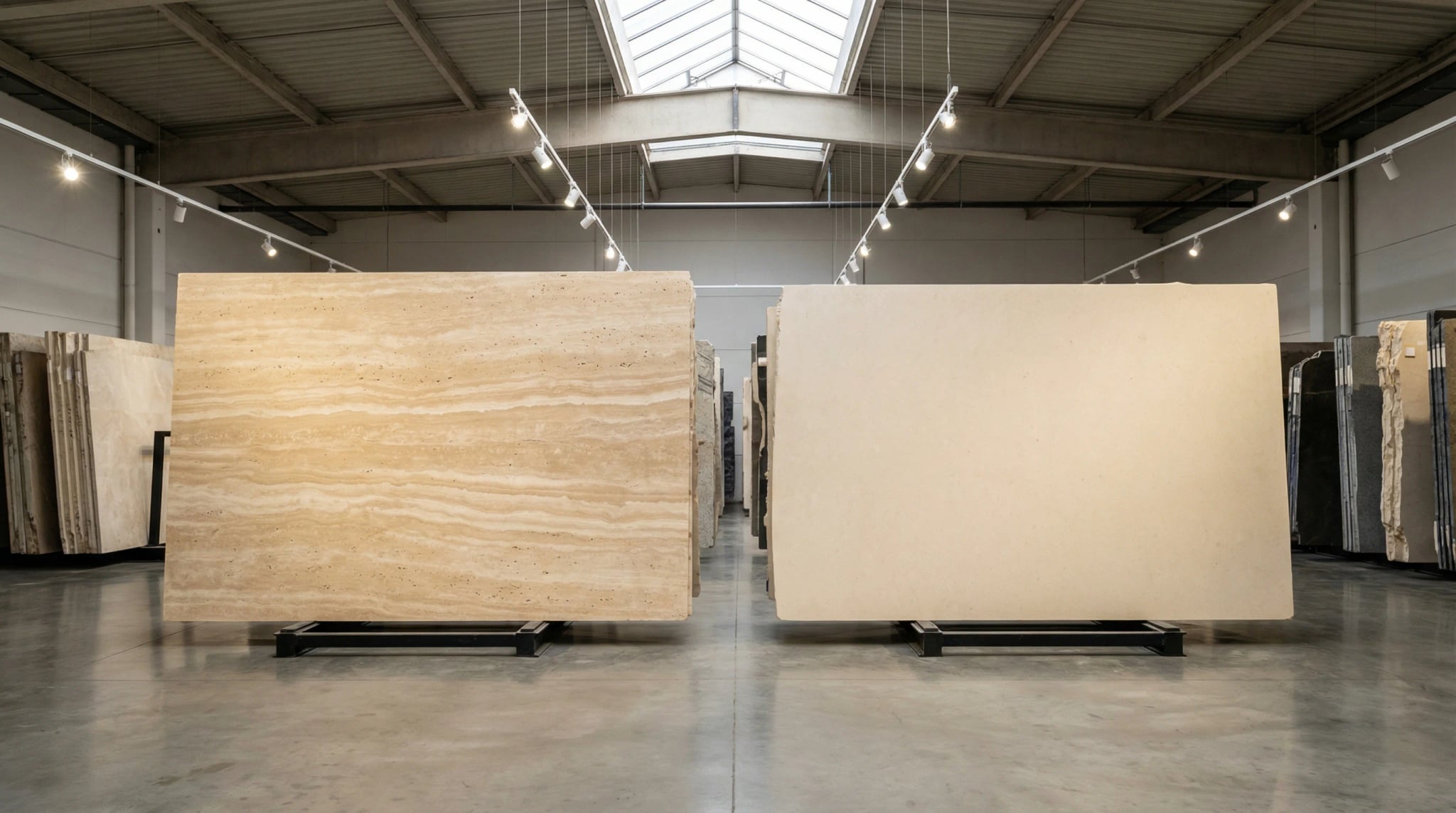
Both are sedimentary calcium carbonate rocks quarried in Turkey, yet travertine forms in hot springs while limestone forms in shallow seas. This guide compares them honestly so you choose the right stone for your project.
20+
Years Experience
40+
Countries Served
500K+
m2 Delivered
100%
Direct from Turkey
Last reviewed: - Reviewed by Sezai Suda
Quick Answer
Travertine and limestone are both sedimentary calcium carbonate (CaCO3) stones from the same geological family. Travertine forms in hot mineral springs and is characterised by natural pores and warm earth tones, while commercial limestone often forms in shallow seas from compressed marine organisms and typically shows a denser, more uniform texture. Application fit is a visual + specification decision: travertine is frequently specified for decorative interiors and pool surrounds when finish and certificates suit the climate; limestone is frequently specified for large-format cladding and landscaping when density, absorption, and strength certificates meet the brief. Exterior performance depends on selection density/porosity, finish, freeze–thaw exposure, and detailing—not stone name alone. Price is quote-driven by variety, finish, thickness, volume, and Incoterms—request current landed quotations. We supply Turkish-origin selections for project teams.
Geology & Formation
Understanding how each stone forms explains why porosity, texture, and thermal behaviour often diverge—but project performance still follows the selected lot’s certificates, finish, and installation system.
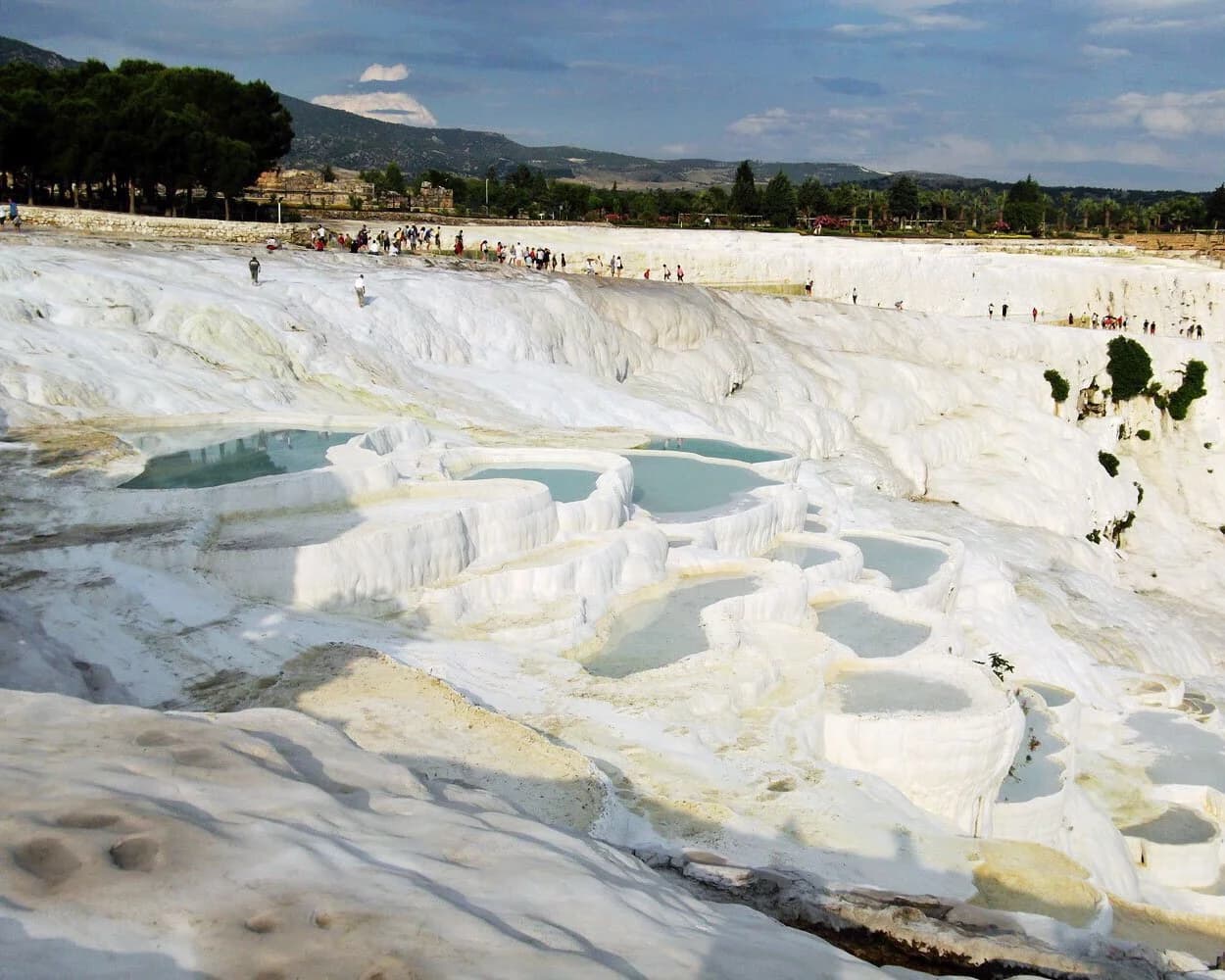
Travertine is a terrestrial sedimentary limestone deposited by geothermal springs. As mineral-rich hot water rises to the surface and cools, dissolved calcium carbonate (CaCO3) precipitates and builds up in layers around the spring outlet. Gas bubbles (mainly CO2) escaping during crystallisation create the characteristic pores and voids that define travertine's texture. These are not defects but natural features that shape the organic aesthetic. Thermal comfort and wet-grip performance depend on density, finish (tumbled/brushed/honed), sealing, and site conditions—confirm with lot data and, where required, project slip criteria. Turkey’s Denizli basin is a major geothermal travertine source; density and colour consistency vary by bed—specify the selection and request current lab reports.
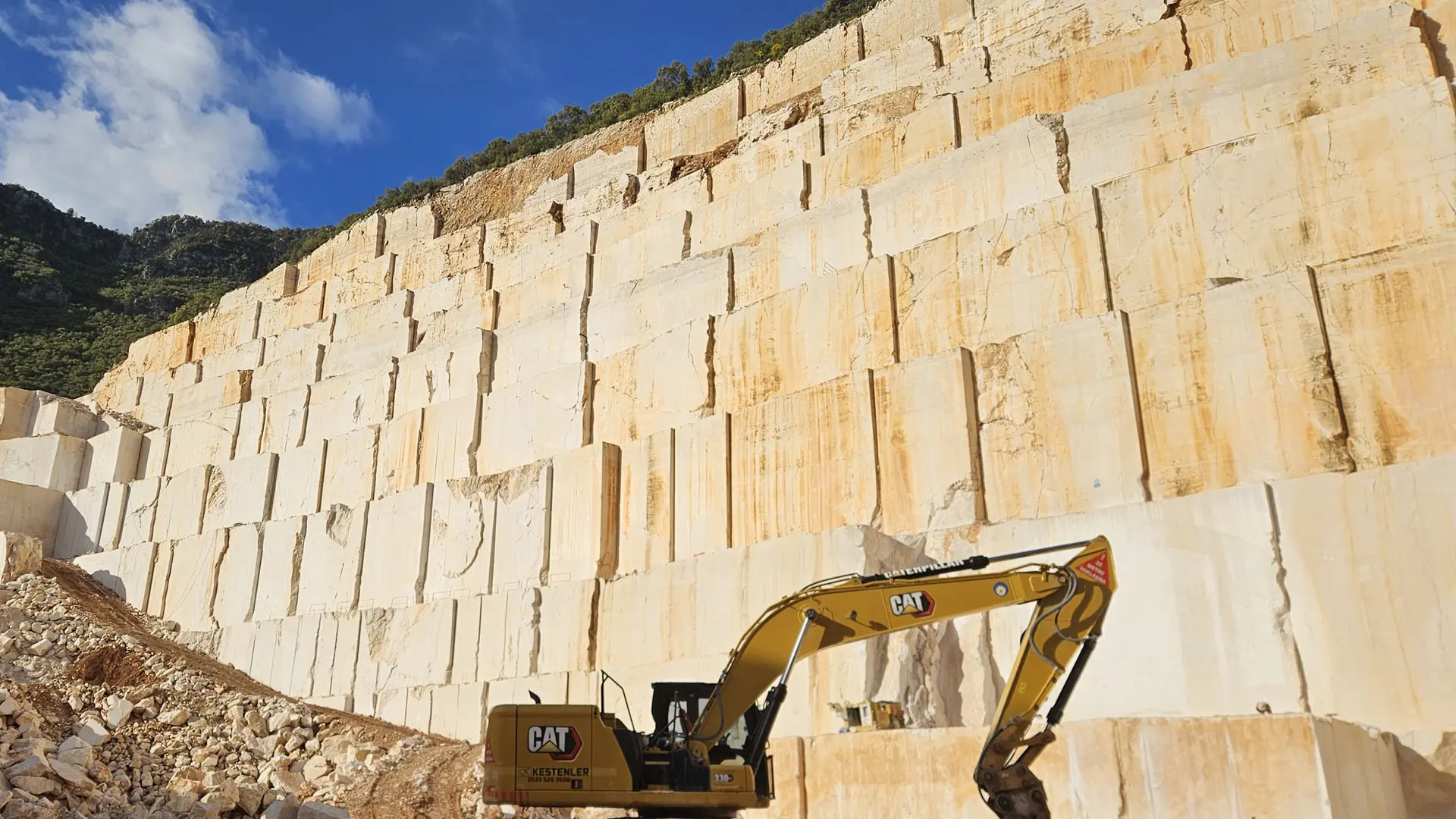
Limestone is a marine sedimentary rock formed over millions of years on the floors of shallow seas. It consists primarily of accumulated shells, coral fragments, and skeletal remains of marine organisms, all cemented together by dissolved calcium carbonate. Unlike travertine's rapid terrestrial deposition, limestone forms slowly under water pressure, resulting in a denser, more uniform structure with minimal visible porosity. Turkey's Antalya, Burdur, and Bilecik regions produce high-quality limestones ranging from creamy whites to warm beiges, with excellent consistency for large-format architectural cladding.
Key Geological Fact
Travertine is technically a type of limestone (both are CaCO3 sedimentary rocks). Formation environments differ: travertine forms in freshwater hot springs at the Earth's surface, while most commercial limestones form in marine environments under water pressure. Commercial lots often show different porosity, density, and strength profiles—but bands overlap. Treat open porosity (EN 1936), water absorption (EN 13755 / ASTM C97), compressive strength (ASTM C170 / EN 1926), and flexural strength (ASTM C880 / EN 12372) as selection-level certificate values, not stone-name guarantees. Thermal behaviour and structural suitability depend on the lot, thickness, finish, and the project engineer’s system design.
Technical Specifications
The table below lists indicative commercial bands and test-method paths for travertine and limestone. These are not product declarations. Specify by lot certificates for the exact selection.
| Property | Travertine | Limestone | Winner | Standard |
|---|---|---|---|---|
| Density (kg/m3) | 2,300-2,500 | 2,300-2,700 | Often limestone on denser marine selections—verify selection density certificate. | EN 1936 / ASTM C97 |
| Compressive Strength (MPa) | Indicative range only—lot ASTM C170 / EN 1926 required. | Indicative range only—lot ASTM C170 / EN 1926 required. | Often limestone on dense selections—confirm certificates. | EN 1926 / ASTM C170 |
| Flexural Strength (MPa) | Indicative only—lot ASTM C880 / EN 12372. | Indicative only—lot ASTM C880 / EN 12372. | Exterior panel sizing and anchors are engineer-led. | EN 12372 / ASTM C880 |
| Water Absorption (%) | Indicative bands—lot EN 13755 / ASTM C97. | Indicative bands—lot EN 13755 / ASTM C97. | Exterior / freeze–thaw needs absorption + frost testing (EN 12371), not averages. | EN 13755 |
| Open Porosity (%) | Lot EN 1936 open porosity—filled/unfilled changes behaviour. | Lot EN 1936 open porosity—confirm selection. | Not fixed by stone name—confirm lot EN 1936. | EN 1936 |
| Mohs Hardness | Rough mineral scale only—not a code acceptance test. | Rough mineral scale only—prefer abrasion (ASTM C1353). | Often similar carbonate hardness band—confirm selection mineralogy and finish wear. | - |
| Thermal Conductivity (W/mK) | Varies by density and moisture—use lot lab values. | Varies by density and moisture—use lot lab values. | Not a stone-only winner—use lot lab values and full build-up. | Project energy model inputs—not catalogue W/mK as design fact. |
| Surface Temp in Sun | Depends on colour, finish, solar load, wind, substrate. | Depends on colour, finish, solar load, wind, substrate. | Lighter, more porous finishes often feel cooler underfoot; verify on site with samples. | Field / site sample check |
| Fire Classification | Commonly non-combustible mineral—confirm system class. | Commonly non-combustible mineral—confirm system class. | Confirm with project fire engineer / local code—not mineral name alone. | EN 13501-1 |
All table values are non-binding indicative bands. They are not product declarations. Specify by lot certificates (density, absorption, compressive, flexural, abrasion, frost where relevant—ASTM C170 / C880 / C1353; EN 1926 / 12372 / 1936 / 13755 / 12371).
Visual Characteristics
Despite sharing a chemical family, travertine and limestone deliver very different visual effects. The choice often comes down to whether you want organic character or clean uniformity.
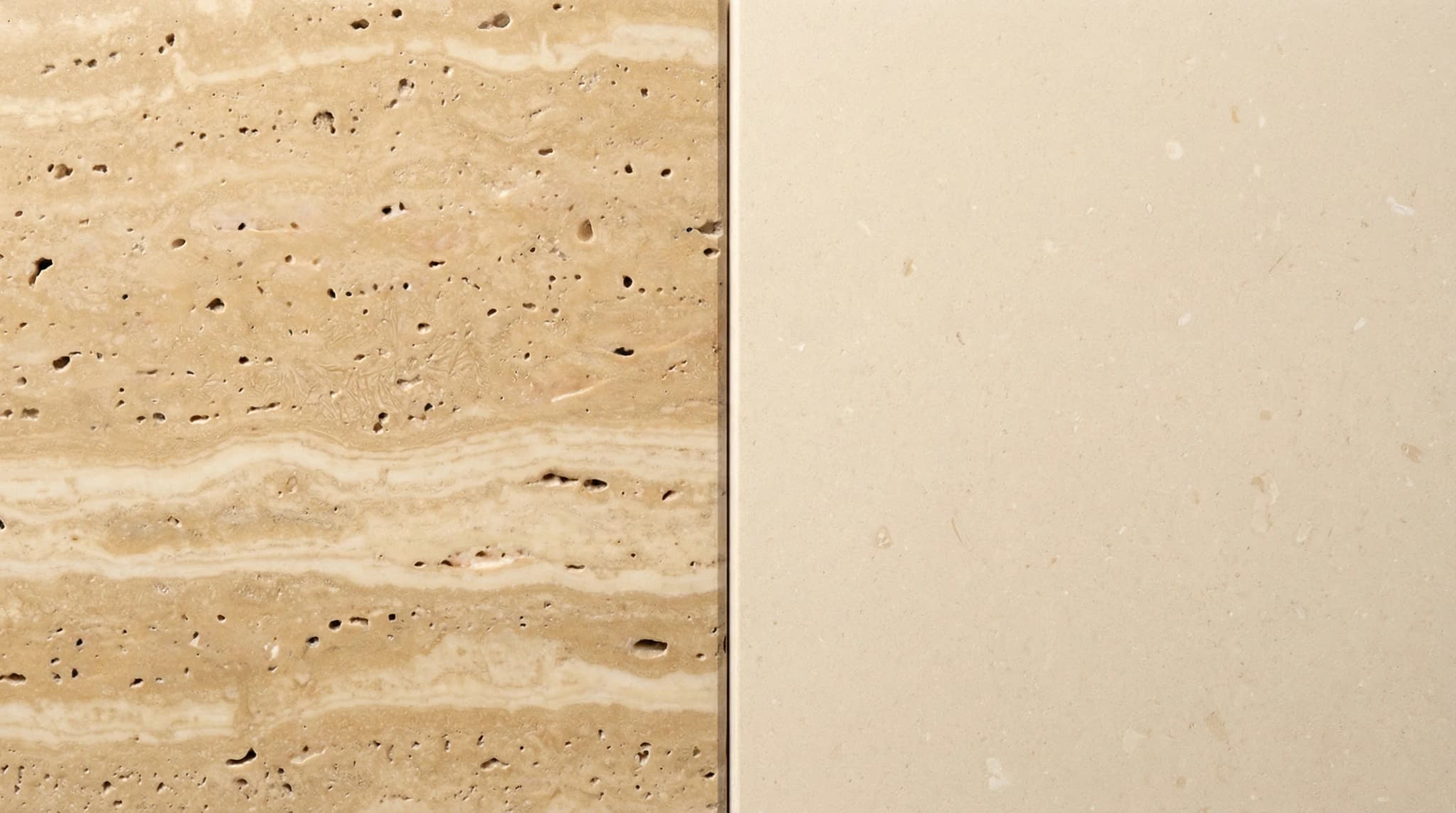
Travertine's colour palette ranges from ivory and cream through gold, walnut, and silver. Its defining visual feature is the natural pore structure, which creates an organic, flowing texture that no manufactured material can replicate. These tones integrate naturally with biophilic and Mediterranean design trends, lending warmth and tactile interest to floors, walls, and outdoor surfaces. Varieties like Classic Travertine and Light Travertine showcase this warm palette beautifully.
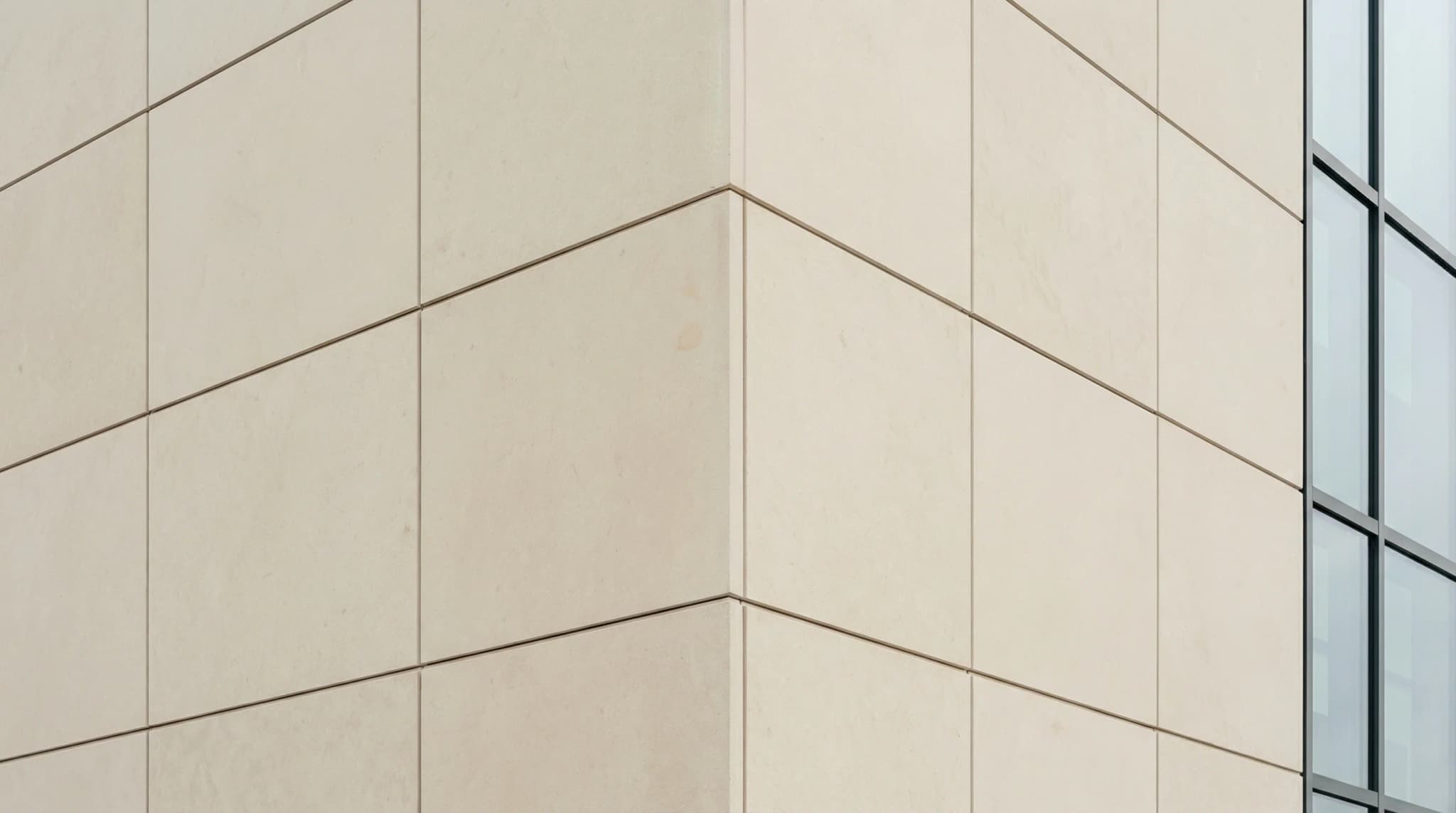
Limestone offers a restrained, uniform aesthetic that architects favour for contemporary minimalist designs. Its colour palette tends toward cool whites, creams, greys, and soft beiges with subtle fossil imprints rather than dramatic patterning. The absence of visible pores gives limestone a smoother, more refined surface that works well in large-format cladding where visual consistency across panels is essential. Limestone's understated elegance makes it the preferred choice for institutional, civic, and high-end commercial architecture.
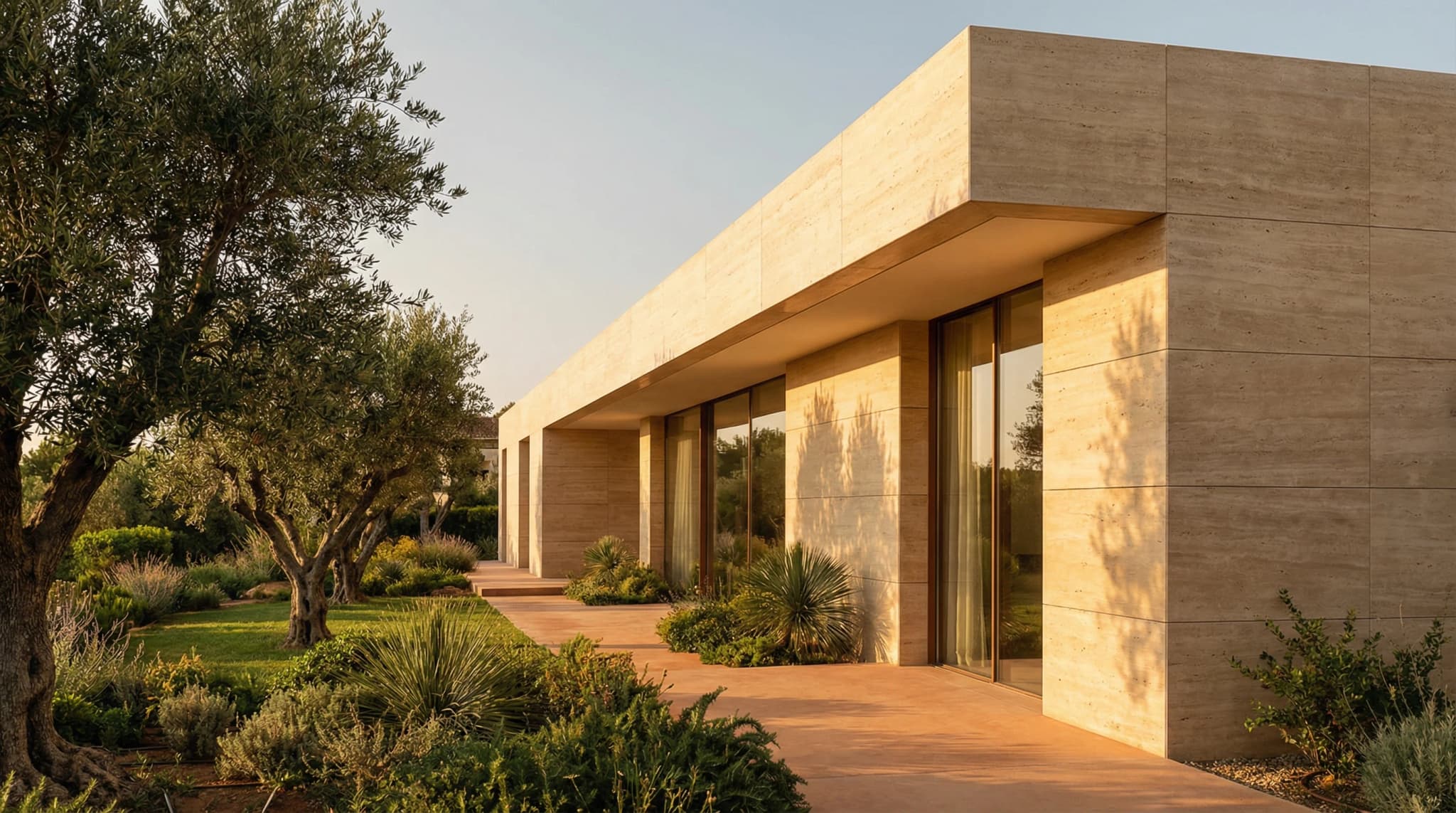
Travertine Facade
Limestone Facade
Biophilic, warm, and textured schemes often favour travertine. Minimalist, institutional, and contemporary cladding briefs often favour limestone’s cleaner panel look. Choice follows project mood and specification—not a universal ranking. Many projects combine both for visual contrast when certificates and detailing align.
Application Comparison
The right stone depends on where and how you use it. Below we compare travertine and limestone across six common applications, with a typical specification lean for each use—always re-check certificates and codes.
For residential and hospitality flooring, travertine is often preferred for warm underfoot feel and organic character in honed or brushed finishes. Wet slip depends on finish and maintenance, not stone name—require project slip criteria where mandated. Limestone suits contemporary schemes that want uniform, clean floors; polished faces can be slippery when wet unless the finish is specified for grip. For high-traffic commercial floors, compare abrasion (ASTM C1353) and compressive certificates on the exact lots—do not assume a category winner. Cost and lead time are quote-driven.
Travertine is widely specified for pool decks and outdoor wet areas when finish (tumbled/brushed) and sealing suit the project. Surface heat depends on colour, solar load, and substrate—not a fixed °C advantage. Wet slip is finish- and maintenance-dependent; meet project slip criteria where codes require them—do not quote SCOF bands without a named test method and lab report for the selection. Natural open texture can aid drainage when detailed correctly. Limestone can work around pools with grip finishes (e.g. bush-hammered) when absorption, frost (EN 12371 where relevant), and algae/maintenance plans are addressed. Frost climates: check EN 12371 and absorption on the lot.
For exterior facades and large-scale architectural cladding, dense, uniform limestone selections are frequently preferred for panel consistency. Suitability still follows certified compressive/flexural strength (ASTM C170 / C880 or EN 1926 / EN 12372), absorption/frost (EN 12371 where relevant), and the full wall system. Anchors, cavity, insulation, and wind loads are set by the project structural engineer—not a stone-name winner. Travertine is widely used on residential and low-rise commercial facades when texture is desired and the selection/system is engineered for exposure.
Limestone is frequently specified for garden walls, paving, steps, and retaining elements when certified density/strength and frost resistance meet the brief. Load-bearing landscape elements need structural design and lot strength data—not stone-name assumptions. Limestone often weathers to a even patina that suits formal and contemporary gardens. Travertine suits decorative paths and patio areas when climate, finish, and certificates allow. Cost-effectiveness is quote- and labour-dependent.
For interior feature walls, fireplace surrounds, and decorative applications, travertine's organic texture and warm tones create focal points that limestone's uniformity cannot match. The interplay of light and shadow across travertine's natural pores adds visual depth and tactile interest that works beautifully in residential, hospitality, and retail interiors. Limestone feature walls suit minimalist and contemporary spaces where the brief calls for subtle, understated elegance rather than textural drama.
Neither travertine nor limestone is ideal for kitchen countertops. Both are calcium carbonate stones vulnerable to acid etching from citrus, vinegar, and wine. Travertine's pores can harbour bacteria if not properly filled and sealed. Limestone's smoother surface is easier to clean but shows acid etching marks more visibly. For vanity tops in bathrooms (less acid exposure), both can work well with diligent sealing. Honest recommendation: for kitchen countertops, consider granite or quartz instead.
Request free samples of both travertine and limestone to compare side by side. We supply both from Turkish quarries.
Pricing & Lifecycle
Travertine and limestone occupy a similar price bracket, making the choice more about application suitability than budget. The table below breaks down costs across the full lifecycle. Turkish sourcing advantage: both materials originate from the same country, enabling combined logistics and lower shipping costs through Go2Stone.
| Cost Factor | Travertine | Limestone | Difference |
|---|---|---|---|
| Material - Tiles (per m2) | Quote-based (variety, finish, thickness, volume, Incoterms) | Quote-based (variety, finish, thickness, volume, Incoterms) | Often overlapping bands—confirm current landed quote. |
| Material - Slabs (per m2) | Quote-based only | Quote-based only | Often overlapping bands—confirm current landed quote. |
| Installation (per m2) | Local contractor quote | Local contractor quote | Installation is regional labour + substrate + format—not a global fixed band. |
| Annual Maintenance (per m2) | Plan sealer cycles from product data—do not budget fixed $/m2 as fact. | Plan sealer cycles from product data—do not budget fixed $/m2 as fact. | Maintenance cost is program-specific (sealer, labour, traffic). |
| Sealing (per application, per m2) | Sealer cost follows product TDS, labour rates, and surface area—quote locally. | Sealer cost follows product TDS, labour rates, and surface area—quote locally. | Quote locally. |
| 30-Year Lifecycle (per m2) | Illustrative only—not a TCO model. | Illustrative only—not a TCO model. | Real TCO needs quotes, maintenance plan, and replacement risk. |
Key insight: Application, aesthetic, and certificates drive the choice between travertine and limestone more than assumed price gaps. Logistics savings are case-by-case when both ship from Turkey in one order—confirm Incoterms and packing list. When sourced through Go2Stone, plan consolidations with your project quote.
All figures are non-binding order-of-magnitude only, not offers. Commercial terms only from a written quotation.
Longevity & Care
Both materials have long architectural service histories when selection, detailing, and maintenance match exposure. Service life is application-dependent—not a product warranty. Compare lot certificates to climate and use.
Both carbonate stones can weather and patina outdoors. Behaviour depends on density, finish, pollution, and detailing. Sealing and cleaning programs manage soiling in open-pore faces. Acid rain and urban pollution can etch CaCO₃ surfaces—mitigate with detailing and maintenance, not stone-name assumptions. Confirm outdoor selections with absorption and frost data where climate demands them.
Stain risk tracks open porosity and finish—confirm lot absorption (EN 13755 / ASTM C97). Both stones typically need sealing for commercial interiors. Sealer type and recoat interval follow product TDS and site exposure, not a fixed 12–36 month law. Filled travertine behaves differently from unfilled.
Both stones are equally vulnerable to acid etching because both are primarily calcium carbonate (CaCO3). Lemon juice, vinegar, wine, and acidic cleaning products will dull the surface of either material. The effect is more visible on polished limestone (shiny-to-matte transition) than on honed or tumbled travertine. Mitigation is identical for both: avoid acids, use pH-neutral cleaners, and accept that some patina will develop over time.
Freeze–thaw performance is selection- and detailing-dependent, not a stone-name rule. Require EN 12371 (and absorption EN 13755 / related methods) on the exact lot for outdoor use in freezing climates. Open porosity can help or hurt depending on saturation and strength—do not assume travertine always wins frost. Dense low-absorption limestones often perform well when certified; soft high-absorption lots of either stone can fail. Drainage, thickness, finish, and anchors matter as much as mineral name.
Porous travertine often needs a more active sealer program than denser limestones, but intervals follow sealer TDS, traffic, climate, and finish—not fixed month bands. Outdoor installations typically need a planned maintenance cycle. Prefer impregnating (penetrating) sealers where the specification calls for them; confirm compatibility with fill and adhesives.
Service life is application- and maintenance-dependent. Historical examples (e.g. Roman travertine monuments; long-service limestone cathedrals) illustrate potential durability of some stones in some climates—not a warranty for every commercial selection. Exposed exterior cladding needs certificates, engineer-designed systems, and maintenance—not a default limestone win. Professional re-honing can restore appearance when the installation allows.
Decision Guide
Use the table below to match your project priorities with the right stone. This framework is designed to be genuinely helpful, not biased toward either material.
| Your Priority | Choose Travertine | Choose Limestone |
|---|---|---|
| Budget-driven decision | Similar pricing | Similar pricing |
| Pool deck / wet areas | Warm look; finish-led barefoot comfort—verify slip/frost for climate. | |
| Decorative interior walls | Textural warmth | |
| Structural facade cladding | Often denser/more uniform panels—confirm lot strength (ASTM C170 / EN 1926; flexural ASTM C880 / EN 12372) and engineer anchors. | |
| Low maintenance | Often lower sealing demand on denser lots—still follow care guidance and TDS. | |
| Warm / organic aesthetic | Natural warmth & character | |
| Clean / uniform aesthetic | Consistent panels | |
| Landscaping & garden walls | Often specified for load-bearing landscape units—engineer + lot strength certificates. | |
| Mediterranean / biophilic design | Strong aesthetic fit for Mediterranean/biophilic schemes. | |
| High-traffic commercial | Often higher abrasion resistance on denser lots—confirm ASTM C1353 / project wear method. |
Our stone specialists can recommend the best material for your specific application, climate, and design vision.
Our Collection
Each stone is sourced directly from Denizli quarries. Click to explore finishes, specs, and pricing.
Common Questions
Practical answers for project teams—always verify with lot certificates and local codes.
Go2Stone supplies both from Turkish quarries. Request free samples of each to compare side by side, or get a project quote with options for both materials through our stone collection.
Samples and quotations on request—typical response within one business day.
Project enquiry
Share the material, format, quantity, destination, and timing.
What helps us answer accurately
Stone · Format and finish · Quantity · Destination city or port
You can expect a reply within
One business day
Need a quick answer? Ask Selim in the chat.

