
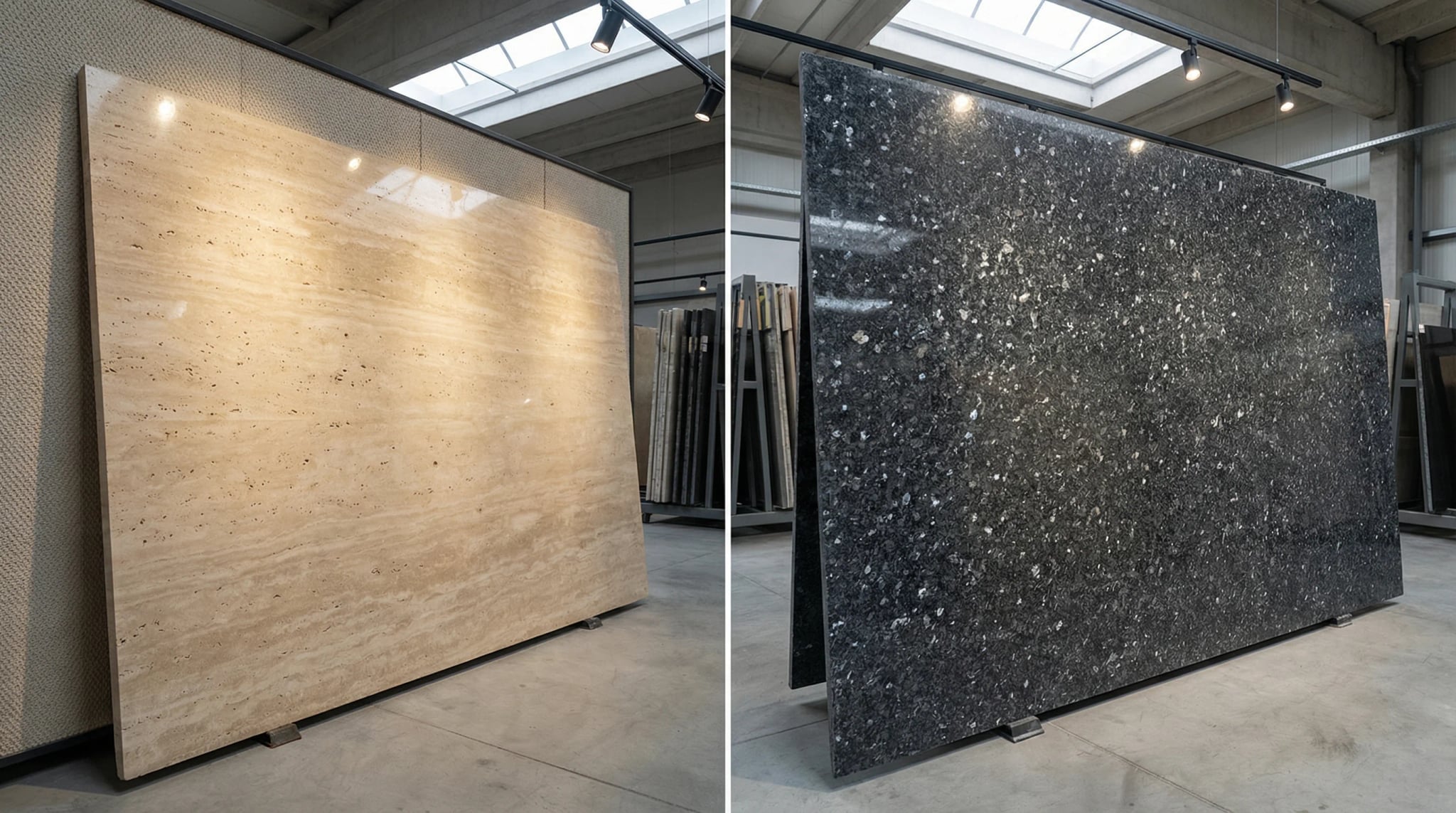
These two stones could not be more different geologically. Travertine forms from hot springs; granite crystallises from volcanic magma. This guide compares them honestly across weight, hardness, cost, and every major application.
20+
Years Experience
40+
Countries Served
500K+
m2 Delivered
100%
Direct from Turkey
Last reviewed: - Reviewed by Sezai Suda
Quick Answer
Travertine and granite are different geological families: travertine is a sedimentary carbonate (CaCO₃); granite is an igneous silicate (quartz/feldspar/mica). Commercial lots often show higher Mohs hardness and density for granite, but numbers are selection-specific—use lab reports (e.g. density EN 1936 / ASTM C97; compressive ASTM C170 / EN 1926; flexural ASTM C880 / EN 12372; abrasion ASTM C1353). Application fit is a visual + specification decision: granite is frequently specified for hard-wear food-prep surfaces; travertine is frequently specified for warm interiors, pool surrounds, and facades when finish, porosity, and freeze–thaw certificates suit the climate. We supply Turkish travertine from Denizli-region production—request certificates and samples for the exact selection.
Geology & Formation
Understanding formation explains why hardness, density, porosity, and thermal behaviour often diverge—but project performance still follows the selected lot’s certificates, finish, and installation system.
Travertine is a sedimentary limestone deposited by geothermal springs. As mineral-rich water rises to the Earth's surface, dissolved calcium carbonate (CaCO3) precipitates and accumulates in layers. Gas bubbles escaping during this process create the characteristic pores and voids that define travertine's organic texture. Pores define travertine’s organic texture. Thermal and wet-grip performance depend on density, finish (tumbled/brushed/honed), and sealing—confirm with lot data and, where required, site slip testing. Turkey’s Denizli basin is a major geothermal travertine source; density and colour consistency vary by bed—specify the selection and request current lab reports.
Granite is an intrusive igneous rock formed when molten magma cools slowly deep within the Earth's crust. This slow cooling allows large crystals of quartz, feldspar, and mica to form, creating granite's distinctive speckled appearance. Interlocking crystals often yield high hardness and low absorption versus many carbonates, but commercial “granite” lots vary. Use water absorption (EN 13755 / ASTM C97) and abrasion (ASTM C1353) for the specified variety—do not assume zero porosity or universal stain immunity without sealing guidance. Major quarries are found in Brazil, India, China, and Scandinavia.
Key Distinction
Travertine (CaCO₃) is acid-sensitive; silicate granites are generally far more resistant to household acids—verify the actual petrography of the commercial variety. Kitchen countertops commonly prefer granite for acid/scratch behaviour; pool decks and warm interiors often prefer travertine for aesthetic and barefoot comfort—surface temperature and slip depend on colour, finish, and climate, not stone name alone. Cost is quote-driven.
Technical Specifications
Hardness and density gaps are often large between dense granites and porous travertines—but extremes vary by selection. Treat the table as indicative commercial bands, not specification values.
| Property | Travertine | Granite | Winner | Standard |
|---|---|---|---|---|
| Density (g/cm3) | 2.3-2.5 (indicative) | 2.6-2.8 (indicative) | Often granite (higher density)—verify selection. | EN 1936 |
| Compressive Strength (MPa) | See lot certificate (ASTM C170 / EN 1926) | See lot certificate (ASTM C170 / EN 1926) | Often granite—confirm certificates. | EN 1926 |
| Flexural Strength (MPa) | Indicative only—lot ASTM C880 / EN 12372 | Indicative only—lot ASTM C880 / EN 12372 | Granite | EN 12372 |
| Water Absorption (%) | Indicative bands—lot EN 13755 / ASTM C97 | Indicative bands—lot EN 13755 / ASTM C97 | Granite (lower) | EN 13755 |
| Open Porosity (%) | Indicative bands—lot EN 1936 open porosity | Indicative bands—lot EN 1936 open porosity | Granite (denser) | EN 1936 |
| Mohs Hardness | Mohs rough scale only—prefer ASTM C1353 | Often higher—confirm selection mineralogy | Often higher for granite—confirm selection mineralogy. | - |
| Thermal Conductivity (W/mK) | Lab values for selected lot | Lab values for selected lot | Use lab values + full build-up—not stone-only | EN 12524 |
| Surface Temp in Sun | Colour/finish/climate-dependent | Colour/finish/climate-dependent | Lighter, more porous finishes often feel cooler underfoot; verify on site with samples. | Site sample check |
| Fire Classification | Often non-combustible as stone—system governs | Often non-combustible as stone—system governs | Confirm with project fire engineer / local code | EN 13501-1 |
All table values are non-binding indicative bands. They are not product declarations. Specify by lot certificates (density, absorption, compressive, flexural, abrasion, frost where relevant). Confirm density EN 1936 / ASTM C97 on the lot. Exterior panel sizing and anchors are engineer-led. Exterior / freeze–thaw decisions need absorption + frost testing (EN 12371). Filled/unfilled travertine changes behaviour. Mohs is a rough mineral scale, not a building-code acceptance test. Published thermal values vary by density and moisture—use lab values for the selected lot and the full wall/floor build-up. Natural stone is commonly treated as non-combustible in classification systems, but system classification (fixings, insulation, cavities) governs facades.
Weight Impact
Panel mass = certified bulk density × thickness (plus moisture/fill if relevant). Many granites are denser than many travertines, so freight and structural load often rise—calculate from certificates, not a fixed 30–40% rule. Weight affects shipping, structure, and install planning.
| Format & Thickness | Travertine (kg/m2) | Granite (kg/m2) | Granite Heavier By |
|---|---|---|---|
| Tiles - 2 cm thick | Indicative example only (assumed densities) | Indicative example only (assumed densities) | Project-calculated % from certified densities. |
| Tiles - 3 cm thick | Indicative example only (assumed densities) | Indicative example only (assumed densities) | Project-calculated % from certified densities. |
| Slabs - 2 cm thick | Indicative example only (assumed densities) | Indicative example only (assumed densities) | Project-calculated % from certified densities. |
| Slabs - 3 cm thick | Indicative example only (assumed densities) | Indicative example only (assumed densities) | Project-calculated % from certified densities. |
For a 100 m² area, mass difference = area × thickness × density difference. Example arithmetic is illustrative only. Freight, structure, and labour outcomes need lot density, packing, Incoterms, and structural review—not assumed savings.
Visual Characteristics
Choosing between travertine and granite is often an aesthetic decision. Each stone brings a fundamentally different visual language to your space.
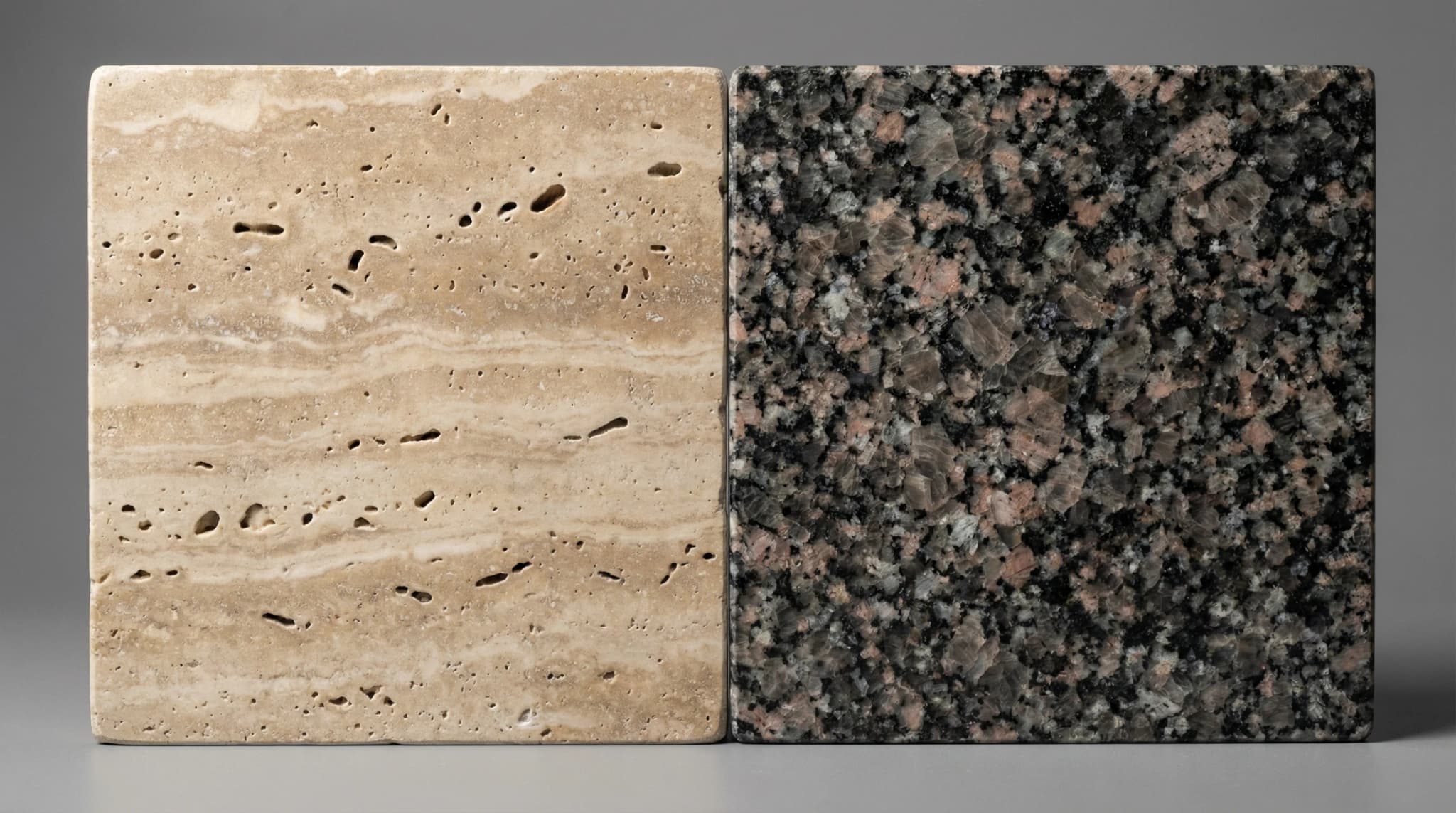
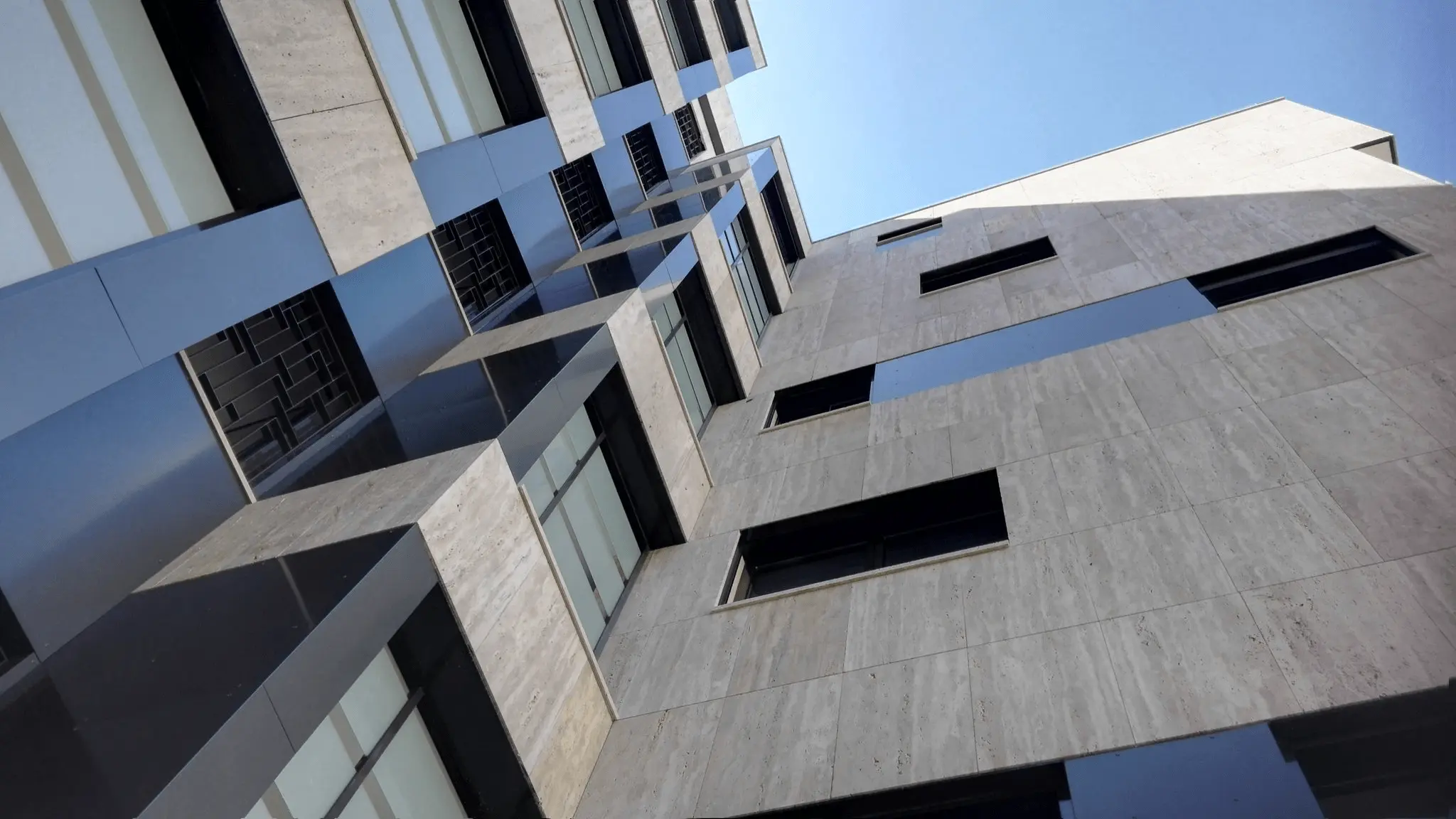
Travertine's colour palette ranges from ivory and cream through gold, walnut, silver, and occasional reds. Its defining feature is the natural pore structure creating an organic, flowing texture that feels alive and warm. These earth tones work naturally with Mediterranean, biophilic, and warm contemporary design. Varieties like Classic Travertine and Light Travertine showcase this palette beautifully. Travertine feels warm underfoot, a tactile quality granite cannot replicate.
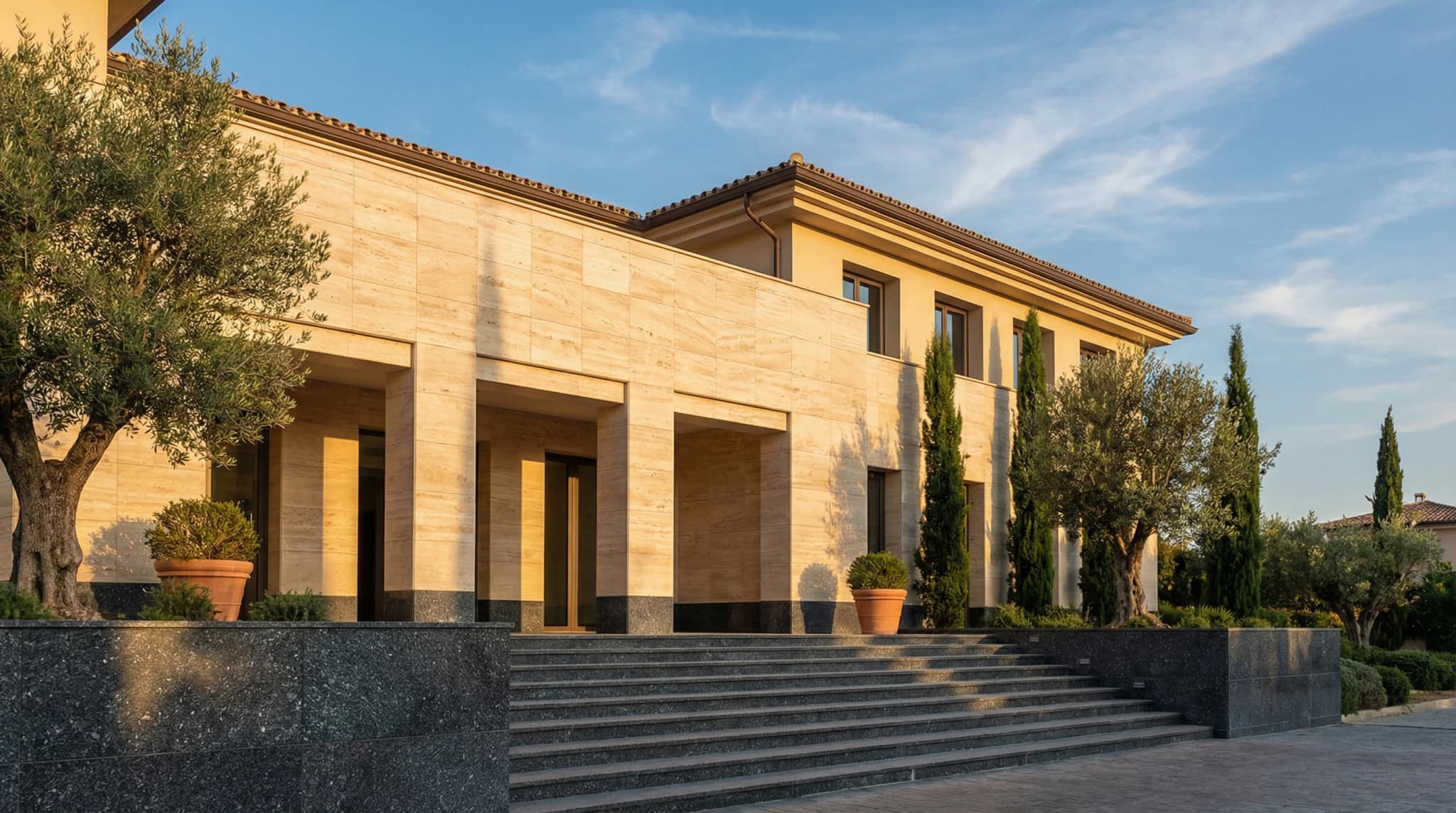
Granite's appearance is defined by its visible crystal structure: specks and swirls of quartz, feldspar, and mica in combinations of black, white, grey, pink, and blue. The effect is bold, confident, and visually strong. Polished granite has a deep, mirror-like sheen that exudes permanence. It reads as modern, industrial, or luxurious depending on the variety chosen. Granite's colour range is broader than travertine's, with options from jet black to vibrant blue, but it always has a cooler, more mineral-forward aesthetic.
Travertine is frequently specified for warm, organic, Mediterranean, and wellness-led interiors; granite for commercial kitchens and hard-wear mineral looks. Choice follows project mood and specification—not a universal ranking. Natural stone remains a preferred alternative to many engineered surfaces when certificates and budget align.
Application Comparison
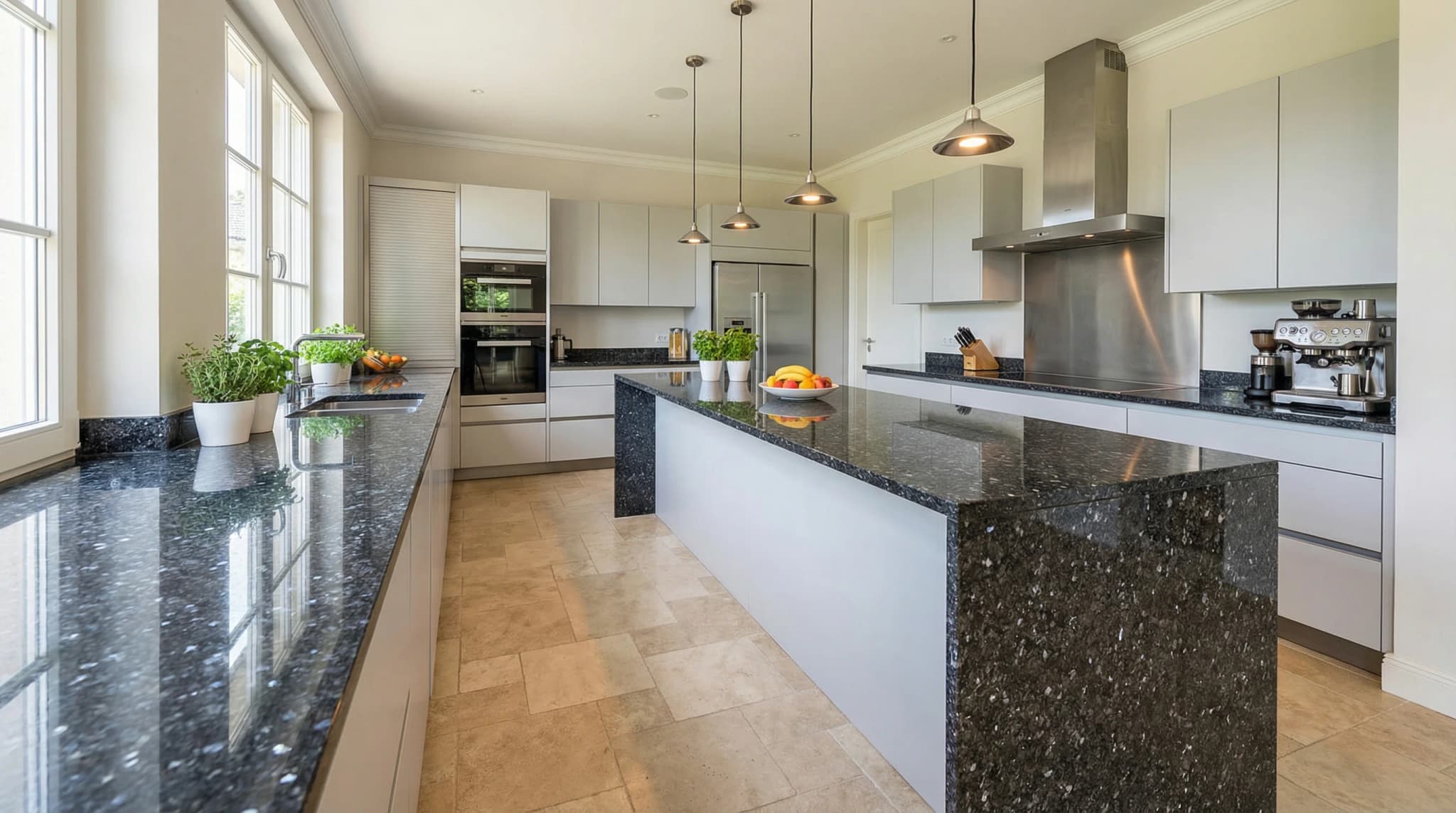
Typical specification lean for each use—always re-check certificates and codes.
For warm residential/hospitality interiors, travertine is often preferred for look and underfoot comfort; cost is quote-dependent. Wet slip depends on finish and maintenance, not stone name—require project slip criteria where mandated. For high-traffic commercial floors, denser granites often show higher abrasion resistance—confirm ASTM C1353 (or project wear method) on the lot.
For kitchen worktops, granite (or other acid-resistant silicates) is the usual specification because CaCO₃ travertine etches with household acids. Confirm absorption/sealer guidance on the granite lot; do not claim zero stain risk. Travertine is generally poor for food-prep tops; if used at all, treat as high-risk aesthetic choice with maintenance plan—not a default ban slogan alone.
Travertine is widely specified for pool decks and barefoot wet areas when finish (tumbled/brushed) and sealing suit the project. Surface heat depends on colour/solar load; granite can be hot and polished granite can be slippery when wet—evaluate finishes and site conditions. Require slip criteria for wet areas where codes demand them. Frost climates: check EN 12371 (and absorption) on the selection.
For cladding, compare certified density × thickness (dead load), strength (ASTM C170 / C880 or EN equivalents), absorption/frost (EN 12371 where relevant), and the full wall system. Anchors, cavity, insulation, and wind loads are set by the project structural engineer—not a stone-name winner. Travertine is frequently used on residential and mid-rise facades when the selection and system are engineered; high exposure may demand higher-strength selections or different systems.
For vehicular paving and harsh winters, dense low-absorption granites are often specified. Performance still follows lot frost/absorption/abrasion data and detailing (drainage, salt exposure). Travertine suits many pedestrian terraces and pool surrounds when climate and certificates allow.
Harder granites often retain nosing profiles longer under heavy traffic; travertine edges need careful detailing and finish. Outdoor wet stairs: prioritise finish + slip criteria + structure, not stone brand alone.
Request free travertine samples and expert guidance for your specific project requirements.
Pricing & Total Cost
Granite's raw material cost per m2 can be similar to travertine's, but the total project cost diverges significantly due to weight-related shipping and installation expenses. Go2Stone supplies premium Turkish travertine at factory-direct prices.
| Cost Factor | Travertine | Granite | Difference |
|---|---|---|---|
| Material - Tiles (per m2) | Quote-based (variety, finish, thickness, volume, Incoterms) | Quote-based (variety, finish, thickness, volume, Incoterms) | Often lower for commodity travertine tiles—confirm current landed quote. |
| Material - Slabs (per m2) | Quote-based only | Quote-based only | Quote-based only |
| Installation (per m2) | Local contractor quote | Local contractor quote | Regional labour + substrate + format |
| Shipping (weight-based) | Calculate from certified density × thickness × packing | Freight follows actual packed weight/volume and lane rates | Calculate from lot density × thickness × packing—not a fixed 30–40% |
| Annual Maintenance (per m2) | Plan sealer cycles from product data—do not budget fixed $/m² as fact | Program-specific (sealer, labour, traffic) | Program-specific—not fixed $/m² |
| 30-Year Lifecycle (per m2) | Illustrative only—not a TCO model | Illustrative only—not a TCO model | Real TCO needs quotes, maintenance plan, and replacement risk |
Material, freight, install, and maintenance trade off by project. Dense granite tops may win on kitchen durability; travertine may win on look and barefoot areas. Compare written landed quotes and certificates—no universal TCO winner.
All figures are non-binding order-of-magnitude only, not offers. Commercial terms only from a written quotation.
Longevity & Care
Many granites test harder/more abrasion-resistant; travertine has long architectural history when selected and detailed correctly.
Granite lots commonly show higher hardness/abrasion resistance than travertine. For floors and tops, specify ASTM C1353 (or project method) on the selection. Quartz grit can abrade softer carbonates—maintenance and entrance matting matter.
Absorption is lot-specific (EN 13755 / ASTM C97). Sealer type and recoat interval follow product TDS and site exposure, not a fixed 12–24 month law.
Silicate granites are generally highly resistant to common food acids versus CaCO₃ stones; some commercial stones sold as granite may include more sensitive minerals—confirm petrography and do a site etch test if critical.
Outdoor durability depends on absorption, frost testing (EN 12371), finish, drainage, and detailing. Historical monuments prove longevity of some stones in some climates—not a warranty for every commercial selection.
Both stones tolerate high service temperatures as minerals. Barefoot comfort is colour/finish/climate-dependent. Use samples under project sun exposure rather than fixed °C claims.
Service life is application- and maintenance-dependent. Historical examples (e.g. Roman travertine monuments; long-service granite paving) illustrate potential durability of well-chosen stone—not a product lifespan warranty. Align selection certificates with exposure.
Sustainability
Embodied carbon is EPD/LCA-specific (quarry, processing, transport, yield). Do not declare a category winner without cited EPDs for the compared products.
Processing energy and yield vary by quarry and plant. Request product-specific EPDs where available. Natural stone can compare favourably to some kiln-fired or resin-bound products—compare published EPDs, not stone-name averages.
Both generate silica-bearing dust risk depending on mineralogy—follow plant H&S and local regulations. Waste reuse as aggregate is common when managed. Avoid "less hazardous" without industrial hygiene data. Turkish travertine quarries in the Denizli region have adopted modern water recycling and waste management practices.
Transport impact follows actual mass/volume, packing efficiency, and shipping mode. Use certified density and logistics plan; Turkey’s Mediterranean routes can be advantageous for EU/MENA lanes when routing is efficient—case by case. When sourced through Go2Stone, Turkish travertine benefits from strategic Mediterranean shipping position when routing is efficient.
Stone is mineral and often reusable/recyclable as aggregate or reclaimed units. Sealers/adhesives/fixings affect end-of-life handling. Mineral content supports reuse/recycling pathways; compare system EPDs and local waste rules.
Decision Guide
Use the table below to match your project priorities with the right stone. This framework is designed to be genuinely helpful, not biased toward either material.
| Your Priority | Choose Travertine | Choose Granite |
|---|---|---|
| Budget matters | Often lower material cost on commodity tiles—get competing landed quotes. | |
| Pool deck / barefoot areas | Warm look; finish-led barefoot comfort—verify slip/frost for climate. | |
| Kitchen countertop | Typically acid- and scratch-resistant silicates—confirm lot data (not 'proof'). | |
| Low maintenance | Usually lower sealing demand than porous carbonates—still follow care guidance. | |
| Maximum hardness | Often higher hardness/abrasion—use ASTM C1353 / project wear method on lot. | |
| Warm / organic aesthetic | Natural warmth | |
| Modern / minimal / industrial | Bold crystalline look | |
| High-traffic commercial | Often higher abrasion resistance—confirm lot abrasion certificates. | |
| Mediterranean / biophilic design | Strong aesthetic fit for Mediterranean/biophilic schemes. | |
| Driveways / vehicular areas | High compressive selections often used for heavy paving—engineer + lot C170/EN 1926. |
Our stone specialists can recommend the best material for your specific application, budget, and climate.
Our Collection
Each stone is sourced directly from Denizli quarries. Click to explore finishes, specs, and pricing.
Common Questions
Practical answers for project teams—always verify with lot certificates and local codes.
Go2Stone supplies premium Turkish travertine direct from Denizli quarries. Request free samples to see and feel the quality, or get a detailed quotation for your project through our stone collection.
Samples and quotations on request—typical response within one business day.
Project enquiry
Share the material, format, quantity, destination, and timing.
What helps us answer accurately
Stone · Format and finish · Quantity · Destination city or port
You can expect a reply within
One business day
Need a quick answer? Ask Selim in the chat.

